Weston
Weston Pro-1100 Vacuum Sealer Reviews (2026)
By Theo Marchetti · Updated October 2026
Independent editorial review. We never accept payment for coverage, though we may earn a commission if you purchase through our links.

Verdict
Owner discussion of the Pro-1100 is thinner than for its bigger sibling, and it splits along a clean line. On performance, the people who own one agree: seals that hold under near-daily use, no leaks, and the speed and quiet that make buyers glad they left a household sealer behind. On support and spare parts, it gets ugly. Two owners on this line, years apart, broke one of the two spring latches that clamp the lid, and Weston told both of them it does not sell the part, offering eBay as the fix. Weston also confirmed to one of them that latches are not interchangeable between the older 65-0601-W and the current version, so much of the repair chatter online is about a machine that is not this one. Underneath all of it runs an argument about money: whether anyone outside bulk buyers, hunters, and home preservers needs this much sealer when a mainstream FoodSaver handles a normal week and can be replaced twice for less. On the evidence here, we think that question is fair.
Read full take ↓Similar vacuum sealers
The Weston Pro-1100 vacuum sealer sits in an awkward and interesting spot. It is a stainless, 460-watt external sealer with a 5mm seal bar wide enough for bags up to 11 inches, which puts it well above the plastic clamshell most people start with and a clear step below the commercial-weight Pro-2300 that gets all the attention in sealer threads. Weston sells it as the Pro 1100, model 65-0650-W, though the Amazon title truncates before the model name ever shows up.
That gap is the whole question. A hundred-dollar FoodSaver seals a week of groceries fine. A Pro-2300 will seal two elk in an afternoon. So who is the 1100 for, and is the middle of that range a smart place to spend? Owner reports on this exact machine are thinner than you would like, and the ones that exist split hard: seals that hold under near-daily use, and a pair of spring latches that Weston will not sell you as a spare part. Which generation each report belongs to turns out to matter enormously, so we flag it every time.
The short version
A capable sealer with one structural weak point, aimed at a narrower buyer than its price suggests.
What's good:
- A 5mm seal bar is roughly double the width of a household sealer, and wide seals are the ones that survive a freezer and a long water bath.
- The 11 inch bar takes standard 11 inch rolls, so you cut bags to length instead of buying pre-made sizes.
- Owners of this line report near-daily use with no leaks, which is the whole reason to leave a FoodSaver behind.
- An accessory port means jars, canisters, and zipper bags all come along for the ride.
- Stainless housing and a design that repair-minded owners describe as opening with a couple of screws.
What's not:
- Two owners of the 1100 line have had a spring latch break, and Weston told both of them it does not sell replacements.
- Weston has confirmed the latches are not interchangeable between the older 65-0601-W and this version, so parts advice you find online may not apply.
- It is heavy and tall, and it will live on a counter or come out of a cupboard with two hands.
- Stock is variable. At the time of writing the listing showed only a handful of units left with more on the way.
- It is an external sealer, so liquids are still your problem in a way a chamber machine solves outright.
Who it's for
The 1100 is a specific answer to a specific problem, and the people it disappoints are usually the ones who bought it for the wrong reason.
Buy it for:
- Sealing in sessions rather than one bag at a time: a share of beef, a garden glut, a weekend of butchering, a batch cook that fills a freezer shelf.
- Wide loads. An 11 inch bar swallows a rack of ribs or a big roast that an eight inch household sealer forces you to cut in half.
- Buying bags by the roll and cutting to size, which is where the money actually comes back over the years.
- Jar sealing and canister work alongside bags, thanks to the accessory port.
Skip it if:
- You seal a few bags a week. The mainstream FoodSaver does that job for a fraction of the outlay and stores in a cupboard.
- You want the longest runway and the most machine per dollar, and you have the counter for it. The Pro-2300 is the step up inside the same family.
- You mostly seal soups, marinades, and wet cures. No external sealer, this one included, handles standing liquid the way a chamber unit does.
- You want a machine you can buy spare parts for with confidence. The latch story below is the reason that sentence is in this list.
The specs that matter
The whole argument for this machine rests on four lines of the listing, and one of them is the model number.
An extra-wide 5mm seal bar: household sealers lay down a seal a couple of millimetres wide, which is enough for a bag of cheese and marginal for a bag that will spend six months in a freezer or eight hours in a bath. A 5mm weld is the single most useful thing on this spec sheet, because a failed seal costs you the food, not just the bag.
Bags up to 11 inches wide: that is the difference between sealing a whole rack of ribs and cutting it in two. It also means standard 11 inch rolls fit, and rolls are how vacuum sealing stops being expensive.
460 watts: wattage here is mostly about duty cycle. Cheap sealers do not fail because one seal is bad, they fail because the fifteenth seal in a row cooks the machine and it needs a rest. A bigger pump and a bigger element is what lets you work through a cooler of meat in one sitting.
Stainless housing, model 65-0650-W: worth writing down, because the Amazon title truncates before the model name appears and there is an older Pro 1100 (the 65-0601-W) still circulating in owner threads. Weston has stated the two versions do not share latch parts, so when you read repair advice online, check which one it is about.
How well it preserves
Sealing is the strongest part of the picture, and the specs and the owner reports agree for once. A food sealer has to pull enough air to stop freezer burn, then lay down a weld that survives freezing, thawing, and a long hot bath. The 1100 brings both things that job needs: a pump sized well past household duty, and a seal bar wide enough that the weld stops being the weak link.
The most useful owner report on this line comes from someone who cross-shopped it against the Pro-2300, chose the 1100 because it cost less, and then ran it hard. This is an owner of the earlier 65-0601-W generation, so read it as the same design lineage rather than a report on the current unit:
It has been outstanding with zero leaks and almost daily use.
Zero leaks under almost daily use is the bar an external sealer has to clear, and cheap ones miss it for a reason that has nothing to do with the vacuum. They overheat. An overheated sealer lays down a weld that looks fine on the counter and opens in the freezer. One owner describes the exact failure that pushes people up to a machine like this:
my food saver is almost 6 years old and I’m about to pull the plug. Thing overheats every 3 seals.
Where an external sealer still gives ground is liquid. The pump pulls air out of the whole bag, so juices travel toward the seal bar as the bag collapses, and a wet seal is a weak seal. The 1100 does not solve that; nothing without a chamber does. You solve it the way everyone else does, by freezing wet things flat first or hitting seal early by hand.
Bag quality also matters more than buyers expect, and this is general external-sealer behaviour rather than a knock on any one machine. Embossed channels are what let the pump reach the far end of the bag, and stiff or shallow-textured bags choke it. One owner in a Weston thread describes it plainly:
I have this one and it works pretty well. Some occasional issues with it not sucking enough, but I think that's from super stiff bags (Ziplock brand vacuum sealer bags are the bad ones).
That is worth knowing before you blame the machine. If a sealer that normally pulls hard suddenly does not, the roll you just opened is the first suspect.
Built to last
The body of the machine is not the problem, and durability is still the lowest score on this page. Weston's external sealers have a real reputation as serviceable appliances, and owners who have opened one up describe a layout built to be fixed rather than binned. That view comes from an owner in a Pro-2300 thread, so read it as a claim about how Weston builds this class of machine rather than a measurement of this exact model:
But the difference here is you can't easily access all of these seals, pumps & motors, so the device is essentially disposable. But with this vacuum sealer, everything is accessible with just a couple of screws. It's an appliance that will outlast you, as long as you take care of it.
The problem is two spring latches that clamp the lid shut. Smaller than a pump or an element, and far more annoying. Break one and the machine still runs, except now you hold the lid down by hand to get a good seal, which is a miserable way to work through a cooler of meat. Two separate owners of the 1100 line have hit exactly that, years apart, and both were told the part is not for sale. The first is the owner whose report also carries the model code, which is why we keep flagging generations here:
One of the two latches has broken, and unless you hold down the left side of the lid, you get poor seals. I contacted Weston, and was informed that since they replaced the version of the Pro 1100 I have (65-0601-W) with a new/improved version, they don't have the latches, and no, the new latch won't fit on the old model.
That is the most important sentence in this review. Weston replaced the 65-0601-W with the current version and told this owner the new latch does not fit the old machine. It cuts both ways. Older owners are stranded. And any repair advice, spare part, or durability verdict attached to a 65-0601-W is a report about the previous generation, not about the 65-0650-W on sale now.
The second report is more recent and the owner does not state which version they bought, so treat it as a Weston 1100 report of unknown generation. It lands in the same place:
I switched vacuum sealers from Food Saver to a Weston 1100 a couple of years ago when my old one died. Well over the holiday prep one of the spring latches broke and I reached out for a replacement since its a lot more difficult to use with just one latch. They just told me they do not sell them and I should purchase a new unit or look for latches on ebay. Kind of ridiculous in my opinion for such an expensive unit.
Two reports is not a failure rate, and neither owner describes a dead pump, a burnt element, or a seal bar that quit. What sits behind them is a policy rather than a defect: a machine sold on being repairable, with a small plastic-and-spring part Weston does not sell separately. Price that in. The counter-argument from the cheap end of the market is blunt, and it is not wrong:
But the replacement seal with shipping is more expensive than my whole new sealer.
If you buy the 1100, order it somewhere you can send it back without a fight if a latch is weak out of the box, treat the latches as the wear item, and be gentle closing the lid. Owners have had luck with appliance-parts suppliers and 3D printed replacements, though neither is something to count on at purchase time.
Living with it
It asks for counter space and pays you back in speed. Step up from a household sealer and the difference shows immediately, in how fast a cycle finishes and how much less racket it makes getting there. Owners of the bigger siblings describe it the same way:
I have the 2300 to replace my food leaver too and those things f’n beast! Way quieter and quicker. I get the bags from uline and haven’t had a problem yet. It’s big though so I have to keep it in the seating storage unit of my entryway.
That quote is about the Pro-2300, the model above this one, and the size complaint in it applies with less force here. The 1100 is the smaller machine in the family. It is still heavy and still tall, and it is not a cupboard appliance the way a compact FoodSaver is. If your counter is already full, that is a real cost.
The accessory port is quietly useful, and buyers name it as a reason they chose this line over a plain sealer. Jars, canisters, and zipper bags all run through the same hose, and FoodSaver accessories fit. An owner from the earlier generation gives the reasoning most people buy on:
I just picked up a Weston 1100 vacuum sealer. One of the reasons I went with this model is it has the option of using canisters. Not that I really want to use the crappy plastic canisters. I’d rather use mason jars for that purpose (cheaper and more durable).
One warning that comes with that flexibility, from a Weston owner running a different model in the same family: the accessory port on these machines does not always know when to stop.
Weston sent me one of those as a replacement(shout out to their customer service!) when I kept having problems with the lower end model. The only downside I've found with it is that although you can use it with FoodSaver accessories, it doesn't auto-shutoff with them. I've over-drawn a marination container, and it imploded- fortunately I wasn't around when it failed and did so- it had quite a bit of force and sent plastic shards flying around my kitchen.
Treat manual accessory vacuuming as manual. Watch the container, stop the pump yourself, and if jar sealing is the main reason you are shopping, read our guide to the best mason jar vacuum sealer before you spend this much on a machine whose main job is bags.
The last living-with-it note is supply. Availability on this listing moves around; at the time of writing it showed only a few units left with more on the way, which is worth knowing if you are timing a purchase around a butchering weekend.
How it compares
In every thread it appears in, the 1100 is bracketed by a cheaper machine on one side and a bigger one on the other.
Versus the Weston Pro-2300: the 2300 is the same idea with more of everything, and it is the one with the deep owner record, including people still running units they bought a decade ago. If you seal in volume, that is where the money goes furthest, and our Weston Pro-2300 review walks through it in full. The 1100 makes sense when you want the wide seal bar and the roll compatibility without the biggest footprint in the family.
Versus the mainstream FoodSaver: this is the honest cross-shop for most buyers, and plenty of them should take it. A FoodSaver seals a normal week of food, stores in a cupboard, and costs a fraction as much, which changes the math on it ever breaking. One long-term owner makes the case better than any spec sheet, and our FoodSaver review covers where that argument holds and where it falls apart:
Have been using it for a year without issue. I opted for a cheap, but name brand, unit because I'd guess that the sealer and the vacuum are about the same on most units. If it eventually breaks, I can replace it without spending hundreds of dollars. Plus, it's small enough to not take up much counter space or cabinet space.
Versus a chamber sealer: if what you seal is wet, no external machine competes. Chamber units seal soups, brines, and marinades without a second thought, and they run all day. They also cost more, weigh a great deal more, and limit you to bags that fit the chamber, which is why owners who want to seal a whole rib rack keep an external sealer around too.
Versus an 8 inch household sealer: the width is not a luxury feature if you buy meat in primal cuts. One cook put a wider machine on a Christmas list for exactly this reason:
I just put it on my Christmas list when my 11” vacuum sealer wouldn’t fit my rib roast and I had to cut it in two.
Using it well
Buy 11 inch rolls rather than pre-cut bags, and cut each one about two inches longer than you think you need. That extra length is your buffer against juices reaching the seal bar. Wipe the top inch of the bag dry before it goes in, and fold the open end back on itself while you load, so nothing greasy touches the sealing surface. Anything wet: freeze it flat on a tray first and seal it solid. Anything with a bone or a sharp edge: wrap the point in a scrap of paper towel or a fold of bag so it cannot puncture in the freezer.
Give it a second seal about half an inch below the first on anything going into long storage or a long sous vide cook. Close the lid with both latches and a firm, even push rather than a slam, since those latches are the part you do not want to replace. Keep the foam gasket clean and replace it when it stops springing back, and never let liquid reach the suction port.
If you are still deciding between formats and price tiers rather than models, our guide to the best vacuum sealer for sous vide and freezer storage lays out where external sealers beat chamber machines and where they lose.
Who should actually buy this
The Pro-1100 is a real machine doing a real job. A wide seal bar, 11 inch capacity, and a pump built for sessions rather than single bags add up to something a household sealer cannot match, and the owners of this line who report back describe seals that simply hold. Buy meat in bulk, hunt, garden, or batch cook into a chest freezer, and the case for leaving a clamshell behind makes itself.
Our hesitation is narrower than a durability problem and more irritating than a nitpick. A machine sold on being serviceable has a small spring latch that two owners could not buy, and Weston's own answer was eBay or a new unit. Set that against the alternatives: the Pro-2300 buys a much deeper track record for a moderate increase, and a FoodSaver buys a machine you could replace twice over for less than this one costs. So we would buy the 1100 only if we needed the 11 inch bar and a pump that will not quit halfway through a cooler. Short of that, spend at one end of the range or the other.
Our Ratings
Overall score
The 5mm seal bar is the headline, and it earns the score: a weld that wide is what survives months in a freezer and hours in a hot bath, which is where cheap sealers actually fail. Owners on this line report near-daily use with no leaks, and 460 watts means the pump keeps working through a session instead of overheating after a handful of bags. It is still an external sealer, so standing liquid remains your problem, and bag quality changes how hard it pulls.
The machine itself is built to be opened and fixed, and Weston earns real credit for that. The catch is the two spring latches that hold the lid: two owners of the 1100 line have broken one, and both were told the part is not sold, with eBay offered as the suggestion. Weston has also confirmed the latch from the current 65-0650-W does not fit the older 65-0601-W, so parts advice you find online may be about the wrong generation entirely. Read that carefully before it scares you off: one of those breakages is confirmed on the older 65-0601-W and the other owner did not state a generation, and the fact that the parts do not interchange means Weston changed the latch. Whether the current version solved the problem is unproven either way. Nobody reports a dead pump, but a repairable machine with an unbuyable part is a fair thing to mark down.
It is faster and much quieter than the household sealer most buyers are leaving behind, and the accessory port adds jars, canisters, and zipper bags to what it can do. In exchange it wants counter space, since this is a two-handed appliance rather than a cupboard one. Manual accessory vacuuming needs watching, because owners report the port will happily keep pulling past the point a canister can take, and stock on the listing comes and goes.
Weston Pro-1100 Vacuum Sealer Reviews (2026) on Amazon.
What People Are Saying
Owner discussion of the Pro-1100 is thinner than for its bigger sibling, and it splits along a clean line. On performance, the people who own one agree: seals that hold under near-daily use, no leaks, and the speed and quiet that make buyers glad they left a household sealer behind. On support and spare parts, it gets ugly.
Two owners on this line, years apart, broke one of the two spring latches that clamp the lid, and Weston told both of them it does not sell the part, offering eBay as the fix. Weston also confirmed to one of them that latches are not interchangeable between the older 65-0601-W and the current version, so much of the repair chatter online is about a machine that is not this one. Underneath all of it runs an argument about money: whether anyone outside bulk buyers, hunters, and home preservers needs this much sealer when a mainstream FoodSaver handles a normal week and can be replaced twice for less.
On the evidence here, we think that question is fair.
We weight candid owner reports from Reddit and preservation forums above brand-influenced editorial coverage, then reach our own verdict from them. The quotes below are the evidence; the rating and the take are ours.
What Reddit Is Saying
“But the difference here is you can't easily access all of these seals, pumps & motors, so the device is essentially disposable. But with this vacuum sealer, everything is accessible with just a couple of screws. It's an appliance that will outlast you, as long as you take care of it.”View thread →
“I have the 2300 to replace my food leaver too and those things f’n beast! Way quieter and quicker. I get the bags from uline and haven’t had a problem yet. It’s big though so I have to keep it in the seating storage unit of my entryway.”View thread →
“I just picked up a Weston 1100 vacuum sealer. One of the reasons I went with this model is it has the option of using canisters. Not that I really want to use the crappy plastic canisters. I’d rather use mason jars for that purpose (cheaper and more durable).”View thread →
“I have this one and it works pretty well. Some occasional issues with it not sucking enough, but I think that's from super stiff bags (Ziplock brand vacuum sealer bags are the bad ones).”View thread →
“Weston sent me one of those as a replacement(shout out to their customer service!) when I kept having problems with the lower end model. The only downside I've found with it is that although you can use it with FoodSaver accessories, it doesn't auto-shutoff with them. I've over-drawn a marination container, and it imploded- fortunately I wasn't around when it failed and did so- it had quite a bit of force and sent plastic shards flying around my kitchen.”View thread →
“Have been using it for a year without issue. I opted for a cheap, but name brand, unit because I'd guess that the sealer and the vacuum are about the same on most units. If it eventually breaks, I can replace it without spending hundreds of dollars. Plus, it's small enough to not take up much counter space or cabinet space.”View thread →
“I just put it on my Christmas list when my 11” vacuum sealer wouldn’t fit my rib roast and I had to cut it in two.”View thread →
“One of the two latches has broken, and unless you hold down the left side of the lid, you get poor seals. I contacted Weston, and was informed that since they replaced the version of the Pro 1100 I have (65-0601-W) with a new/improved version, they don't have the latches, and no, the new latch won't fit on the old model.”View thread →
“I switched vacuum sealers from Food Saver to a Weston 1100 a couple of years ago when my old one died. Well over the holiday prep one of the spring latches broke and I reached out for a replacement since its a lot more difficult to use with just one latch. They just told me they do not sell them and I should purchase a new unit or look for latches on ebay. Kind of ridiculous in my opinion for such an expensive unit.”View thread →
“But the replacement seal with shipping is more expensive than my whole new sealer.”View thread →
“my food saver is almost 6 years old and I’m about to pull the plug. Thing overheats every 3 seals.”View thread →
Frequently asked questions
Is the Weston Pro-1100 Vacuum Sealer worth it?
It is faster and much quieter than the household sealer most buyers are leaving behind, and the accessory port adds jars, canisters, and zipper bags to what it can do. In exchange it wants counter space, since this is a two-handed appliance rather than a cupboard one. Manual accessory vacuuming needs watching, because owners report the port will happily keep pulling past the point a canister can take, and stock on the listing comes and goes.
How is the Weston Pro-1100 Vacuum Sealer built?
The machine itself is built to be opened and fixed, and Weston earns real credit for that. The catch is the two spring latches that hold the lid: two owners of the 1100 line have broken one, and both were told the part is not sold, with eBay offered as the suggestion. Weston has also confirmed the latch from the current 65-0650-W does not fit the older 65-0601-W, so parts advice you find online may be about the wrong generation entirely.
What is the Weston Pro-1100 Vacuum Sealer best suited for?
The 5mm seal bar is the headline, and it earns the score: a weld that wide is what survives months in a freezer and hours in a hot bath, which is where cheap sealers actually fail. Owners on this line report near-daily use with no leaks, and 460 watts means the pump keeps working through a session instead of overheating after a handful of bags. It is still an external sealer, so standing liquid remains your problem, and bag quality changes how hard it pulls.
What do real owners say about the Weston Pro-1100 Vacuum Sealer?
Owner discussion of the Pro-1100 is thinner than for its bigger sibling, and it splits along a clean line. On performance, the people who own one agree: seals that hold under near-daily use, no leaks, and the speed and quiet that make buyers glad they left a household sealer behind. On support and spare parts, it gets ugly.
Options Worth Checking Out

Weston Pro-2300 Vacuum Sealer Machine
The step up inside Weston's own line, and the model with the deep owner record: people are still running units they bought a decade ago. Worth the extra outlay if you seal whole seasons of harvest or game. It also takes noticeably more counter.

FoodSaver Vacuum Sealer Machine with Automatic Bag Detection
The cross-shop most buyers should take seriously. Automatic bag detection, a handheld attachment for zipper bags and canisters, and a fraction of the Weston outlay. It will not seal all afternoon, but it handles a normal week of groceries.
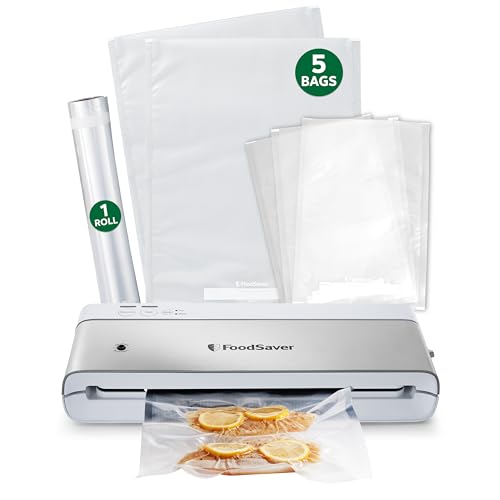
FoodSaver Compact Vacuum Sealer Machine
The cheapest sensible way in. Small enough to live in a cupboard rather than own a counter, and sized for sous vide portions, leftovers, and the odd freezer batch. Duty cycle is where machines this size give up, so skip it if you buy in bulk.
You Might Also Need
Accessories worth grabbing alongside your purchase


