Weston
Weston Jerky Slicer Reviews (2026)
By Nora Calloway · Updated October 2026
Independent editorial review. We never accept payment for coverage, though we may earn a commission if you purchase through our links.

Verdict
Jerky makers who slice their own meat are broadly sold on manual crank slicers like the Weston, and the praise repeats: several pounds sliced in minutes, pieces the same thickness every time, jerky that dries evenly as a result. The gripes repeat just as reliably. Cleaning between the sharp disc blades is fiddly and a little dangerous, the meat has to be partially frozen and kept under about an inch thick to feed cleanly, and a minority argue a good knife or the store butcher covers it. A few point to reviews questioning long-term cut quality. Reading it all together, the split is about volume: past a few pounds a session the time saved is real, and below that the knife wins. We would put the line right about there ourselves.
Read full take ↓Similar curing kits
The Weston Manual Support Beef Jerky Slicer is the hand-crank box that keeps coming up when jerky makers get tired of hunching over a cutting board with a knife. You partially freeze a roast, drop a chunk into the hopper, turn the crank, and a bank of stainless disc blades pulls it through into a row of even strips. No motor, no cord, just an aluminum body, a clamp for the counter, and about a minute of turning per batch. For the jerky and dehydrating crowd, the pitch is simple: uniform strips, made fast, without paying for a full deli slicer.
Uniformity is why it earns counter space. Strips of the same thickness dry at the same rate, so a tray of even pieces finishes together in a dehydrator or smoker instead of leaving some jerky scorched and brittle while the rest is still wet in the middle. Owners are happy about that payoff and equally clear about what it costs them: elbow grease, partially frozen meat, a bank of sharp blades that is fiddly and a little dangerous to clean, and a hard ceiling around an inch of thickness. Whether that trade is worth making comes down almost entirely to how much meat goes through your kitchen in a year.
The short version
A well-liked time-saver with two strings attached, and neither of them is a surprise once you own it.
What's good:
- Turns several pounds of roast into even strips in a few minutes, far faster than careful knife work.
- Every piece comes out the same thickness, so a dehydrator or smoker batch dries evenly and finishes together.
- Simple hand-crank mechanism with no motor to burn out, and an aluminum body that clamps to a counter.
- Cheaper than a real deli slicer while doing the one job a jerky maker actually needs.
What's not:
- Cleaning between the sharp disc blades is fiddly and easy to cut yourself on.
- It is a manual tool, so big batches mean real cranking, and the meat has to be partially frozen first.
- Thickness is capped at about an inch; anything thicker has to be butterflied or it gums up the cutters.
- Long-run durability data on this exact model is thin, and a few buyers worry about cut quality over time.
Who it's for
How many pounds a year you slice is the whole question here.
Buy it for:
- Making jerky regularly, in the five-to-twenty-pound range, and being sick of uneven hand-cut strips.
- Caring that every strip dries the same, so you can standardize times in a dehydrator or smoker.
- Wanting the result of a slicer without the price, footprint, or full teardown of a deli machine.
Skip it if:
- You only make jerky once or twice a year; a jerky board and knife kit gets you even strips for far less.
- You process big or nonstop batches; a motorized electric slicer does the cranking for you at higher volume.
- You hate cleaning gear; the disc blades are the fussiest part of owning one, and that will not change.
The specs that matter
Three things on the box change how this feels at the counter:
A feed opening rated up to 5 inches wide by 1.25 inches thick: wide enough to take a trimmed hunk of eye of round or pork loin, but in practice owners keep meat to about an inch thick. Go much past that and the piece has to be butterflied first, because the cutters will not pull a thicker chunk through cleanly.
Fixed stainless disc blades on a hand crank: the blade bank sets your strip thickness for you, which is exactly why the pieces come out uniform. There is no dial to fuss with, but it also means the strip width is whatever the blades give you, so you plan the cut around the tool rather than the other way around.
Aluminum body with a counter clamp, no motor: it is light, it stores in a cupboard between batches instead of hogging the counter, and there is no electrical part to fail. The flip side is that every strip is powered by your arm, so a twenty-pound session is a workout, not a walk-away.
How well it preserves
One question decides a slicer: does it produce strips even enough to dry evenly. The Weston's answer is yes, and the people who slice their own jerky are unusually consistent about it. Even pieces finish together on the tray. Uneven ones leave you picking out scorched bits and re-drying the wet ones. A maker who gave up on knife work describes the before and after:
Before, cutting beef or pork into thin even slices for jerky meant a partial freeze and what seemed like hours of careful work with a knife. And as the outside thawed and stretched, things inevitably got uneven. Now, it only takes a few minutes and I get perfect, even slices.
Speed is the other half. A hand crank chews through a batch far faster than careful slicing, and owners put numbers on it: ten pounds in five minutes, against the better part of an afternoon with a knife:
I own this exact jerky slicer. I can have 10lbs of meat, sliced perfectly in 5 minutes. I could use my Globe, but it is a huge pain to clean. This is a handy little gadget if your making jerky regularly. I think I paid $115 on Amazon. You can probably find it cheaper.
Uniformity is what actually improves the jerky, though. Same thickness every strip means the drying step becomes predictable, in a dehydrator or a smoker. One maker ran two different thicknesses in a single load and still got even results, because each thickness was consistent within itself:
I dried some at 1/8 inch for the fam and some at 1/4 inch specifically for me. Amazingly based on positioning in dehydrator I got equal drying times. But consistent slices was the best part
Even people still working with a knife name the exact gap the tool closes, which is worth hearing since it is the whole reason to buy one:
Thank you for making me aware of this. I do an okay job with the cutting board and knife but I like the idea of the strips being the same thickness. No small over dried bits or large too moist pieces.
Thickness is the ceiling, not quality. The blades want meat around an inch thick, and one long-time owner lays out exactly where the limit bites and why it still saves hours on a real batch:
As others have mentioned (or scoffed at) this is a great little slicer. I've gone through several different ones from cheap $60 electric ones from Amazon to $400 deli slicers. This is the easiest to use and clean. The only downside is that, as stated in the instructions, you are limited to 1" of thickness on your meat of choice. This will be the width of your jerky after slicing. So, if you have a 1.125" thick piece of meat (or thicker) you will need to butterfly it before slicing because it absolutely will NOT go through cleanly. I mention the extra 1/8" because you can squeeze it through using compression. But anything a bit larger gums up the cutters. But properly thick meat will save you HOURS on a large batch.
Stay under that limit and nothing short of a commercial slicer does this job better: fast, even strips that dry on schedule.
Built to last
A manual slicer has very little to break. No motor, no electronics, just an aluminum frame, a crank, and a stack of stainless blades. That simplicity counts for something, and owners who use theirs steadily report it holding up:
I use a Weston jerky slicer I got from Amazon for like $120 or whatever. Works well.
What we cannot tell you is how it looks after five years, because long-run reports on this exact model are thin. The recurring worry from shoppers is about cut quality over time rather than the body falling apart. One person weighing the Weston against its rivals named it directly:
I have seen some reviews on the weston saying it only works well once or twice or does not cut the pieces all the way through and isn't worth the price tag.
Keep that in proportion. Blades on any crank slicer dull eventually, and cheaper units in this class flex on tough or thick cuts, which is where half-cut pieces and uneven strips come from. Nothing in the ownership reports says the Weston is fragile. There is also not enough long-horizon evidence to call it a buy-it-for-life tool, and we would rather say so than guess. Keep the blades clean and dry, stop forcing oversized chunks through it, and order somewhere returns are painless so a bad unit surfaces early. That missing evidence is what parks this score in the middle.
Living with it
Slicing is the easy part. Cleaning is the tax. Feeding partially frozen meat and turning a crank takes no skill at all, and once you have the rhythm a batch goes fast. Owners call the actual use painless, and some push back hard on the idea that upkeep ruins it:
I’ve got one as well. It slices a lot of jerky fast! Clean up is not that bad either.
No technique to acquire, which is half the appeal. More than one owner pairs it with a cheap guillotine cutter to chop dried strips into bite-size pieces afterward, so it slots into a two-tool workflow:
I have this exact slicer and it's a game changer. I use this one plus a lil cheapo guillotine slicer off Amazon to cut the strips into bite sized pieces after they have been dehydrated
Cleaning is the price you pay for owning one, and the most common gripe across every manual crank slicer on the market. Those stainless discs are sharp, they trap marinade and meat between them, and getting in there without opening a finger is the part nobody makes peace with. An owner of a similar hand-crank disc slicer captures the love-hate exactly:
I have this exact slicer and absolutely love it. I do a lot of deer meat and try to process myself so don’t have the chance to have the locker slice it for me. It’s so much faster then cutting myself and the pieces are exactly the same thickness every time. The only down fall I’ve found with this slicer is cleaning it. Haven’t quite figured out how to not get cut by the wheels of death! Super sharp and have a hard time getting in between every blade.
A stiff pipe-cleaner brush and cut-resistant gloves take most of the danger and tedium out. Rinse the blades the moment you finish, before anything dries on. Add the partial-freeze prep and the arm work on a heavy load and the shape of this thing is clear: a hands-on tool for someone who does not mind a bit of ritual, not an appliance you walk away from.
How it compares
The Weston sits in the middle of a small field. Three alternatives bracket it on either side.
Versus a 200W electric meat slicer: this is the step up in volume and effort. A motorized slicer does the cranking for you, feeds partially frozen roasts through a moving carriage, and dials thickness from deli-thin to jerky-thick, so it shines when you process big or frequent batches. You pay for it with a bigger footprint, a cord, and more parts to wash, and the blade is just as demanding to clean.
Versus a jerky slicer board and knife kit: this is the cheaper, simpler route to even strips. A slotted cutting board guides a long knife to the same depth every pass, with nothing sharp to disassemble and nothing to store but a board and a blade. It is slower and more hands-on than the Weston's crank, but for an occasional maker it gets you uniform jerky for a fraction of the outlay.
Versus a knife and the store butcher: plenty of people insist a sharp knife and a partial freeze, or a friendly meat counter, does the job for free. At low volume they are right. The math flips fast once you are slicing real quantity, though, and higher-volume makers say so bluntly:
You obviously dont make enough, I have made 20 lbs at a time where a slicer would be worth every penny. Maybe if you're doing a small roast or something free hand is fine.
The dissent deserves airtime too. For a light user it is the correct call:
Seems like a waste of money-and a waste of counter space. I just free hand it. Not really difficult.
Using it well
Partially freeze the meat first, one to four hours, until it is firm but not rock solid, so it holds its shape and feeds cleanly through the blades. Trim a roast into hunks that fit the opening and keep them around an inch thick, butterflying anything thicker before it gums up the cutters. Clamp the slicer to the counter and feed at a steady pace. Let the crank do the work instead of forcing it. Then clean the blades the moment you finish, before marinade and fat dry on, with a stiff brush and cut-resistant gloves so the discs never get a chance to catch you.
Uniform strips pay off at the drying step. For jerky, aim for 160 to 165F and judge by doneness rather than the clock, since thickness and humidity move the timing. Our guide to the best dehydrator for jerky covers tray layout, temperature, and airflow across machines in depth.
Is it worth it
If you make jerky often enough to resent the knife, yes. Uniform slices are exactly what a clean, predictable dehydrator or smoker batch needs, and this produces them in minutes at a small share of a deli slicer's price. Performance carries this review.
The upkeep is what holds the score down, along with what we do not know. Disc blades that are fiddly and hazardous to clean, batches that want elbow grease and partially frozen meat, and not enough long-run evidence on this exact model to call it a lifetime buy. Keep cuts under an inch and expect a real tool with real maintenance. Making jerky twice a year? Get a slicer board and a good knife and spend the difference on better meat.
Our Ratings
Overall score
Turning a roast into even strips is the core job and the Weston does it well. Owners report cutting several pounds in a few minutes with pieces the same thickness every pass. That matters because uniform strips dry at the same rate, so a dehydrator or smoker batch finishes together instead of leaving some jerky scorched and some still wet. The ceiling is the roughly 1-inch thickness limit, since anything thicker has to be butterflied before it feeds cleanly.
Aluminum body, stainless blades, a hand crank: very little here can burn out, and owners who use theirs hard mostly report it holding up. Long-run data on this exact model is thin though. The recurring buyer worry is whether the blades keep cutting cleanly over time, and cheaper crank slicers in this class are known to flex on tough cuts. A solid tool rather than a lifetime one, on the evidence available, which is why this axis sits in the middle.
Slicing is easy. Cleaning is the tax. Feeding partially frozen meat and turning the crank is simple and fast, and plenty of owners call cleanup manageable. The sharp disc blades are still fiddly and hazardous to clean between, so a stiff brush and cut-resistant gloves earn their keep from day one. Add the partial-freeze prep and the arm work on a big batch and you have a hands-on tool, which is why this number is not higher.
Weston Jerky Slicer Reviews (2026) on Amazon.
What People Are Saying
Jerky makers who slice their own meat are broadly sold on manual crank slicers like the Weston, and the praise repeats: several pounds sliced in minutes, pieces the same thickness every time, jerky that dries evenly as a result. The gripes repeat just as reliably. Cleaning between the sharp disc blades is fiddly and a little dangerous, the meat has to be partially frozen and kept under about an inch thick to feed cleanly, and a minority argue a good knife or the store butcher covers it.
A few point to reviews questioning long-term cut quality. Reading it all together, the split is about volume: past a few pounds a session the time saved is real, and below that the knife wins. We would put the line right about there ourselves.
We weight candid owner reports from Reddit and preservation forums above brand-influenced editorial coverage, then reach our own verdict from them. The quotes below are the evidence; the rating and the take are ours.
What Reddit Is Saying
“I use a Weston jerky slicer I got from Amazon for like $120 or whatever. Works well.”View thread →
“I own this exact jerky slicer. I can have 10lbs of meat, sliced perfectly in 5 minutes. I could use my Globe, but it is a huge pain to clean. This is a handy little gadget if your making jerky regularly. I think I paid $115 on Amazon. You can probably find it cheaper.”View thread →
“I have this exact slicer and it's a game changer. I use this one plus a lil cheapo guillotine slicer off Amazon to cut the strips into bite sized pieces after they have been dehydrated”View thread →
“As others have mentioned (or scoffed at) this is a great little slicer. I've gone through several different ones from cheap $60 electric ones from Amazon to $400 deli slicers. This is the easiest to use and clean. The only downside is that, as stated in the instructions, you are limited to 1" of thickness on your meat of choice. This will be the width of your jerky after slicing. So, if you have a 1.125" thick piece of meat (or thicker) you will need to butterfly it before slicing because it absolutely will NOT go through cleanly. I mention the extra 1/8" because you can squeeze it through using compression. But anything a bit larger gums up the cutters. But properly thick meat will save you HOURS on a large batch.”View thread →
“I’ve got one as well. It slices a lot of jerky fast! Clean up is not that bad either.”View thread →
“Before, cutting beef or pork into thin even slices for jerky meant a partial freeze and what seemed like hours of careful work with a knife. And as the outside thawed and stretched, things inevitably got uneven. Now, it only takes a few minutes and I get perfect, even slices.”View thread →
“I have this exact slicer and absolutely love it. I do a lot of deer meat and try to process myself so don’t have the chance to have the locker slice it for me. It’s so much faster then cutting myself and the pieces are exactly the same thickness every time. The only down fall I’ve found with this slicer is cleaning it. Haven’t quite figured out how to not get cut by the wheels of death! Super sharp and have a hard time getting in between every blade.”View thread →
“I dried some at 1/8 inch for the fam and some at 1/4 inch specifically for me. Amazingly based on positioning in dehydrator I got equal drying times. But consistent slices was the best part”View thread →
“You obviously dont make enough, I have made 20 lbs at a time where a slicer would be worth every penny. Maybe if you're doing a small roast or something free hand is fine.”View thread →
“Thank you for making me aware of this. I do an okay job with the cutting board and knife but I like the idea of the strips being the same thickness. No small over dried bits or large too moist pieces.”View thread →
“Nice! I'm jealous. I'm getting better at cutting consistent thicknesses with a knife....but some still get away from me. I'd rather be able to ensure consistent thickness so I can standardize my drying times a bit.”View thread →
“I have seen some reviews on the weston saying it only works well once or twice or does not cut the pieces all the way through and isn't worth the price tag.”View thread →
“Seems like a waste of money-and a waste of counter space. I just free hand it. Not really difficult.”View thread →
Frequently asked questions
Is the Weston Jerky Slicer worth it?
Slicing is easy. Cleaning is the tax. Feeding partially frozen meat and turning the crank is simple and fast, and plenty of owners call cleanup manageable.
How is the Weston Jerky Slicer built?
Aluminum body, stainless blades, a hand crank: very little here can burn out, and owners who use theirs hard mostly report it holding up. Long-run data on this exact model is thin though. The recurring buyer worry is whether the blades keep cutting cleanly over time, and cheaper crank slicers in this class are known to flex on tough cuts.
What is the Weston Jerky Slicer best suited for?
Turning a roast into even strips is the core job and the Weston does it well. Owners report cutting several pounds in a few minutes with pieces the same thickness every pass. That matters because uniform strips dry at the same rate, so a dehydrator or smoker batch finishes together instead of leaving some jerky scorched and some still wet.
What do real owners say about the Weston Jerky Slicer?
Jerky makers who slice their own meat are broadly sold on manual crank slicers like the Weston, and the praise repeats: several pounds sliced in minutes, pieces the same thickness every time, jerky that dries evenly as a result. The gripes repeat just as reliably. Cleaning between the sharp disc blades is fiddly and a little dangerous, the meat has to be partially frozen and kept under about an inch thick to feed cleanly, and a minority argue a good knife or the store butcher covers it.
Options Worth Checking Out

200W Electric Meat Slicer with Two 7.5-Inch Stainless Steel Blades
Step up to a motor when hand-cranking a big batch gets old. This 200W slicer runs two stainless blades and a sliding tray, so you feed partially frozen roasts and it does the work, dialing thickness for thin, even strips faster than a manual crank.
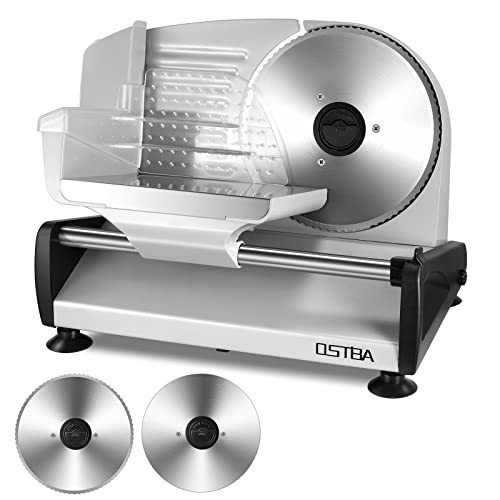
OSTBA 200W Electric Deli Meat Slicer
The closest electric cross-shop. OSTBA's 200W deli slicer takes partially frozen meat, adjusts from deli-thin to jerky-thick, and adds a child lock and removable blade for cleanup. A solid pick if you would rather push a carriage than turn a crank.

Beef Jerky Slicer Kit with Stainless Cutting Board and 14-Inch Knife
The cheaper route to even strips. A stainless board with an adjustable-depth slot guides the 14-inch knife to the same thickness every pass, with no blades to disassemble. Slower and more hands-on than the Weston, but it stores flat and rinses fast.


