Best Fermentation Weights for Mason Jars
By Ruth Alvarez · Updated October 2026
Independent editorial guide. We never accept payment for coverage, though we may earn a commission if you purchase through our links.
Quick Take
A fermentation weight is the cheap accessory that most decides whether a beginner's first jar ferments or molds. Its only job is to hold the vegetables under the brine, where they pickle safely, instead of letting them bob into the air where mold and kahm yeast take hold. For a standard wide-mouth Mason jar, a notched glass weight that actually fits the opening and gives you something to grip is all you need.
Two details trip people up. First, fit: a wide-mouth weight will not drop through a regular-mouth jar, and a regular-mouth weight leaves too much gap in a wide one, so match the weight to your jars before you buy. Second, removal: a plain glass disc with no handle is a pain to pull out of a full jar, which is why the grip matters more than it sounds. Glass is the material to want, inert in an acidic brine and dishwasher-safe between batches.
Below is what a weight actually has to do, wide-mouth versus regular-mouth fit, glass versus the DIY alternatives fermenters swear by, and the four weights we would put in your cupboard. See picks
Almost every failed first ferment fails the same way. A few pieces of cabbage or a couple of cucumber tops float up above the brine, catch air, and grow a fuzzy spot, and the whole jar goes in the bin. The fix is not a better recipe or a fancier crock. It is a small weight sitting on top of the vegetables, keeping them where the brine can protect them.
Spend time in the fermentation forums and the same advice comes up in thread after thread: keep everything submerged, and the rest mostly takes care of itself. People do it with purpose-made glass weights, with a bag of brine, with boiled rocks, with a smaller jar wedged inside a bigger one. They argue about grip handles, about plastic, about which size fits which jar. What they agree on is the goal.
This guide pulls that collective experience together. It is about what a fermentation weight has to accomplish, why glass earns its place over the improvised options, how to match a weight to a wide-mouth or regular-mouth Mason jar, and which specific weights are worth buying. The four picks at the end are our own editorial, spec-based choices, not a community-voted ranking.
The one rule: keep vegetables under the brine
Fermentation is an anaerobic process. Below the brine, salt-tolerant lactic acid bacteria do their work and mold and kahm yeast are shut out. Above the brine, in contact with air, those same vegetables are just sitting out at room temperature, which is exactly where spoilage starts. One fermenter put the logic about as plainly as it can be put:
In the airlock it's not like it's a vacuum. That's still air! An airlock doesn't prevent spoiling. You can weigh them down or push them down or use more brine but you have to have them under the brine completely. Think about what you're trying to do. Ferment stuff using brine. Anything that isn't under the brine, you're not doing that to so it's just rotting / spoiling as it would normally.
That is why the single most repeated piece of beginner advice is to keep everything submerged, and why a weight is the tool that does it without you thinking about it. You can push the vegetables down by hand a couple of times a day instead, but that only works if you are home and remember:
They should be under the brine to prevent mold If you don't have weights, then shaking it a little couple of times a day is also one alternative, this prevents anything from drying and making sure there isn't any good spots for mold
A weight also solves a second, quieter problem. Ferments rise and bubble as they get going, and a jar packed to the very top will push brine out onto the counter. Leaving headroom and letting a weight hold the vegetables down is the calmer setup:
You can ferment without weights, but my concern here is that you did not leave any headroom for the liquid level to rise. I can almost guarantee that those will be spilling over/leaking out the top once fermentation kicks in. The idea behind using a weight is to help keep the foods from touching that pocket of air, which should be there.
If you are still deciding whether fermenting is for you at all, our best fermentation kit for beginners guide covers the whole starter setup that a weight slots into.
What a good weight actually does (and what it does not)
A weight is not magic. It presses down on a mass of vegetables, and it works best when there is a barrier between it and the small, floaty bits so they cannot slip up around the edges. The weight and the barrier work as a pair, not a single fix:
You guys are both almost there. You need a barrier AND a weight(s). The barrier keeps the weights from dropping to the bottom and the produce from rising above the weights. A cabbage leaf, alone, works on friction, which is great until it gets fermented and starts losing its rigidity. I use a cabbage leaf and a glass stone for 90% of my lacto ferments, and I haven’t looked back since.
The shape of your jar matters here too. A straight-sided Mason jar has nothing to trap floaters, so the weight is doing all the work, which is the case for a weight that fits the opening snugly. When people skip the weight in a straight jar, the advice they get back is blunt about the risk, and about the cheapest reliable substitute:
These will very likely mold if the vegetables aren’t fully submerged. In a vessel that shape, a plastic zip-sealed bag full of brine is probably the best option to weigh it down.
That zip-top bag of brine is the recurring backup plan, and it is a real option. But it is fussier to seat, it can leak, and it puts plastic in prolonged contact with an acidic ferment, which is exactly what a lot of people are trying to avoid. A weight that simply fits the jar removes the fuss.
Wide-mouth versus regular-mouth: get the fit right first
This is the mistake that sends new weights straight back to the shelf. Fermentation weights are sized to the jar opening, and the two common Mason jar mouths, wide and regular, take different weights. A wide-mouth weight is too big to drop through a regular-mouth jar. A regular-mouth weight rattles around in a wide-mouth jar and lets vegetables escape up the sides. Buy the wrong one and you get this:
I tried the glass weights, but they were too small to fit in my jars, but the neck of the jar was too small to fit anything bigger in, so I gave up. Thought about using the cabbage stalk, but thought the whole point was all the veg had to be submerged or it would get mouldy, so didn't try that one.
Wide-mouth jars win for a reason: they are easier to pack, easier to reach into, and easier to weight, and the people who use them tend to stay happy:
Yep. I got a set of four wide-mouth glass fermentation weights for Christmas a few years ago and I've LOVED fermenting with them. I've literally never had a mold problem.
If you are committed to regular-mouth jars, you have fewer purpose-made options and people improvise, sometimes cleverly:
I use shot glasses! Then I can get away with a normal mouth mason jar (I only have 3 wide mouth)
The practical takeaway: look at the jars you actually own before you buy. If they are wide-mouth, get a wide-mouth weight. If they are regular-mouth, get one made for that narrower opening rather than forcing a wide one. Weights pair naturally with an airlock lid, and our best Mason jar fermentation lids guide covers that half of the setup.
Why glass, and why not plastic or a random rock
Material matters more in a ferment than in almost any other kitchen job, because the environment is acidic and the contact lasts for days or weeks. Glass is inert, it does not leach into a low-pH brine, it does not stain or hold odors, and it goes in the dishwasher to reset between a batch of garlicky kraut and a batch of something milder. Try the alternatives for a while and you land back on glass:
I use glass weights. Sometimes I use a flattened cabbage leaf as a gasket. There are some Korean and Chinese fermentation jars at my grocery store that use a indented rim that is sealed with water when the lid in in place. They are a little pricey, but seem like they would be easy to use. I have fewer problems with mold since I started using the glass weights. I find the plastic bag method fussy, and don't like using plastic if I can avoid it.
The durability argument is the other half of it. Rigid plastic inserts are cheap up front, but they wear in a way glass does not:
They are less "expensive" than this plastic because they will last a lifetime and beyond unless you drop them. This plastic will stain, take on odors, and slowly dissolve and break over time. Spend a little bit more now and save a lot later.
DIY rocks come up constantly as a free option, and they can work if you know the stone, but there is a caution worth repeating: an unknown rock can be porous or can leach minerals and heavy metals into an acidic brine, so a scrubbed, boiled, food-safe stone is the only version worth trusting. Glass skips that guesswork entirely. If you want a larger vessel where the weight lives permanently, our best fermentation crock guide covers the step up from jars.
The grip handle is the part people underrate
On paper, a fermentation weight is a flat glass disc and any flat glass disc will do. In practice, the single most common complaint is not about whether the weight works but about getting it back out of a full, slippery jar. A handle or a raised knob is the difference between a two-second lift and fishing around with your fingers in the brine:
I like using them, I got some glass ones from Amz. Honestly, I don't recommend these because it's hard to get them out. Look for ones that have a knob on the top.
For the people who like their weights, the grip is the reason:
I use them and think they’re helpful since they keep floaters down. Those with an airlock make life a lot easier. I use glass ones from Amazon and some ceramic ones I got at a fermentation festival long ago. They both work equally well. If you get the clear glass ones make sure they have a handle to pull them out of the jar more easily. I have some really large jars I don’t have weights for and just recently tried using a plastic bag filled with brine as many people suggest on here. It’s worked great too.
There is nuance on how the grip is shaped. A small nub you can catch with tongs is what most people want, and a few find certain low-profile designs still slip:
I use glass weights. They can be a little tricky to remove so the ones with a little bump out work best, you can use tongs to remove them. I've been using them with pickle pipes & the system works pretty well. I try to avoid plastics, worried about breakdown.
For buying, treat the handle as a feature to seek out, not a bonus. A notch, a knob, or a raised loop you can hook with tongs turns weight removal from the annoying part of fermenting into a non-event.
The DIY alternatives, and when they work
You do not strictly need to buy anything to keep vegetables submerged, and the forums are full of working improvisations: a zip-top bag filled with brine, boiled glass beads or marbles in a sanitized bag, a smaller jar or shot glass wedged on top, a cabbage leaf pinned down with something heavy. One fermenter's dollar-store version is representative:
If you don't have weights, you get get glass beads from the dollar store. The kind you see in those gaudy fake plant pots. Boil them to sterilize, and put in a (also sterilized) ziploc bag. Perfect weights.
Plenty of people also describe starting with an improvised weight and upgrading once they knew they were in the hobby to stay:
You are going to have a mess. Fermentation produces CO2. The sealed jars can explode. Filled up to the top, they are going to shoot out when you open them. Also anything out of the water is at risk for getting moldy. You don't need a fancy setup. Before I had glass weights and airlocks, I used a smooth rock in a ziplock, then I moved to a stubby beer bottle full of salt and wrapped the top loosely with plastic wrap. As I got better I bought better equipment.
So why buy a weight at all? Because the purpose-made ones are cheap, they fit, they are inert, and they remove the small daily friction that makes beginners quit. That is the case a lot of experienced fermenters make once they have tried both:
I get not wanting to spend too much on specialist equipment but fermentation weights are so cheap and do the job better than anything else. It’s the one thing I would say is worth actually spending money on
If a DIY route appeals, a brine-filled bag is the most reliable of them, and matching the bag's salinity to your ferment means a leak will not throw off the batch. But for a few dollars, a weight that drops straight into your jar and comes out with a handle is the option we would point a beginner to.
Batch fermenting: you need more weights than you think
One jar needs one weight. The problem arrives in peak garden season, when you are running four, six, or eight jars at once and a four-pack leaves you short. Weights are single-tasking: each one is tied up in its jar for the length of a ferment, which can be a week or several. If you ferment in volume, buying a larger set once is cheaper per jar than adding four-packs a bottle at a time, and it means you are never rationing weights across jars.
This is also the moment to point out that consistency helps. If every jar uses the same style of weight, your brine math and headspace stay predictable from jar to jar. Our fermentation brine calculator assumes a standard glass weight with a grip handle sitting on top, so the salt and water figures it gives you line up with what is actually in the jar.
Our four picks, and which one to buy
To be clear about what these are: the four weights below are our editorial, spec-based recommendations, chosen on fit, material, and grip. They are not a popularity ranking pulled from the quotes above, which speak only to the general practice of weighting a ferment. We picked for the jars and use cases most home fermenters actually have.
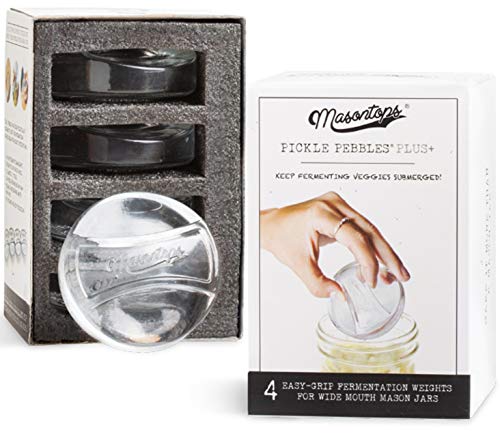
For most people, buy the wide-mouth notched glass weight. It fits the wide-mouth Mason jars the majority of fermenters use, the notched glass gives you a grip to lift it out, and glass is the material you want against an acidic brine. It is the safe default and the one we would hand a beginner.
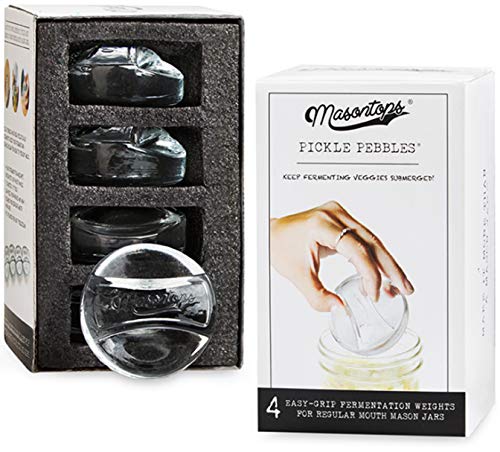
If your jars are regular-mouth, buy the regular-mouth version instead. This is a fit decision, not a quality one: a wide-mouth weight will not go through the narrower opening, so match the weight to the jars in your cupboard.
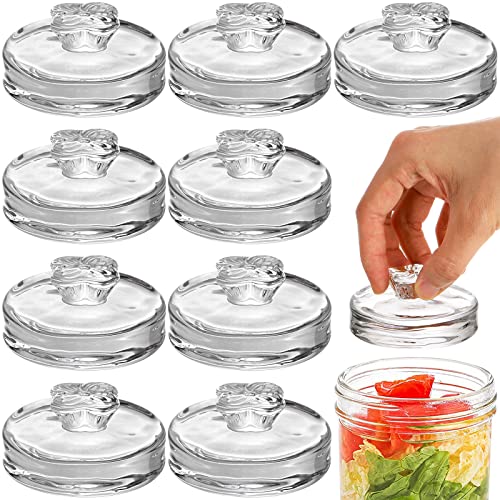
If you want the best value, the generic glass weights with a grip handle do the same job for less, and that easy-grip handle is what saves you when you are pulling a weight up out of the brine. It is also the weight our brine calculator assumes, so the numbers there match your setup.
And if you ferment in volume, buy the bulk nine-pack so you are never short a weight when every jar is full at harvest time. Whichever you choose, the rule underneath all of it is the same one the whole community agrees on: keep the vegetables under the brine, and let the weight do that job for you.
Recommended
Products related to this guide.

What owners say
Real owner reports from the threads and editorial sources we drew on for this guide.
“In the airlock it's not like it's a vacuum. That's still air! An airlock doesn't prevent spoiling. You can weigh them down or push them down or use more brine but you have to have them under the brine completely. Think about what you're trying to do. Ferment stuff using brine. Anything that isn't under the brine, you're not doing that to so it's just rotting / spoiling as it would normally.”
— r/fermentation / u/ivankatrumpsarmpits
“They should be under the brine to prevent mold If you don't have weights, then shaking it a little couple of times a day is also one alternative, this prevents anything from drying and making sure there isn't any good spots for mold”
— r/fermentation / u/juhotuho10
“You can ferment without weights, but my concern here is that you did not leave any headroom for the liquid level to rise. I can almost guarantee that those will be spilling over/leaking out the top once fermentation kicks in. The idea behind using a weight is to help keep the foods from touching that pocket of air, which should be there.”
— r/fermentation / u/h2opolopunk
“You guys are both almost there. You need a barrier AND a weight(s). The barrier keeps the weights from dropping to the bottom and the produce from rising above the weights. A cabbage leaf, alone, works on friction, which is great until it gets fermented and starts losing its rigidity. I use a cabbage leaf and a glass stone for 90% of my lacto ferments, and I haven’t looked back since.”
— r/fermentation / u/sacrebluh
“These will very likely mold if the vegetables aren’t fully submerged. In a vessel that shape, a plastic zip-sealed bag full of brine is probably the best option to weigh it down.”
— r/fermentation / u/toocleverbyhalf
“I tried the glass weights, but they were too small to fit in my jars, but the neck of the jar was too small to fit anything bigger in, so I gave up. Thought about using the cabbage stalk, but thought the whole point was all the veg had to be submerged or it would get mouldy, so didn't try that one.”
— r/fermentation / u/chazdothands
“Yep. I got a set of four wide-mouth glass fermentation weights for Christmas a few years ago and I've LOVED fermenting with them. I've literally never had a mold problem.”
— r/fermentation / u/utahh1ker
“I use shot glasses! Then I can get away with a normal mouth mason jar (I only have 3 wide mouth)”
— r/fermentation / u/murrajes
“I use glass weights. Sometimes I use a flattened cabbage leaf as a gasket. There are some Korean and Chinese fermentation jars at my grocery store that use a indented rim that is sealed with water when the lid in in place. They are a little pricey, but seem like they would be easy to use. I have fewer problems with mold since I started using the glass weights. I find the plastic bag method fussy, and don't like using plastic if I can avoid it.”
— r/fermentation / u/cheesepage
“They are less "expensive" than this plastic because they will last a lifetime and beyond unless you drop them. This plastic will stain, take on odors, and slowly dissolve and break over time. Spend a little bit more now and save a lot later.”
— r/fermentation / u/ExtremeHobo
“I like using them, I got some glass ones from Amz. Honestly, I don't recommend these because it's hard to get them out. Look for ones that have a knob on the top.”
— r/fermentation / u/Flaky-Wrongdoer8286
“I use them and think they’re helpful since they keep floaters down. Those with an airlock make life a lot easier. I use glass ones from Amazon and some ceramic ones I got at a fermentation festival long ago. They both work equally well. If you get the clear glass ones make sure they have a handle to pull them out of the jar more easily. I have some really large jars I don’t have weights for and just recently tried using a plastic bag filled with brine as many people suggest on here. It’s worked great too.”
— r/fermentation / u/The_Issa