Best Fermentation Kit for Beginners: Crock vs Mason-Jar Systems
By Theo Marchetti · Updated October 2026
Independent editorial guide. We never accept payment for coverage, though we may earn a commission if you purchase through our links.
Quick Take
You do not need a big stoneware crock to start fermenting. For your first sauerkraut, pickles, or hot sauce, a mason-jar kit with an airlock lid and a weight is the cheap, low-risk way in. It fits on a counter, costs little, and does the one thing that matters: keeping your vegetables submerged and away from air.
Buy the water-seal crock later, once you are fermenting by the head of cabbage instead of the handful. Owners who love theirs love it for exactly that reason, big batches in one vessel. It is also heavier, harder to clean, needs its water channel topped up, and costs more, which is a lot to take on before you know you even like this hobby.
Match the vessel to the batch you are making, and the crock-or-jar argument mostly dissolves. Below are the kits worth starting with, and the crock worth upgrading to. See picks ↓
Search "best fermentation kit" and you'll get a wall of pricey crocks photographed like heirlooms. That framing quietly assumes you've already decided this is your hobby. If you're on your first batch, it's the wrong place to start.
The people who actually ferment week to week tell a more useful story. Plenty of them started in a plain mason jar with a cheap lid and a weight, made great kraut, and only bought a crock later once they were making enough to justify it. Some never bothered with a crock at all. And a fair number who splurged on a beautiful crock quietly went back to jars.
So this guide covers the kit-versus-crock decision and who each one suits. Which airlock-lid brand seals best is its own rabbit hole and not our subject. What to put on your counter for your first ferment, and what to reach for when you outgrow it, is.
Start in a jar, not a crock
Your first fermentation vessel should be cheap enough that a failed batch doesn't sting. A mason jar with an airlock lid and a weight clears that bar easily. You probably already have jars, and if you don't, they're everywhere and useful for a hundred other things.
That is not a consolation prize. Owners who've tried both keep landing in the same place for everyday ferments:
I have a fermentation crock. I personally prefer a mason jar with an airlock and a glass weight for ease of storage and a bit easier to fill. The fermentation crock is great for a big batch fermentation, whereas I prefer the jars more for smaller batch. I like the jars cuz I can monitor better for mold without letting oxygen into the ferment.
Storage, ease of filling, watching for mold. Those are beginner problems, and the jar wins all three. A crock's advantages show up at a batch size most first-timers won't hit for months.
What a beginner kit is
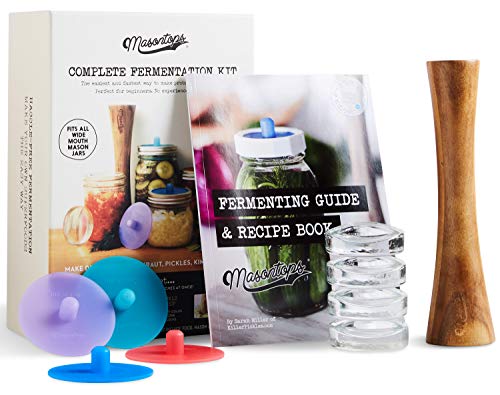
A fermentation kit sounds fancier than it is. Strip it down and you're buying three things: a jar to hold the ferment, a lid that lets gas out without letting air in, and a weight to hold your vegetables under the brine. That's the whole machine.
A complete starter kit bundles all three so you don't have to source parts that fit each other. If you already own a stack of wide-mouth jars, you can skip straight to a lid-and-weight set and spend even less. Either way, don't overthink the shopping. One owner put the beginner mindset well:
Im not too sure if the quality increases, tbh... you need an oxygen-deprived environment, humidity and a certain % of salt for a safe fermentation to happen... whether you achieve that in mason jars or something else seems indifferent to me. Ive been fermenting using mason jars and plastic sandwich bags filled with water and it works well hahah, other vessels are way more expensive and i dont see a clear advantage to using them
There's truth to that. Salt, no oxygen, and time do the work. The gear just makes hitting those conditions easier and less fussy to babysit.
Why the weight matters more than the vessel
The weight is the make-or-break piece. Almost every failed first ferment traces back to the same thing: a piece of vegetable floated up above the brine, met the air, and grew mold. Keep everything submerged and most problems never start.
Experienced fermenters treat weights as non-negotiable and pair them with an airlock:
I always use both and will always recommend this too. Weights keep the product submerged, so no chance for mold. Airlock keeps your container from exploding by preventing pressure buildup. Also it's a comparatively tiny investment considering you'll get years of use out of both.
Years of use for a few dollars is the correct arithmetic. Owners improvise constantly when they run short: a small jar of water, a brine-filled bag, a folded cabbage leaf tucked over the top. Any of those beats an uncovered ferment, so do not stall a batch waiting on a branded weight to arrive.
Airlocks and the mold-watching problem
The lid is the other half of a kit. A basic loose lid works if you're diligent about burping it. An airlock lid does that job for you, letting fermentation gas escape while keeping oxygen out, which is the environment your ferment wants. Less oxygen at the surface, less mold to fret over.
For a beginner the payoff is mostly peace of mind. You stop prying the jar open daily to second-guess every bubble. An airlock and a weight together cover the two ways a first ferment usually goes wrong: air at the top, and produce floating up into it. Get those right and sauerkraut is hard to mess up.
When a crock earns its shelf space
Crocks are not a scam. A water-seal crock is a better tool for one specific job: big batches. Ferment whole heads of cabbage at a time and a jar turns into a juggling act.
They're pretty much perfect for sauerkraut because you can make gigantic batches. Even if I use one single cabbage it's too much for mason jars. I don't use mine for things other than sauerkraut but there's no reason you couldn't if you want to make a big batch
That is the one thing a crock does better. A single cabbage can overflow a jar, and a five-liter crock swallows several without blinking. If you already know you want gallons of kraut for the year, buy the crock and skip the jar phase. Most beginners aren't there yet.
The crock downsides nobody puts on the box
A water-seal crock has a trough of water around the rim that seals out air, and that trough needs tending. It evaporates. In some homes it does something worse:
Also, if you have temperature swings in your house it seems like the pressure change can cause water in the airlock to get sucked into the crock sometimes. To the point where I don't use mine anymore and just use 1/2 gallon jars when I want bigger batches.
Temperature swings pulling trough water down into the ferment is a common complaint. So is the daily chore of topping the channel up. Crocks are heavy, hard to see into, and a pain to clean on top of that. Even the people who like them are blunt about it:
Crocks are best IMO, but they're expensive and you better hope you buy a quality one with good glazing. Some have too small openings so that to get the weights in you can't fill beyond 60% or so, which is a bad design IMO.
Glazing quality and opening size matter, and you often cannot tell which you are getting until the box is open. That is a lot of unknowns for a first purchase, next to a jar you can inspect at a glance.
Mason-jar kit vs crock: who each is for
Buy the jar kit if you're new, unsure how deep you'll go, making small-to-medium batches, or you want to watch the ferment and store it in the same vessel. Buy the crock if you already ferment, you're doing large batches of mostly kraut or pickles, and you've got the counter space and patience for the upkeep.
Owners who have both usually reach for the jar day to day and the crock for the occasional big run:
I have a hand-made German crock with a water seal. Love it because it's beautiful and large enough to make absurd amounts of sauerkraut or fermented green cherry tomatoes. But to be perfectly honest, I have fewer failures (with equally tasty results) using a wide-mouth Mason jar and self-burping fermentation lid.
The jar-first path also scales on its own. Start small, size up, never touch a crock:
FWIW, I started with quart mason jars and ported caps (call me silly!)... One example, sauerkraut, I would finish it so fast, so I moved up to 1/2 gallon and that's the right size for me. They've treated me well, and they can be used for other things besides fermenting, very modular, all (pint, quart, 1/2 gallon) use same size lids. And I can see what's going on inside.
One lid size across pints, quarts and half gallons is a bigger deal than it sounds. You grow the setup a jar at a time instead of committing to one large vessel up front. Half-gallon jars are where a lot of people end up, for the reason the owner above gives: quarts of kraut disappear faster than you expect, and the same lids and weights carry straight over. The jars also go on doing ordinary jar work between ferments, which is more than a crock can say.
Your first buy
For almost everyone reading this, start with a mason-jar kit that includes airlock lids and weights. It's the cheapest way to find out whether you love fermenting, it fails cheaply if a batch goes sideways, and it makes great sauerkraut, pickles, and hot sauce. If you already own jars, buy just the lids and weights and spend even less.
Reach for a crock when, and only when, a jar stops being big enough. If you know upfront you'll be fermenting by the gallon, buy a well-made one with good glazing and a deep water channel, and keep it topped up. Two rules matter more than the vessel either way: keep your vegetables under the brine, and keep oxygen off the top. A plain jar run carefully beats a beautiful crock run carelessly, every time.
Recommended
Products related to this guide.


What owners say
Real owner reports from the threads and editorial sources we drew on for this guide.
“I have a fermentation crock. I personally prefer a mason jar with an airlock and a glass weight for ease of storage and a bit easier to fill. The fermentation crock is great for a big batch fermentation, whereas I prefer the jars more for smaller batch. I like the jars cuz I can monitor better for mold without letting oxygen into the ferment.”
— r/fermentation / u/Lunasi
“Im not too sure if the quality increases, tbh... you need an oxygen-deprived environment, humidity and a certain % of salt for a safe fermentation to happen... whether you achieve that in mason jars or something else seems indifferent to me. Ive been fermenting using mason jars and plastic sandwich bags filled with water and it works well hahah, other vessels are way more expensive and i dont see a clear advantage to using them”
— r/fermentation / u/theMauMauUpriser
“I always use both and will always recommend this too. Weights keep the product submerged, so no chance for mold. Airlock keeps your container from exploding by preventing pressure buildup. Also it's a comparatively tiny investment considering you'll get years of use out of both.”
— r/fermentation / u/the_sour_kraut
“They're pretty much perfect for sauerkraut because you can make gigantic batches. Even if I use one single cabbage it's too much for mason jars. I don't use mine for things other than sauerkraut but there's no reason you couldn't if you want to make a big batch”
— r/fermentation / u/car8r
“Also, if you have temperature swings in your house it seems like the pressure change can cause water in the airlock to get sucked into the crock sometimes. To the point where I don't use mine anymore and just use 1/2 gallon jars when I want bigger batches.”
— r/fermentation / u/Figwit_
“Crocks are best IMO, but they're expensive and you better hope you buy a quality one with good glazing. Some have too small openings so that to get the weights in you can't fill beyond 60% or so, which is a bad design IMO.”
— r/fermentation / u/GoPointers
“I have a hand-made German crock with a water seal. Love it because it's beautiful and large enough to make absurd amounts of sauerkraut or fermented green cherry tomatoes. But to be perfectly honest, I have fewer failures (with equally tasty results) using a wide-mouth Mason jar and self-burping fermentation lid.”
— r/fermentation / u/Taggart3629
“FWIW, I started with quart mason jars and ported caps (call me silly!)... One example, sauerkraut, I would finish it so fast, so I moved up to 1/2 gallon and that's the right size for me. They've treated me well, and they can be used for other things besides fermenting, very modular, all (pint, quart, 1/2 gallon) use same size lids. And I can see what's going on inside.”
— r/fermentation / u/nibblicious