Best Fermentation Crock: How to Choose Without Guessing
By Ruth Alvarez · Updated October 2026
Independent editorial guide. We never accept payment for coverage, though we may earn a commission if you purchase through our links.
Quick Take
For most kitchens the best fermentation crock is a glazed, water-seal stoneware crock in the two to four liter range, with weights included. The water-seal design is the whole point: a moat of water around the rim lets fermentation gas bubble out while oxygen can never get back in, so a batch of kraut or pickles sits for weeks with no daily burping and no mold on top. Get one glazed inside and out, big enough for a head or two of cabbage, and you have covered the decision that matters.
The traps are all in the details. An open crock with no water seal is cheaper but wants a plate-and-jar weight and closer minding. A giant crock looks impressive and then sits half empty because it takes eight heads of cabbage to fill. The unglazed ceramic weights that ship in most boxes are the single most-complained-about part of the whole category, and factory glaze quality varies from unit to unit. None of that is a reason to skip a crock, only reasons to buy the right one and inspect it the day it lands.
Below are the crocks worth buying at each size and price, plus the mason-jar kit that is the smarter call when a crock is overkill. See picks ↓

Type "best fermentation crock" into a search bar and you get a wall of narrative blog posts: someone's kraut journey, a history of German Gartopf pottery, a recipe with a crock photographed like an heirloom. What you rarely get is the one thing a shopper actually needs, which is a clear map of the real choices and what each one costs you at the counter.
There are only three ways most people ferment vegetables at home, and a crock is just one of them. Sort out which vessel fits the batch you actually make and the brand question mostly answers itself. Get it wrong and you end up with a heavy, beautiful pot that lives on the floor and never gets filled, or a jar setup you have quietly outgrown.
This guide walks the decision the way an experienced fermenter would: water seal versus open crock versus mason jar, how to size one to your household, what the included weights really do, and how to think about ceramic quality and lead safety without either panicking or hand-waving. Every spec and every owner voice below traces back to a real product listing or a real comment, nothing invented.
Three vessels, one job: keep oxygen off the brine
Every fermentation vessel is trying to do the same simple thing: hold your vegetables under a salt brine, keep them submerged, and keep air off the surface while the gas of fermentation escapes. Three formats do that job, and they sit on a clear ladder.
A water-seal crock is the classic answer. Glazed stoneware, a channel of water around the rim, and a lid that sits down into that channel so gas burps out and oxygen stays out. Set it and forget it for weeks.
An open crock is the older, simpler pot with no water channel. It ferments fine, but you supply the seal yourself with a plate and a weighted jar on top, and you watch it more closely because the surface is exposed.
A mason-jar kit turns jars you may already own into small ferments with an airlock lid and a glass weight. It is the cheapest way in and the easiest to clean, and for a quart at a time it is all you need.
Long-time fermenters are blunt about where the crock earns its keep. One pickle maker who has run the same routine for years puts the case for a proper crock plainly:
if you’d like to ferment pickles, follow this recipe. I followed this for four summers (last year my cuke seedlings failed; this year I’m just growing tomatoes). the important factors: invest in a good crock and stones. mason jars and ported caps are silly (imo). stones are crucial to keep everything below the top of the brine, and both ceramic stones and crock are easy to clean after you bottle the finished pickles up and put them in the fridge. refrigeration stops the fermentation. I ordered a 5-gallon Ohio Stoneware crock and stones at my local Ace Hardware. F Amazon. use the recommended 5% brine. that’s 190g pickling salt : 1-gallon fresh clean water. the math is easy to scale. find a source for grape leaves. you can use oak leaves in a pinch. there are other high-tannin plants, but we have wild (edible) grapes growing on the back fence. wash them before you layer them in with a shit ton of cracked garlic cloves (dozen+) and fresh dill. the tannins in the grape leaves keep the pickles crisp. if kahm yeast starts to scum on top, skim it right away. it’s harmless but it can impart an off flavor. with summer temps what they are and assuming your house is hot like ours, pickles are ready in about a week, and you can generally outpace yeast bloom in a hot kitchen. AMA. submitted by /u/tehsecretgoldfish [link] [comments]
That is one honest opinion, not gospel. Plenty of people make superb kraut in jars and never touch a crock. The crock's real advantage is volume and walk-away time, not better fermentation. If you only ever make a jar at a time, the ladder ends at the bottom rung and you are done.
How a water-seal crock actually works
The water seal is the feature people are really paying for, so it is worth understanding. The lid does not clamp down. It rests in a moat of water you pour into the rim channel. As the ferment produces carbon dioxide, the pressure lifts the gas out through the water as bubbles, and because water fills the gap, outside air can never travel back down into the crock. The result is a passive, self-regulating seal that holds for as long as the moat stays full.
Because the seal is passive, the crock rewards patience in a way a jar never can. You are not opening it, checking it, or burping it, so a long ferment is no more work than a short one. One owner's story about a very long hold is the whole argument for the format:
Story time. I have a 10L Gartopf crock. A couple years ago I shredded up 7-8 cabbages, salted, and got them all (water) sealed into the crock. A month goes by, I keep the water well filled, I think to myself, "I should have a taste!" Nope, next month.. This continues for 6-7 months. At this point I'm nervous about opening the crock because I can anticipate the STANK!!!!.. I keep the water well filled, but am actively putting off opening the thing and fearing being overcome with stank, and passing out. A little over the 12 month mark, I decide that today's the day. I absorb the water out of the trough with a sponge, take the lid off carefully and all I can smell is sweet, sweet sauerkraut. Granted, my place is super hot in the Summer while I'm at work, and cold in the Winter. I jarred up about 10 Mason jars of it and gave it to friends at work, and it was DELICIOUS!!!!!!!
There is exactly one rule that keeps the seal working, and it is the thing new owners trip over: the moat cannot run dry. Evaporation is real, and in a warm, dry room it can happen faster than you expect, as one puzzled owner found:
I have a crock similar to this but I've been wondering if its moat is maybe just decorative. It holds just enough water to go above the holes in the lid and a tad more. I tried it and it evaporates to below the hole line in only one day, so it would have to be refilled every day. Is this normal or not? The "holes" are just two places where the lid rides up a bit to allow more air. I'm not even sure why they exist, since it seems to be begging for gnats to fly inside. Seems like gas would escape just fine without them, and the moat would be more functional. Link: https://www.everten.com.au/schmitt-fermentation-crock-pott-5l-white.html
The fix is simply to top the channel up and to keep the crock out of a hot, dry spot. A moat that has evaporated below the lid is no longer a seal, it is just a lid sitting in air. Check it when you walk past, and on most crocks in a normal room it needs attention every few days rather than every day.
Sizing a crock to your household
Most buyers overspend at this step and then regret it. Crock capacity is measured in gallons or liters, and it is tempting to buy big. The problem is that cabbage packs down hard, and a large crock needs a startling amount of it to fill. One owner of a four-gallon crock lays out the reality:
Looks great, OP! How many cabbages did you use? I inherited a 4 gallon crock and have never been able to get it to the top. I think the most I've used was 4-5 medium-ish cabbages.
So do the arithmetic before you buy. As a rough rule owners repeat, a gallon of crock capacity swallows roughly five pounds of shredded cabbage, which is about one large head, and a filled crock wants to be at least three-quarters full to ferment well. That means a one-gallon crock suits one or two people making a head of kraut at a time, a two to three liter crock covers most small households, and anything past two gallons is a harvest tool for people putting up a season at once. Even fans of the big pots warn against reaching too high, and a note of buyer's regret about undersizing cuts the other way too:
What color did you get? Mine is red and I love the vintage feel! Also low key regret not getting the largest size
It helps to know the sizes actually exist before you shop. Water-seal crocks are commonly sold from small sizes up to very large, and the components can often be bought separately, as one owner catalogs:
This one came from stonewareoutlet.com this kit is $69 and they have a 1 gallon kit for $55 (USD). Amazon apparently sells these kits too but there have been reviews of them coming cracked. If you want water sealed then there is a 2 and 3 gallon kit. You can get the crock, lid, and weights separately in 1, 2, 3, 4, 5, and 10 gallon sizes.
Use decides it, not size. A crock only earns its counter or floor space if you fill it often, and a smaller one you run every few weeks beats a huge one you fill twice a year:
A 5 liter crock for 25 bucks is frugal as long as you use it, from one tightwad to another.
One more sizing aid worth mentioning: getting the salt right matters more than the crock, and it scales with batch weight. Our free fermentation brine calculator turns a target salt percentage and your vegetable weight into grams of salt, so a bigger crock does not mean guesswork at the mixing bowl.
The weights that come in the box (and mold)
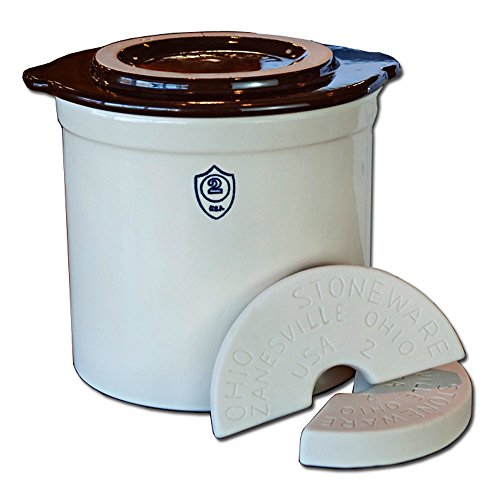
Nearly every crock ships with a pair of fitted ceramic weights, and their job is essential: they hold the shredded vegetables down under the brine, which is exactly where fermentation stays safe and mold stays away. The weights work. The complaint, and it is the loudest one in the whole category, is about what happens to them between batches.
The stones that come standard are usually unglazed, which makes them porous, which means they hold moisture and grow mold if you store them wrong. Owner after owner reports the same thing, and some of it is permanent:
Yeah that’s what I do. But between ferments I left them in the crock with the lid on for a few weeks and when I checked again they had a fuzzy coat that would put Huggy Bear to shame (even though I ran them through the dishwasher and cleaned the crock). I just boiled them for a few minutes to kill it but they’re now permanently stained red from the mold.
The cause is almost always storing them wet and sealed inside the crock, and the fix that experienced owners converge on is simple and worth following to the letter:
Ive bought 2 crocks, one from etsy, much smaller, a larger one from a manufacturer. Both have unglazed weights, after the first batch in the large one, I left the weights in the crock. I had mold. I boiled them like another, stopped leaving them in the crock. I bought the second crock from etsy, the creator has strict instructions to NOT leave the weights in the crock when not fermenting. You want them to have lots of air and be dry. DO NOT LEAVE WEIGHTS IN THE CROCK WHEN NOT FERMENTING
Cleaning them asks for a light touch too, because their porous surface can pick up whatever you wash them in. The routine owners trust avoids soap:
The stones are porous and you might not notice it but using soap could affect the flavor. I either throw mine in boiling water or in the oven to clean them if it's been a while in between uses.
The practical takeaways are three: keep the weights submerged the entire time a batch is fermenting, dry them fully and store them out of the crock, and if the included stones give you trouble, glass weights are a cheap, non-porous swap that will not stain or hold mold. The included stones are a starting point, not necessarily the ones you will keep using.
Ceramic quality and lead safety, read carefully
Two real concerns live under the glaze, and both deserve a careful, non-alarmist answer. The first is simple durability. A share of crocks arrive with glaze flaws or develop crazing, the fine cracking of the glaze that lets brine seep through, and owners are right to take a cracked glaze seriously:
no. The fact that this is on the outside means the inside enamel is cracked too. Enamel is glass. Glass in food is no bueno.
A crock with cracks that reach the ceramic is one to return or replace, not to nurse along, and experienced fermenters say so plainly when they see salt weeping through a glaze:
Salt leaking through no doubt. I’d recommend a better crock.
The worry is not squeamishness. A cracked or crazed surface gives microbes somewhere to hide that a wipe-down cannot reach, which is why the standard advice is to reject a damaged crock rather than trust it:
I’d return it. The crock is going to be containing microbes and you dont want nasty things living in the cracks.
On lead specifically, be precise about what can and cannot be claimed here. A well-made, food-grade glazed stoneware crock fired to a high enough temperature is the established vessel for fermenting, and a healthy ferment is an acidic environment where good microbes crowd bad ones out. What no listing in front of us proves is a lab lead test, so the responsible move is to buy from a maker who states a food-safe glaze, favor glazed over bare earthenware for the surfaces that touch food, and when you improvise a weight, choose glass or a lead-free-glazed plate rather than an unknown piece of pottery. One community answer captures the improviser's version of that caution:
I was just looking at fermentation crocks last night! I found this: http://www.culturesforhealth.com/natural-fermentation/fermentation-crocks.html . The site also offers advice on work-arounds. When you find crocks at auctions or antique shops, they usually come without the weights, because they often broke. They are more likely to be dropped evidently. Most people recommend finding a plate (glass or ceramic with lead-free glaze) that is nearly the same diameter of the crock and weighing it down with a glass jar filled with water. If you do a Google image search for "fermenting crocks As I understand it, the goal is to keep everything submerged under the brine. Best of luck.
Where to actually buy one
A crock is heavy, which quietly shapes where it makes sense to buy. Shipping a stoneware pot is not cheap, and a crock that cracks in transit is a genuine risk, so buying one is partly a logistics problem, not just a product choice. One shopper sums up the friction:
I'm eyeballing that crock so hard. Shipping is expensive! Did you have a local place that sold them? The Ace Hardware near me sells Ohio Stoneware crocks, but not the water-locking one.
There are three reasonable routes. Buying a well-packed crock online, from Amazon or a stoneware maker direct, is the most convenient and gets a heavy object to your door, though it is worth reading recent reviews for cracked-on-arrival reports before you commit. A local hardware store or kitchen shop lets you inspect the glaze in person and skip shipping damage entirely, but the water-locking versions are harder to find on a shelf than plain open crocks. And secondhand crocks turn up in antique shops and thrift stores at real bargains, with the catch that the weights are often missing or broken and you will need to supply your own. Whichever route you take, inspect the glaze the day it arrives and run water in the moat before you trust it with a batch.
Cleaning and storage: these are heavy
The last thing to make peace with before buying is the sheer physical fact of a crock. A full one is a two-person lift, and even empty it is an awkward, bulky object that does not tuck into a cabinet the way a stack of jars does. Most owners give a crock a permanent home on the floor or a low shelf and work from there rather than hauling it around the kitchen. If your kitchen has no such spot to spare, that alone is a reason to size down or to stay with jars.
Cleaning is the standing chore, and it is inherent to the water-seal design rather than a flaw in any one crock. The moat and the crevice where the seal meets the wall trap residue, so plan on a hot-water-and-vinegar wipe into those channels after each batch. It is not hard, but it is not nothing, and it is the tax you pay for the hands-off weeks the water seal buys you. Weigh that against a mason jar, which you can simply run through a dishwasher, and the tradeoff is clear: a crock trades easy cleanup for big-batch, walk-away fermenting.
So which crock should you buy?
Start from your batch size, not the photos. For most households the answer is a glazed, water-seal stoneware crock in the two to four liter range with weights included, which handles a head or two of cabbage and stores without dominating the room. Size up to two gallons or more only if you are putting up a season at once and have the floor space to keep a heavy pot filled and working.
Buy it glazed, inspect the glaze the day it arrives, and treat the included ceramic weights as a starting point you may swap for glass. Keep the moat topped up, keep the weights submerged while fermenting and dry between batches, and a good crock will outlast you. And if after all this you are fermenting a quart at a time, skip the crock entirely: a mason-jar kit is cheaper, lighter, and easier, and it makes kraut every bit as good.
For the full case on jars versus crocks, our guide to fermentation kits for beginners walks the decision in more depth, and if you land on the jar route, our roundup of the best mason jar fermentation lids covers the airlock lids worth buying. For deep dives on the two crocks recommended below, see our full reviews of the Humble House Sauerkrock and the TOMO Fermentation Crock.
Recommended
Products related to this guide.


What owners say
Real owner reports from the threads and editorial sources we drew on for this guide.
“if you’d like to ferment pickles, follow this recipe. I followed this for four summers (last year my cuke seedlings failed; this year I’m just growing tomatoes). the important factors: invest in a good crock and stones. mason jars and ported caps are silly (imo). stones are crucial to keep everything below the top of the brine, and both ceramic stones and crock are easy to clean after you bottle the finished pickles up and put them in the fridge. refrigeration stops the fermentation. I ordered a 5-gallon Ohio Stoneware crock and stones at my local Ace Hardware. F Amazon. use the recommended 5% brine. that’s 190g pickling salt : 1-gallon fresh clean water. the math is easy to scale. find a source for grape leaves. you can use oak leaves in a pinch. there are other high-tannin plants, but we have wild (edible) grapes growing on the back fence. wash them before you layer them in with a shit ton of cracked garlic cloves (dozen+) and fresh dill. the tannins in the grape leaves keep the pickles crisp. if kahm yeast starts to scum on top, skim it right away. it’s harmless but it can impart an off flavor. with summer temps what they are and assuming your house is hot like ours, pickles are ready in about a week, and you can generally outpace yeast bloom in a hot kitchen. AMA. submitted by /u/tehsecretgoldfish [link] [comments]”
— r/fermentation / u/tehsecretgoldfish
“Story time. I have a 10L Gartopf crock. A couple years ago I shredded up 7-8 cabbages, salted, and got them all (water) sealed into the crock. A month goes by, I keep the water well filled, I think to myself, "I should have a taste!" Nope, next month.. This continues for 6-7 months. At this point I'm nervous about opening the crock because I can anticipate the STANK!!!!.. I keep the water well filled, but am actively putting off opening the thing and fearing being overcome with stank, and passing out. A little over the 12 month mark, I decide that today's the day. I absorb the water out of the trough with a sponge, take the lid off carefully and all I can smell is sweet, sweet sauerkraut. Granted, my place is super hot in the Summer while I'm at work, and cold in the Winter. I jarred up about 10 Mason jars of it and gave it to friends at work, and it was DELICIOUS!!!!!!!”
— r/fermentation / u/SilenceSeven
“I'm eyeballing that crock so hard. Shipping is expensive! Did you have a local place that sold them? The Ace Hardware near me sells Ohio Stoneware crocks, but not the water-locking one.”
— r/fermentation / u/IamNotPersephone
“I have a crock similar to this but I've been wondering if its moat is maybe just decorative. It holds just enough water to go above the holes in the lid and a tad more. I tried it and it evaporates to below the hole line in only one day, so it would have to be refilled every day. Is this normal or not? The "holes" are just two places where the lid rides up a bit to allow more air. I'm not even sure why they exist, since it seems to be begging for gnats to fly inside. Seems like gas would escape just fine without them, and the moat would be more functional. Link: https://www.everten.com.au/schmitt-fermentation-crock-pott-5l-white.html”
— r/fermentation / u/Skitzette
“Looks great, OP! How many cabbages did you use? I inherited a 4 gallon crock and have never been able to get it to the top. I think the most I've used was 4-5 medium-ish cabbages.”
— r/fermentation / u/Hereforthekitkits
“What color did you get? Mine is red and I love the vintage feel! Also low key regret not getting the largest size”
— r/fermentation / u/Jackie_Lang_UCD
“This one came from stonewareoutlet.com this kit is $69 and they have a 1 gallon kit for $55 (USD). Amazon apparently sells these kits too but there have been reviews of them coming cracked. If you want water sealed then there is a 2 and 3 gallon kit. You can get the crock, lid, and weights separately in 1, 2, 3, 4, 5, and 10 gallon sizes.”
— r/fermentation / u/geoslim21
“A 5 liter crock for 25 bucks is frugal as long as you use it, from one tightwad to another.”
— r/fermentation / u/jason_abacabb
“The stones are porous and you might not notice it but using soap could affect the flavor. I either throw mine in boiling water or in the oven to clean them if it's been a while in between uses.”
— r/fermentation / u/jmoney927
“I was just looking at fermentation crocks last night! I found this: http://www.culturesforhealth.com/natural-fermentation/fermentation-crocks.html . The site also offers advice on work-arounds. When you find crocks at auctions or antique shops, they usually come without the weights, because they often broke. They are more likely to be dropped evidently. Most people recommend finding a plate (glass or ceramic with lead-free glaze) that is nearly the same diameter of the crock and weighing it down with a glass jar filled with water. If you do a Google image search for "fermenting crocks As I understand it, the goal is to keep everything submerged under the brine. Best of luck.”
— r/fermentation / u/home_ec_dropout
“Yeah that’s what I do. But between ferments I left them in the crock with the lid on for a few weeks and when I checked again they had a fuzzy coat that would put Huggy Bear to shame (even though I ran them through the dishwasher and cleaned the crock). I just boiled them for a few minutes to kill it but they’re now permanently stained red from the mold.”
— r/fermentation / u/ColdPorridge
“Ive bought 2 crocks, one from etsy, much smaller, a larger one from a manufacturer. Both have unglazed weights, after the first batch in the large one, I left the weights in the crock. I had mold. I boiled them like another, stopped leaving them in the crock. I bought the second crock from etsy, the creator has strict instructions to NOT leave the weights in the crock when not fermenting. You want them to have lots of air and be dry. DO NOT LEAVE WEIGHTS IN THE CROCK WHEN NOT FERMENTING”
— r/fermentation / u/Delengowski