Best Meat Grinder for Sausage Making (2026)
By Theo Marchetti · Updated October 2026
Independent editorial guide. We never accept payment for coverage, though we may earn a commission if you purchase through our links.
Quick Take
For sausage making, buy a dedicated electric grinder sized to your batches, not a stand-mixer attachment. The LEM BigBite #8 is the safe overall pick: a half-horsepower motor and a true #8 head grind pork shoulder and venison faster than you can feed them, and it is the machine serious hobbyists in r/Charcuterie keep naming. Match the size to your volume, keep every part cold, and grind first, then stuff with a dedicated stuffer.
The size number is most of the decision. A #8 handles a home cook doing 5-25 pounds at a sitting, a #12 steps up for regular 25-50 pound sessions and light game processing, and a #22 or larger is for people breaking down whole deer. The stand-mixer attachment still grinds clean meat fine for a pound or two, but it bogs down on volume and makes a poor stuffer, which is why nearly every experienced maker splits the job: grind on the grinder, stuff on the stuffer.
Here is what sausage making actually asks of a grinder, the size chart in plain English, and the four machines we would put on your bench for the job. See picks ↓

Search "best meat grinder for sausage making" and most of what turns up is a listicle ranking machines nobody in the results has run a batch through. The people who actually make sausage every season argue in a different place, the hunting and charcuterie threads, and they argue about two things above all: what size grinder to buy, and whether the stand-mixer attachment already in the cupboard is good enough.
A clear pattern runs through those threads. Sausage is a volume job, not a two-ounce job. It wants a grinder sized to the batches you make, parts cold enough that the fat stays firm instead of smearing, and a workflow that separates grinding from stuffing so the meat gets packed tight with no air pockets. The reward for getting all three right is a grinder that mostly disappears into the background, which is exactly what you want.
So this is not a spec-sheet beauty contest. It is about what turning pork shoulder and venison into links actually demands, why the famous KitchenAid attachment takes so much heat from people doing real volume, and which four machines cover the job from a stand-mixer owner making a pound at a time to a hunter grinding fifty.
What sausage making asks of a grinder that burgers do not
Grinding a pound of beef for burgers is easy. Sausage is different because it is a volume habit and a cold-chain discipline at the same time. People who have been at it a while describe outgrowing their first tool fast, usually the stand-mixer attachment, and wanting something built to last:
The KitchenAid grinder attachment just isn't going to cut it anymore, and I want something that's going to last a lifetime. I've been making fresh and smoked sausages for years, and I'm about to try my hand at cold smoking and dry curing.
That is the recurring arc: start on the attachment, hit its ceiling, move to a dedicated grinder, and never look back. The jump in capability is not subtle:
I have a 3/4 HP Big Bite. It's light years better than a KitchenAid attachment. But, if I had to do it again, I would probably take a chance on the Cabela's one.
A real grinder buys three things the attachment cannot: a motor that keeps grinding when you feed it fast, a wider throat and auger that swallow larger chunks, and metal parts heavy enough to hold a chill. The rest of this guide is how to size that grinder, keep it cold, and pair it with a stuffer.
Grinder size decoded: what #8, #12, and #22 actually mean
The number on a grinder is not the horsepower, it is the diameter of the grinding plate and the throat, and it is the single most useful spec for matching a machine to your batches. A bigger number means a wider plate, a larger feed opening, and more meat per minute. People who make sausage regularly tend to point new buyers at a #12 as the do-everything size:
you want a manual hand cranked grinder? Go for a #12 size then. Get whatever is cheapest, as they are all built like tanks that should last a lifetime. I have a manual LEM.
A #8 is the standard home size, and it is plenty for most makers. Owners who process game on a half-horse #8 describe it shrugging off everything they feed it:
I have a 1/2 hp #8 and it eats anything, it has processed dozens of deer and hundreds of pounds of beef and pork. I will buy a 3/4 if this one ever dies
Step up to a #12 and the batch size climbs without the machine straining. One owner runs sizeable sessions on a three-quarter-horse #12 and still has headroom:
I have a LEM bigbite #12. It is 3/4 horse. It does more than anything I need. Yesterday, I did 14 pounds of sausage really quickly. I have had it for years and never had a problem. The most I have ever done at one time was 70 pounds. I also have the dualgrind adapter that I like a lot.
In plain English, here is how the common sizes map to real kitchens:
- #5 and smaller: occasional cook making a pound or two of fresh sausage. This is the stand-mixer-attachment lane.
- #8: the standard home size. Comfortable for 5-25 pounds at a sitting and light game, which covers most hobby sausage makers. Our top pick sits in this class.
- #12: the do-everything upgrade. Handles regular 25-50 pound sessions and heavier game processing without straining, and it is the size veterans most often tell newcomers to buy if the budget allows.
- #22 and larger: serious volume. For people breaking down whole deer or hogs every season, or running a small operation.
Buy for the batches you actually make, and if you are between sizes, the people who do this a lot lean toward going up rather than down. A bigger grinder loafing along under its limit runs cooler and lasts longer than a small one you push to the edge every session, and the extra throat size means less pre-cutting of your meat before it goes in.
Why a dedicated grinder beats the stand-mixer attachment for volume
The KitchenAid grinder attachment is the most common starting point in these threads, and the verdict is split along a clear line: it is a decent grinder for small amounts and a frustrating one for real volume. As a grinder alone, owners rate it fairly:
As a grinder, the kitchen aid works quite well and produces very nice ground meat. As a stuffer it's barely usable.
The catch is throughput. It is happy at a pound or two and struggles past that:
If you already have a Kitchen Aid, the grinder is a pretty inexpensive addition and it makes pretty decent small batches of sausage. I use it all the time, but I only make 2 - 3 pounds of sausage at a time.
Push it harder and the affection wears off. Owners who moved to dedicated machines are blunt about the gap:
I use a Pro 6 too, I liked it when I first started this hobby. Compared to dedicated grinders the KA just seems like a toy.
There is also a safety wrinkle for anyone curing. Dry-cured sausage has to be stuffed tightly with no air pockets, and the attachment is a weak stuffer, so experienced makers steer dry-curers toward a proper grinder and a proper stuffer:
The Kitchen Aid Attachment is not too bad at grinding meat. It is not the best for stuffing sausage. If you are making dry-cured sausages (salami/saucisson/chorizo/soppresatta/pepperoni) this attachment might not be great. These dry cures need to be stuffed properly to ensure safety.
None of this makes the attachment useless, and we recommend a good metal one below for exactly the people it suits: stand-mixer owners making a pound or two of fresh sausage who do not want another appliance on the counter. It is simply not the tool for volume.
Keep everything cold: the rule that makes or breaks a grind
Ask why a grind comes out as smeared paste instead of clean, distinct particles and the answer is almost always temperature. Warm fat smears, cold fat cuts. The makers who never have this problem treat cold as a checklist, chilling the meat and freezing the metal parts before they start:
I've never tried that one. I keep the grinding parts in the freezer until ready to use and chill the cut meat to about 40* before even thinking of grinding.
A metal grinder earns its keep over an all-plastic one for exactly this reason: you can put the auger, blade, and plate in the freezer and they hold that chill through the grind. It is also an argument for working in batches sized to your grinder, so the meat spends less time out of the fridge. A common trick is to cut the meat into strips, spread them on a sheet pan, and freeze them until firm but not solid, so they feed cleanly and the fat never has a chance to warm and smear.
Cold meat, cold parts, and a sharp blade seated tight against the plate are the three things that separate a clean grind from a mushy one, and none of them cost anything. If a grind ever comes out pasty midway through a session, the usual culprits are a warm room and meat that has been sitting out too long, so it is worth chilling the next batch and even the ground meat before you move on to stuffing.
Grind first, then stuff: the two-step workflow
The most common mistake new makers make is trying to grind and stuff in one pass through the grinder. Almost everyone who does volume separates the two steps: grind the seasoned meat, then load it into a dedicated stuffer that pushes it into casings tight and air-free. Owners describe the dedicated stuffer as the upgrade that changed the hobby:
I am a very casual sausage maker/hunter. I process just about what you’re looking to do. I upgraded from a Kitchenaid to a LEM #8 (.50 hp) and could not be happier. I also bought a dedicated sausage stuffer in that was a game changer. I bought a 5 pound sausage stuffer and I wish I would’ve gone with something twice the size.
Even people who own a capable grinder that can technically stuff still reach for a separate stuffer:
we needed to upgrade and bought the LEM #12 big bite grinder. It works awesome. Definitely get the foot pedal too. Having both hands free to work with is a huge plus. I used the LEM grinder for stuffing which works but I would recommend their stuffer if you have the money.
That is why our companion coverage lives in two dedicated reviews rather than in this guide. Once the meat is ground, a stuffer like the one in our LEM sausage stuffer review does the packing far better than any grinder, and for jerky and snack sticks a jerky cannon handles the extrusion. Grind on the grinder, stuff on the stuffer, and each tool does the one job it is good at.
How our four picks compare for sausage making
All four picks below grind sausage meat well. They differ in size, motor, and who they are for.
The LEM BigBite #8 is the overall pick. A half-horsepower motor and a true #8 head handle the batches most home makers run, the stainless build takes a freezer chill, and it is the name that comes up again and again for people getting serious. Owners who size up to the #12 in the same BigBite line are just as happy, which tells you the platform holds up:
Hard to beat the LEM bigbite #12. I've had one for 5 years and tell recommend it to friends.
The STX Turboforce 3000 is the value play. It is a size #12 at a fraction of what a commercial #12 costs, and it ships with multiple plates, blades, and stuffing tubes, so it is a lot of grinder per dollar for someone who wants #12 capacity without the premium price. Owner discussion of it is thin next to the LEM, so we recommend it on specs and value, but the accounts that do exist are positive on it as a solid low-to-mid range machine:
I bought a stc-3000 TF a couple of weeks ago and I love it so far. Only have about 40 pounds of meat through it, so can't speak to its longevity, but it seems built pretty solid for a low-mid range grinder. It's definitely a huge step up from the kitchenaide plastic one I was using before.
The LEM #8 Countertop is the budget way into the LEM line. It is a lighter 575-watt aluminum machine rather than the commercial-grade BigBite, but it is a genuine #8 from the brand hobbyists trust, and it is the right call for someone who wants a real dedicated grinder without the BigBite outlay.
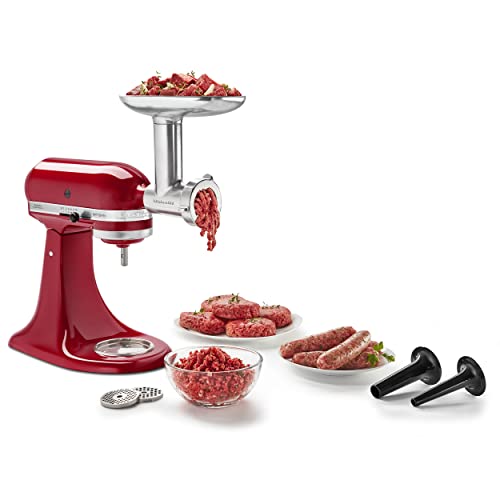
The KitchenAid Metal Food Grinder Attachment is for people who already own the mixer and make small fresh-sausage batches. The metal version matters here: unlike the plastic one, you can freeze it to keep the grind cold, and owners find it grinds clean meat well within its limits:
I have this and love it. Everything but the blade can be washed/sterilized in the dishwasher. The motor on my Pro 600 series mixer is more than powerful enough for my grinding needs with this attachment. I use a dedicated stuffer so no comment on that aspect.
Be honest with yourself about volume when you choose. If you regularly make more than a few pounds, or you cure, the attachment will frustrate you and a dedicated grinder will not.
Which grinder for your batch size
For most sausage makers, get the LEM BigBite #8. It has the motor and the #8 capacity for real batches, it takes a chill, and it is the machine the experienced crowd keeps recommending. If you want #12 capacity on a tighter budget, the STX Turboforce 3000 gives you the bigger size for far less, with the tradeoff of a lighter-duty build and a thinner track record. If you want into the LEM line for less, the #8 Countertop is the budget entry. And if you already own a KitchenAid and only make a pound or two of fresh sausage at a time, the metal grinder attachment is all you need.
Whichever you choose, remember the parts the machine cannot do for you: match the size to your batches, freeze the parts and chill the meat before every grind, and stuff with a dedicated stuffer rather than the grinder. Do that and the grinder becomes the easy part of sausage day.
Recommended
Products related to this guide.


What owners say
Real owner reports from the threads and editorial sources we drew on for this guide.
“The KitchenAid grinder attachment just isn't going to cut it anymore, and I want something that's going to last a lifetime. I've been making fresh and smoked sausages for years, and I'm about to try my hand at cold smoking and dry curing.”
— r/Charcuterie / u/thesuperspy
“I have a 3/4 HP Big Bite. It's light years better than a KitchenAid attachment. But, if I had to do it again, I would probably take a chance on the Cabela's one.”
— r/Charcuterie / u/acuity_consulting
“you want a manual hand cranked grinder? Go for a #12 size then. Get whatever is cheapest, as they are all built like tanks that should last a lifetime. I have a manual LEM.”
— r/Charcuterie / u/SnoDragon
“I have a 1/2 hp #8 and it eats anything, it has processed dozens of deer and hundreds of pounds of beef and pork. I will buy a 3/4 if this one ever dies”
— r/Charcuterie / u/dharbolt
“I have a LEM bigbite #12. It is 3/4 horse. It does more than anything I need. Yesterday, I did 14 pounds of sausage really quickly. I have had it for years and never had a problem. The most I have ever done at one time was 70 pounds. I also have the dualgrind adapter that I like a lot.”
— r/Charcuterie / u/Ansio-79
“As a grinder, the kitchen aid works quite well and produces very nice ground meat. As a stuffer it's barely usable.”
— r/Charcuterie / u/chrismtb
“If you already have a Kitchen Aid, the grinder is a pretty inexpensive addition and it makes pretty decent small batches of sausage. I use it all the time, but I only make 2 - 3 pounds of sausage at a time.”
— r/Charcuterie / u/vmsmith
“I use a Pro 6 too, I liked it when I first started this hobby. Compared to dedicated grinders the KA just seems like a toy.”
— r/Charcuterie / u/Hamsterdam
“The Kitchen Aid Attachment is not too bad at grinding meat. It is not the best for stuffing sausage. If you are making dry-cured sausages (salami/saucisson/chorizo/soppresatta/pepperoni) this attachment might not be great. These dry cures need to be stuffed properly to ensure safety.”
— r/Charcuterie / u/Mathieu_Berurier
“I've never tried that one. I keep the grinding parts in the freezer until ready to use and chill the cut meat to about 40* before even thinking of grinding.”
— r/Charcuterie / u/BornAgainNewsTroll
“I am a very casual sausage maker/hunter. I process just about what you’re looking to do. I upgraded from a Kitchenaid to a LEM #8 (.50 hp) and could not be happier. I also bought a dedicated sausage stuffer in that was a game changer. I bought a 5 pound sausage stuffer and I wish I would’ve gone with something twice the size.”
— r/Charcuterie / u/advantagegrant
“we needed to upgrade and bought the LEM #12 big bite grinder. It works awesome. Definitely get the foot pedal too. Having both hands free to work with is a huge plus. I used the LEM grinder for stuffing which works but I would recommend their stuffer if you have the money.”
— r/Charcuterie / u/majewskitj