Hoosier Hill Farm
Prague Powder #1 Curing Salt Review (2026)
By Theo Marchetti · Updated September 2026
Independent editorial review. We never accept payment for coverage, though we may earn a commission if you purchase through our links.
Verdict
r/Charcuterie handles this product with more rigor than almost anything else the forums discuss, and the good answers are genuinely good: that cure #1 is roughly 6.25 percent sodium nitrite in salt, that it cannot stand in for the salt in a recipe, that the dilution exists to make home measuring feasible, and that volumetric measuring should give way to grams. The threads also self-correct well, with people catching each other's overdoses and doing the ppm arithmetic in public. Where we part company is the wet-brine convention. The most technically confident commenters calculate the dose across the whole system, meat plus water, and while that is defensible for a sealed equilibrium bag, it is not the basis regulators use, and applied to a 1:1 brine it doubles the figure on the meat itself. The same threads also repeat 200 ppm as the bacon limit when pumped and immersion bacon is held to 120. Our read is that this is a community worth learning from on technique and worth double-checking on numbers.
Read full take ↓Similar curing kits
Curing salt is the cheapest thing in a charcuterie setup and the only one that can hurt you. A pound of Prague Powder #1 costs less than a decent cut of pork belly, lasts years, and is the difference between bacon and smoked roasted belly. It is also sodium nitrite, and the entire safety of the product rests on it being diluted to roughly one part in sixteen.
The product itself is close to unimprovable: a commodity powder that does exactly one job. What earns a review is everything around it. The arithmetic for how much to use trips up more people than the product ever will, the published rate and the metric rate answer different questions, and the most technically confident advice in the hobby forums uses a basis that regulators do not. We will be specific about where that goes wrong.
What is actually in the bag
Prague Powder #1, also sold as Insta Cure #1, pink cure, or simply cure #1, is mostly table salt with a small, carefully measured fraction of sodium nitrite. The proportion is the whole design:
It says it is 6.25% sodium nitrite right on the bottle. That's exactly what Prague #1 is. It's not nitrate, it's nitrite: 15 (or 16) parts salt, 1 part sodium nitrite, which makes it easier to measure (either using volume or weight). That comes out to about 1 tsp per 5 lbs of meat, which a lot of folks still use.
That is right, and the one correction is worth making because it affects your dosing: 6.25 percent is typical, not universal. At least one reputable supplier sells cure #1 at 6.75 percent nitrite, which shifts every calculation below by about eight percent. Read the percentage on the bag you actually bought rather than assuming the standard figure. A second commenter puts the practical consequence plainly:
It's actually mostly NaCl, usually around 6% nitrite. But yes, you need to add more normal salt to make your food salty enough.
The dilution is a safety feature rather than a cost saving, and it is why a home cook can handle this at all:
The adulterated versions are good for home curing since it makes the quantities easier to measure
On the color: manufacturers dye it pink so it cannot be mistaken for table salt. That is a manufacturer convention, not a legal requirement, and the dye itself is in flux, since the FDA revoked the food authorization for one of the traditional pink colorants in 2025 and some suppliers have already moved to a plant-based alternative. Do not use color as a way to identify what is in an unlabeled container.
Cure #1 is not the salt in your recipe
This is the single most common beginner error and it runs in both directions. The question comes up constantly, and the answer in the threads is correct:
Prague powder has a small amount of salt, but you use so little that it can't replace salt. Use both as directed. Your prague powder should say how much to use by weight, it is a very small amount.
Put numbers on it. A level teaspoon of cure #1 weighs roughly six grams, of which about 94 percent is salt, so it contributes something like a quarter of one percent salt to five pounds of meat. Curing practice puts a finished product somewhere in the range of two to three percent salt for taste and preservation. Cure #1 is supplying under a tenth of what the recipe needs.
So the two failure modes are symmetrical and both are serious. Treat cure #1 as your salt and the product is drastically under-salted, losing the salt contribution to preservation. Scale cure #1 up until the food tastes properly salty and you have overdosed nitrite by roughly ten times. Weigh your salt and your cure separately, as two different ingredients with two different jobs.
The dosing arithmetic, and where the forums get it wrong
Here is the part that justifies a review rather than a product page. There are two common ways to calculate a dose, they answer different questions, and mixing them up is how people end up over the limit.
The published rate. One level teaspoon of cure #1 per five pounds of meat, or one ounce per twenty-five pounds. That is the manufacturer and extension figure, and it targets about 156 parts per million of nitrite. Worth knowing its tolerance: a teaspoon of this powder can weigh anywhere from roughly 4.5 to 6.5 grams depending on grind and packing, which swings the result from about 124 ppm to about 179 ppm. The rate is sound; the spoon is the imprecise part.
The metric rate. 0.25 percent of the meat weight, which lands on 156 ppm exactly, since 0.25 percent multiplied by 6.25 percent is 156 parts per million. For a dry equilibrium cure this is the cleaner method and the one we would use.
Now the problem. In wet brining, the most confident answers in the forums tell you to calculate on the whole system, meat plus water:
When equilibrium brining it’s the mass of the system, not of just the water or just the meat. So 2kg meat plus 2kg water would use the same amount of salt as 500g meat in 3.5kg water, for example. Your 18g PP1 in a 4.5kg system results in a 0.4% pp1 concentration which is 250ppm nitrite (0.004 x 0.0625 = 0.00025), recommended to stay below 200pm.
The amount of meat doesn’t matter, what does matter is the total mass you have including water and all. You should be shooting for 0.25% league powder if I remember correctly or about 150-200PPM of sodium nitrite.
The internal arithmetic in those comments is correct, and the instinct behind it is reasonable: in a sealed bag at true equilibrium, the nitrite distributes through everything. But it is not the basis regulators use. USDA computes ingoing nitrite on the weight of the meat block, not the total formulation, and the gap is not small. Take one kilogram of meat in one kilogram of brine and dose 0.25 percent of the combined two kilograms: that is five grams of cure, which is 156 ppm of the system but 312 ppm on the meat, above every ceiling except dry curing. Even a modest thirty percent brine lands you around 200 ppm.
So our position is to dose on meat weight and follow a tested recipe for wet cures rather than a rule of thumb, and to treat the total-system method as a hobbyist convention that happens to work in a sealed bag rather than as a limit you are meeting. Here are the figures the limits are actually set at.
| Product type | Maximum ingoing nitrite | Note |
|---|---|---|
| Comminuted (sausage, ground) | 156 ppm | What the 0.25% rate targets |
| Pumped or massaged, except bacon | 200 ppm | Immersion cures sit here |
| Bacon, pumped or immersion | 120 ppm | Lower than most people assume |
| Bacon, dry cured | 200 ppm | The only bacon figure that is 200 |
| Dry cured products | 625 ppm | Highest ceiling, dry application only |
Note the bacon line, because it is the one most commonly misquoted, including in the threads we read. Pumped and immersion-cured bacon is held to 120 ppm, not 200. The 200 figure applies only to dry-cured bacon. If you make bacon, you are working to the tightest limit of the lot.
Do you need a gram scale?
Our answer is yes, and for a more modest reason than the internet usually gives. The published position from food preservation extension is that the premix exists precisely so home cooks do not need an analytical balance, which is a fair point and the reason the teaspoon rate is published at all. Volumetric measuring of a 6.25 percent premix is imprecise rather than dangerous, landing you somewhere in that 124 to 179 ppm band.
A scale reading to a tenth of a gram costs about the same as two bags of cure and removes that variance entirely, which is worth it when the whole point of the product is a controlled dose. The place where weighing stops being optional is if you ever handle pure sodium nitrite rather than a premix, where the margin for a volumetric error is gone.
Cure #1 or cure #2, and never the wrong one
Cure #1 is for anything that will be cooked, smoked hot, or refrigerated, which covers bacon, sausage, pastrami, and jerky. Cure #2 adds sodium nitrate, which acts as a slow reservoir that converts to nitrite over weeks, and it is for long dry-cured products that are never cooked, such as salami, coppa, and pancetta.
Substituting one for the other is not a minor swap in either direction. Cure #1 in a months-long dry cure runs out of protection partway through. Cure #2 in anything fried or cooked is worse: nitrate is barred outright from bacon, and heating nitrate-cured product is the pathway regulators specifically limit. Availability pushes people toward the substitution, which is why it is worth naming:
#1 is available and cheap, around $10-$20/lb, but #2 is either out of stock or $80-$300+/100g (3.5oz)
That scarcity is real and it is regional. It is not a reason to reach for #1 instead. And a caution on the #2 label specifically: the nitrate percentage is not standardized. Verified figures from reputable suppliers run from one percent to over three and a half, so a recipe's gram figure for #2 assumes a particular product. Read your bag.
The safety points that actually matter at home
Keep it labeled, separate, and out of reach. This is the one with documented cases behind it rather than a theoretical risk. A published case describes a four-year-old who drank a glass of water in which roughly half a teaspoon of a parent's home sausage cure had been dissolved, and was cyanotic within two hours. She recovered. A separate mass poisoning of five adults traced to a bag of pure sodium nitrite labeled as table salt. Store it in its own labeled container, nowhere near the salt cellar.
The dilution is your margin. An acutely lethal dose of sodium nitrite for an adult is on the order of a couple of grams, which corresponds to something like forty grams of cure #1, or seven teaspoons. You are not going to reach that by over-scooping into a batch of sausage, and it is worth saying so plainly rather than leaving people frightened of a product they are using correctly. You could reach it easily with pure nitrite, which is the argument for buying the premix.
Pink curing salt is not Himalayan pink salt. They look similar, they are sold in similar places, and they are not remotely the same thing. Himalayan salt contains no nitrite at all, so a recipe run with it produces a salt-only cure with no protection against the organism the cure exists to control.
Nitrites are not permitted in foods for babies, juniors, or toddlers. That is a regulatory prohibition, and a reasonable line for a home kitchen to hold as well.
The "uncured" alternative is not what the label suggests
Worth addressing because the label does real work to mislead you. Products sold as uncured or naturally cured with celery juice powder are not nitrite-free. Vegetable juice powders can carry nitrite in the percent range, which is to say comparable in kind to what you are dosing deliberately, and the crucial difference is that the amount is not controlled the way a premix is.
So the natural route gives you nitrite without a known dose, and the evidence for its effectiveness at inhibiting the relevant organisms is weaker than for a measured cure. Our read is that the honest choice for home curing is the labeled 6.25 percent premix, used at a known rate, over an unlabeled dose from a vegetable source with better branding.
On the cancer question
Readers deserve a straight answer rather than either reassurance or alarm. Processed meat is classified by the World Health Organization's cancer agency in its highest evidence category, and the widely quoted figure is that fifty grams a day is associated with about an eighteen percent higher relative risk of colorectal cancer.
Two precisions matter. That classification ranks how strong the evidence is that something causes cancer, not how large the risk is, and it applies to processed meat as a food category rather than to sodium nitrite as an additive. And curing at home does not exempt the result: your bacon is processed meat by that definition. The reasonable conclusion is the one the WHO itself reaches, which is moderation rather than abstinence, and not the conclusion that switching to a celery-powder cure solves it.
Why bother at all, then? Because the alternative is not the same food:
Bacon without nitrate is just smoked roasted belly, it does not feel like bacon.
One case where the usual rate does not apply
A question from the threads that deserves a direct answer, since it is a genuine edge case:
Is using the normal calculations for assessing the amount of curing salt fine here despite there not being any real curing time?
Short answer: the standard calculation assumes the cure has time to distribute through the meat. A rub applied shortly before cooking has not cured anything, so you get the flavor and color contribution without the preservation, and a long low-temperature cook on an uncured product is the scenario the cure is normally there to cover. If a recipe uses cure #1 as a seasoning in a short preparation, follow that recipe's figure rather than scaling a curing calculation, and do not treat the result as a cured product.
For working out a specific batch, our curing salt calculator does the arithmetic on meat weight, and the guide to building a curing chamber covers what happens after the cure goes on.
Buy it, then learn the arithmetic
There is no meaningful quality difference between reputable bags of cure #1, so buy on price and on a clearly printed percentage. What separates a good outcome from a bad one is entirely in how you use it: weigh rather than scoop, dose on meat weight, keep your salt as a separate ingredient, and use a tested recipe for wet cures instead of a forum rule of thumb.
We would not start curing without it. We also would not start without a scale that reads to a tenth of a gram and a labeled container that lives nowhere near the table salt.
Our Ratings
Overall score
It does exactly what it exists to do, and the design is the clever part: diluting sodium nitrite to roughly one part in sixteen turns a substance no home cook should be measuring neat into something you can dose with a spoon. It delivers the color, the flavor, and the botulinum control that define cured meat, and there is no home substitute that does the same job. The one deduction is that the percentage is not universal across brands, so the figure printed on your bag, not the assumed 6.25, is the one your arithmetic depends on.
As a product it is close to indestructible. Kept dry and sealed it does not meaningfully degrade, a one-pound bag outlasts years of hobby curing, and there is nothing to break. What costs it points is consistency of labeling rather than of the powder: cure #1 is typically 6.25 percent nitrite but is sold at 6.75 by at least one reputable supplier, and cure #2's nitrate fraction ranges from one percent to over three and a half depending on brand. For a product whose entire function is a controlled dose, that variance has to be read off the bag every time.
The weakest axis by a distance, and not because of the price, which is trivial. Using it correctly demands arithmetic that the product does nothing to help with, and the most confident guidance circulating in the hobby gets the basis wrong by calculating on meat plus brine rather than on the meat block, which can double the ingoing figure. The teaspoon rate carries a wide tolerance, the limits differ by product type in ways people misquote, and the salt-versus-cure confusion catches nearly every beginner. It is cheap to buy and expensive to get wrong.
Prague Powder #1 Curing Salt on Amazon.
What People Are Saying
25 percent sodium nitrite in salt, that it cannot stand in for the salt in a recipe, that the dilution exists to make home measuring feasible, and that volumetric measuring should give way to grams. The threads also self-correct well, with people catching each other's overdoses and doing the ppm arithmetic in public. Where we part company is the wet-brine convention.
The most technically confident commenters calculate the dose across the whole system, meat plus water, and while that is defensible for a sealed equilibrium bag, it is not the basis regulators use, and applied to a 1:1 brine it doubles the figure on the meat itself. The same threads also repeat 200 ppm as the bacon limit when pumped and immersion bacon is held to 120. Our read is that this is a community worth learning from on technique and worth double-checking on numbers.
We weight candid owner reports from Reddit and preservation forums above brand-influenced editorial coverage, then reach our own verdict from them. The quotes below are the evidence; the rating and the take are ours.
What Reddit Is Saying
“The adulterated versions are good for home curing since it makes the quantities easier to measure”View thread →
“Bacon without nitrate is just smoked roasted belly, it does not feel like bacon.”View thread →
“It says it is 6.25% sodium nitrite right on the bottle. That's exactly what Prague #1 is. It's not nitrate, it's nitrite: 15 (or 16) parts salt, 1 part sodium nitrite, which makes it easier to measure (either using volume or weight). That comes out to about 1 tsp per 5 lbs of meat, which a lot of folks still use.”View thread →
“It's actually mostly NaCl, usually around 6% nitrite. But yes, you need to add more normal salt to make your food salty enough.”View thread →
“Prague powder has a small amount of salt, but you use so little that it can't replace salt. Use both as directed. Your prague powder should say how much to use by weight, it is a very small amount.”View thread →
“The amount of meat doesn’t matter, what does matter is the total mass you have including water and all. You should be shooting for 0.25% league powder if I remember correctly or about 150-200PPM of sodium nitrite.”View thread →
“Is using the normal calculations for assessing the amount of curing salt fine here despite there not being any real curing time?”View thread →
“When equilibrium brining it’s the mass of the system, not of just the water or just the meat. So 2kg meat plus 2kg water would use the same amount of salt as 500g meat in 3.5kg water, for example. Your 18g PP1 in a 4.5kg system results in a 0.4% pp1 concentration which is 250ppm nitrite (0.004 x 0.0625 = 0.00025), recommended to stay below 200pm.”View thread →
“#1 is available and cheap, around $10-$20/lb, but #2 is either out of stock or $80-$300+/100g (3.5oz)”View thread →
Frequently asked questions
Is the Hoosier Hill Farm Prague Powder #1 Curing Salt worth it?
The weakest axis by a distance, and not because of the price, which is trivial. Using it correctly demands arithmetic that the product does nothing to help with, and the most confident guidance circulating in the hobby gets the basis wrong by calculating on meat plus brine rather than on the meat block, which can double the ingoing figure. The teaspoon rate carries a wide tolerance, the limits differ by product type in ways people misquote, and the salt-versus-cure confusion catches nearly every beginner.
How is the Hoosier Hill Farm Prague Powder #1 Curing Salt built?
As a product it is close to indestructible. Kept dry and sealed it does not meaningfully degrade, a one-pound bag outlasts years of hobby curing, and there is nothing to break. 75 by at least one reputable supplier, and cure #2's nitrate fraction ranges from one percent to over three and a half depending on brand.
What is the Hoosier Hill Farm Prague Powder #1 Curing Salt best suited for?
It does exactly what it exists to do, and the design is the clever part: diluting sodium nitrite to roughly one part in sixteen turns a substance no home cook should be measuring neat into something you can dose with a spoon. It delivers the color, the flavor, and the botulinum control that define cured meat, and there is no home substitute that does the same job. 25, is the one your arithmetic depends on.
What do real owners say about the Hoosier Hill Farm Prague Powder #1 Curing Salt?
25 percent sodium nitrite in salt, that it cannot stand in for the salt in a recipe, that the dilution exists to make home measuring feasible, and that volumetric measuring should give way to grams. The threads also self-correct well, with people catching each other's overdoses and doing the ppm arithmetic in public. Where we part company is the wet-brine convention.
Options Worth Checking Out
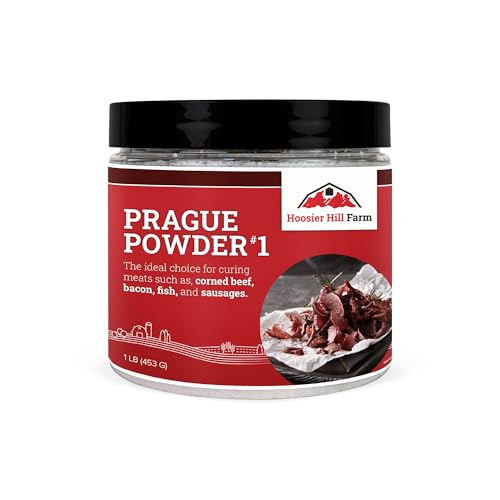
Hoosier Hill Farm Prague Powder No. 1, 1 lb
The standard bag, and a pound is years of hobby curing. Buy on a clearly printed nitrite percentage rather than brand loyalty, since that figure is what every dose calculation depends on. Decant nothing: keep it in the labeled bag it arrived in.

Digital Pocket Scale, 200g x 0.01g
The accessory that makes the cure predictable. A teaspoon of this powder can vary enough to swing the result by fifty parts per million, which a tenth-gram scale removes entirely. Costs about what two bags of cure do and comes with a calibration weight.
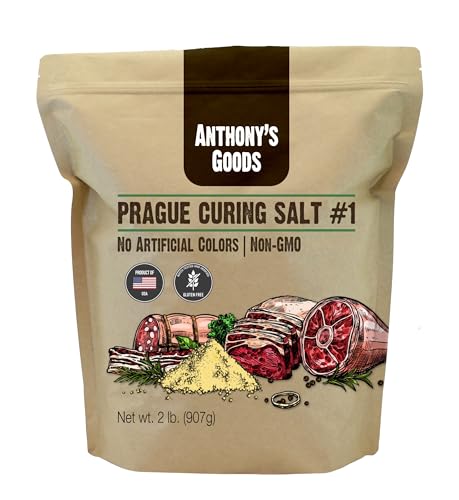
Anthony's Prague Curing Salt No. 1, 2 lb
The same chemistry in a larger bag, worth it only if you cure often enough to work through two pounds. Check its stated percentage against whatever recipe you are following, as cure #1 is not sold at one universal strength.
You Might Also Need
Accessories worth grabbing alongside your purchase
