LEM
LEM Sausage Stuffer Reviews (2026)
By Theo Marchetti · Updated October 2026
Independent editorial review. We never accept payment for coverage, though we may earn a commission if you purchase through our links.

Verdict
Home charcuterie makers are broadly happy with the LEM 5 lb, and the praise lands in the same three places: steel gears instead of plastic, a piston that fills casings evenly under real pressure, and a build that lasts, with owners reporting five and ten year units and hundreds of pounds stuffed. It is what experienced makers point beginners toward once they outgrow a grinder attachment or a jerky cannon. The gripes are ergonomic, not structural. The base walks on the counter as the cylinder empties so people clamp it, meat hangs up in the elbow every batch, and plenty of owners swap the plastic tubes for stainless. A minority cross-shop a heavier rival for stability. Almost nobody questions how it fills or how long it lasts, and neither would we.
Read full take ↓Similar curing kits
If you make your own sausage, salami, or summer sausage, there is a point where the grinder attachment stops being good enough and you start looking at a dedicated stuffer. The LEM MightyBite 5 lb Vertical Sausage Stuffer is the machine most home charcuterie makers land on when they cross that line. It is a vertical piston stuffer: you pack ground, seasoned meat into a stainless cylinder, crank a plunger down, and it pushes the mix through a horn and into the casing in one steady column instead of smearing it the way an auger does.
Owners like it for the reasons that matter in this craft: steel gears instead of plastic, a stable base, two crank speeds, and a fill that is fast and even once you find the rhythm. The knocks are real too. It costs more than a bargain stuffer, it can walk across the counter when the cylinder is nearly empty, there is a short learning curve around air pockets, and a bit of meat always hangs up in the elbow. We wrote this for someone about to fill casings in their own kitchen, not someone comparing spec sheets.
The short version
The LEM is a well-built, widely liked machine with two or three ergonomic quirks you should know about before the meat is already ground.
What's good:
- Steel gears rather than the plastic ones on cheaper stuffers, so the crank does not strip or slip under load.
- A piston that builds real pressure and fills casings in one even column, which is the whole reason to own a dedicated stuffer.
- Two crank speeds, so you can back the plunger out fast to refill and stuff slow for control.
- A reputation for lasting: owners report five and ten year units still going, some with hundreds of pounds through them.
What's not:
- It can lift or slide on the counter as the cylinder empties, so most people clamp or brace it, often a two-hand job.
- There is a learning curve to working air pockets out of the casing before they turn into blowouts.
- A slug of meat always stays behind in the elbow where the horn meets the cylinder, and you dig it out by hand.
- It costs more than a basic stuffer, which stings if you only make sausage once or twice a year.
Who it's for
How often you make sausage matters more here than how much you make. Once a month and the LEM pays for itself. Once a year and it is an expensive way to fill two dozen brats.
Buy it for:
- Regular batches of fresh, smoked, or cured sausage, from brats and Italian links to snack sticks and summer sausage.
- Anyone stepping up from a grinder stuffer or a jerky cannon who is tired of smeared texture and tiny loads.
- A maker who wants a stuffer that will still be here in ten years and does not mind paying once to get there.
Skip it if:
- You stuff big communal batches and split them; the Hakka 7 lb gives you more cylinder per crank for a similar spend.
- You only make sausage occasionally and want the lowest way in; the MASTER FENG stainless stuffer covers the basics for less.
- You already run high volume and want a complete outfit; the larger LEM stuffing kit bundles horns and a bigger canister in one box.
The specs that matter
Read the cylinder size first, then the gears. Those two decide more about your evening than the price does.
Five pound cylinder capacity: that is roughly one grind-and-season session for a household, enough for a couple dozen brats or a batch of snack sticks before you back out the plunger and reload. It is not a bulk canister, and makers who stuff fifteen or twenty pounds at a sitting refill it a few times per run.
Steel gears and two crank speeds: the metal gear train is the durability story in one detail, since the plastic gears on cheaper units are the part that strips first. Two speeds let you crank the piston back up quickly to refill, then drop to the slow, controlled speed for the actual fill so casings do not tear.
Stainless cylinder and base with a piston plunger: the piston is what separates this from a grinder. It pushes the farce through the horn as a solid, even column instead of an auger smearing it, which is what keeps the texture of a good sausage intact and the fill consistent from the first link to the last.
How well it preserves
One question decides a stuffer: does it push meat into the casing evenly, under enough pressure, without wrecking the grind. The LEM's piston does. That alone is why experienced makers keep steering beginners off grinder attachments and combo grinder stuffers.
I've got 2 lems staffers, yes definitely stay away from a grinder/stuffe
That holds across everything you would actually make: fresh brats, Italian sausage, smoked snack sticks, cured salami. Steady plunger pressure means the casing fills in one continuous column, so you control diameter and work at a pace you can keep up with. Owners who came from a jerky cannon or a stand-mixer attachment describe it as going from a fight to a process. Volume is not the issue either. One owner is hundreds of pounds past where a lesser machine would have quit.
I can't speak for the others, but I have that model LEM stuffer and I love it. Have probably put about 300lbs of meat through it with no issues.
The limits are about the cylinder, not the fill. Five pounds is a household batch, so real volume means reloading mid session. And you learn to work air pockets out of the casing yourself, before they turn into blowouts; the machine will not do that part for you. On the actual job of moving meat into a casing, nothing near this size and price does it cleaner.
Built to last
People buy the LEM for the gear train. On cheaper stuffers those gears are plastic, and they are the first thing to strip or slip once you are cranking against a full casing. Owners who did their homework picked this machine for the metal ones and said so.
LEM 5Lb stuffers have steel gears. LEM Stuffers I specifically sought out the LEM for the steel gears. The ones sold at Gander Mtn and Cabellas have plastic (nylon) gears. Grizzly is another brand. Academy Sports has a steel gear version but it looks like cheap and non-stainless. You cant go wrong with the LEM.
Nobody is replacing these every couple of seasons. Ten-year-old units still filling casings turn up in thread after thread.
I’ve had my 5# LEM for close to ten years. Still going strong.
The one footnote is small parts, not the machine. The stuffing horn attaches with a collar, and at least one owner lost that collar mid batch and could not run the stuffer until it turned up. Keep the small pieces in one bin between sessions. That is a storage gripe, not a breakage report. Ask whether the gears, cylinder, and piston survive years of real use and the answer from owners is a flat yes, which is why durability is the strongest score on this page.
Living with it
Stability is the first thing you notice, and it is why ease of use scores lowest on a machine people otherwise praise. As the cylinder empties, cranking force can lift the base or walk it across the counter, so most people clamp it down or recruit a second set of hands. Manageable. Also real, and one owner who ran both formats found a heavier rival steadier.
Agreeing with others here, avoid a stuffer with an auger, it ruins the texture of the meat. I prefer the Weston 7lb (Amazon US) after also owning the LEM-5. It is way more stable and much better to use. I also prefer the stainless steel tubes to the plastic that came with my LEM. You do get a little of your mix left in the deep elbow where the filling tube connects, but I just push that through with the handle of a wooden spoon. I am also a big fan of my LEM grinder. (#5 Big Bite) Check FB Marketplace or eBay for deals, I got my grinder this way, it had been used twice and I paid less than 1/3 of retail.
That same comment names the quirk every vertical piston stuffer shares: a slug of meat stays behind in the elbow where the horn meets the cylinder. Dig it out by hand, push it through with a wooden spoon handle, or just fry it as a patty. A few ounces per batch. Not a dealbreaker, but a tax you pay every single time. Owners also flag the plastic stuffing tubes as the piece most worth swapping for stainless if you run it hard.
Braced, though, it is a pleasant machine. Simple to load, simple to run, easy to clean, and stout enough that owners press it into jobs LEM never advertised.
Same. It’s a perfectly great machine. I have even used it to press apples for cider!
Nothing here is broken. You will clamp it, you will learn the air-pocket rhythm, and you will scrape the elbow. Expect those three habits and the rest takes care of itself.
How it compares
The same handful of stuffers turn up alongside the LEM in every thread.
Versus the Hakka 7 lb Stuffer: the Hakka is the popular value alternative and the one most often mentioned in the same breath. It gives you a larger cylinder for a similar outlay, so it is the pick if your batches run big or you split them with friends. The LEM's edge is its steel-gear reputation and a smaller footprint that stores easier.
Versus the MASTER FENG stainless stuffer: this is the budget floor. It is the cheapest way to get a real vertical piston stuffer on the counter, and it will fill casings, but you are trusting a lighter build and lesser support. It makes sense for someone testing whether sausage making sticks before committing to a LEM.
Versus other well-known stuffers generally: owners who have run the LEM next to Hakka and VIVO units tend to say all three will make you sausage, and the choice comes down to gears, stability, and price rather than a night-and-day gap in the fill.
I have the LEM one and it's great. That being said, I believe that you would be happy with the other 2 that you linked.
Using it well
Clamp or brace the base before you start, so it does not walk as the cylinder empties. Keep the meat cold right up until you stuff, so it feeds cleanly instead of smearing. Pack the cylinder with as few trapped air gaps as you can manage, then crank slowly and work any bubbles up and out of the casing as you go, or you will find them later as blowouts on the grill or in the smoker. Save the fast speed for backing the plunger out to refill. And plan on scraping the elbow and hand-stuffing the last few ounces at the end of every batch.
If you are still deciding between capacities and brands before you buy, it helps to see the LEM next to the other machines in the category. You can browse our curing and smoking reviews to weigh it against the other stuffers and meat-prep gear we have tested.
Where we land on the LEM stuffer
This is the stuffer we would buy for what most home sausage makers actually do: regular batches of fresh, smoked, and cured sausage, filled evenly, on a machine that will still be here a decade from now. Steel gears, a proper piston fill, and a real longevity record separate a stuffer you keep from one you replace, and the LEM has all three.
Ease of use is the only thing holding the score down. You will clamp or brace it, you will learn to work air pockets out of the casing, and you will scrape meat out of the elbow every batch. None of that is a defect. It is what a stout vertical piston stuffer at this size costs you in habits. Accept the three, and the LEM earns its bench space.
Our Ratings
Overall score
The piston builds real pressure and pushes the farce into the casing as one even column instead of an auger smearing it, so the grind stays intact and the fill holds from the first link to the last. Owners run brats, snack sticks, and salami through it, some hundreds of pounds' worth, without the machine struggling. The only limit is the five pound cylinder, which means reloading on big batches. That is a capacity issue, not a fill issue.
This is the reason people buy a LEM at all. Its gear train is steel where cheaper stuffers use plastic, and plastic gears are the exact part that strips first under load. Owners report five and ten year units still filling casings, some with hundreds of pounds through them. The only footnote is losing a small part like the horn collar, which is about where you store things rather than how the machine holds up.
Ease of use is where the LEM gives ground, fairly. The base can lift or walk across the counter as the cylinder empties, so most owners clamp or brace it, often a two-hand job. Working air pockets out of the casing before they turn into blowouts takes practice. A slug of meat always stays behind in the elbow to scrape or hand-stuff. None of that is breakage, just three habits you pick up, and plenty of owners swap the plastic tubes for stainless while they are at it.
LEM Sausage Stuffer Reviews (2026) on Amazon.
What People Are Saying
Home charcuterie makers are broadly happy with the LEM 5 lb, and the praise lands in the same three places: steel gears instead of plastic, a piston that fills casings evenly under real pressure, and a build that lasts, with owners reporting five and ten year units and hundreds of pounds stuffed. It is what experienced makers point beginners toward once they outgrow a grinder attachment or a jerky cannon. The gripes are ergonomic, not structural.
The base walks on the counter as the cylinder empties so people clamp it, meat hangs up in the elbow every batch, and plenty of owners swap the plastic tubes for stainless. A minority cross-shop a heavier rival for stability. Almost nobody questions how it fills or how long it lasts, and neither would we.
We weight candid owner reports from Reddit and preservation forums above brand-influenced editorial coverage, then reach our own verdict from them. The quotes below are the evidence; the rating and the take are ours.
What Reddit Is Saying
“I’ve had my 5# LEM for close to ten years. Still going strong.”View thread →
“Same. It’s a perfectly great machine. I have even used it to press apples for cider!”View thread →
“I've got 2 lems staffers, yes definitely stay away from a grinder/stuffe”View thread →
“I can't speak for the others, but I have that model LEM stuffer and I love it. Have probably put about 300lbs of meat through it with no issues.”View thread →
“I have the LEM one and it's great. That being said, I believe that you would be happy with the other 2 that you linked.”View thread →
“LEM 5Lb stuffers have steel gears. LEM Stuffers I specifically sought out the LEM for the steel gears. The ones sold at Gander Mtn and Cabellas have plastic (nylon) gears. Grizzly is another brand. Academy Sports has a steel gear version but it looks like cheap and non-stainless. You cant go wrong with the LEM.”View thread →
“I had great success with a jerky cannon for a long time before I got my 5lb stuffer. The cannon is a great affordable entry to sausage stuffing, but can only do 1.5 lb of meat before needing reloaded. If the $200 price tag doesn't scare you, look at haka or if you want a smaller profile and a rear crank (as opposed to a side crank), look at the lem 5lb or the sausage maker 5 lb. Both have steel gears and work great.”View thread →
“Agreeing with others here, avoid a stuffer with an auger, it ruins the texture of the meat. I prefer the Weston 7lb (Amazon US) after also owning the LEM-5. It is way more stable and much better to use. I also prefer the stainless steel tubes to the plastic that came with my LEM. You do get a little of your mix left in the deep elbow where the filling tube connects, but I just push that through with the handle of a wooden spoon. I am also a big fan of my LEM grinder. (#5 Big Bite) Check FB Marketplace or eBay for deals, I got my grinder this way, it had been used twice and I paid less than 1/3 of retail.”View thread →
“LEM. 5lbs. I can't answer anymore do to rage. Just made 15 lbs of sausage meat. Can't find the collar that attaches the stuffing tube to the upright stuffing column. Driving to a Bass Pro Shop tomorrow morning to buy what will be a "back up" $160 stuffer. I'm sorry this doesn't really help you. I need to scream into the void.”View thread →
Frequently asked questions
Is the LEM Sausage Stuffer worth it?
Ease of use is where the LEM gives ground, fairly. The base can lift or walk across the counter as the cylinder empties, so most owners clamp or brace it, often a two-hand job. Working air pockets out of the casing before they turn into blowouts takes practice.
How is the LEM Sausage Stuffer built?
This is the reason people buy a LEM at all. Its gear train is steel where cheaper stuffers use plastic, and plastic gears are the exact part that strips first under load. Owners report five and ten year units still filling casings, some with hundreds of pounds through them.
What is the LEM Sausage Stuffer best suited for?
The piston builds real pressure and pushes the farce into the casing as one even column instead of an auger smearing it, so the grind stays intact and the fill holds from the first link to the last. Owners run brats, snack sticks, and salami through it, some hundreds of pounds' worth, without the machine struggling. The only limit is the five pound cylinder, which means reloading on big batches.
What do real owners say about the LEM Sausage Stuffer?
Home charcuterie makers are broadly happy with the LEM 5 lb, and the praise lands in the same three places: steel gears instead of plastic, a piston that fills casings evenly under real pressure, and a build that lasts, with owners reporting five and ten year units and hundreds of pounds stuffed. It is what experienced makers point beginners toward once they outgrow a grinder attachment or a jerky cannon. The gripes are ergonomic, not structural.
Options Worth Checking Out
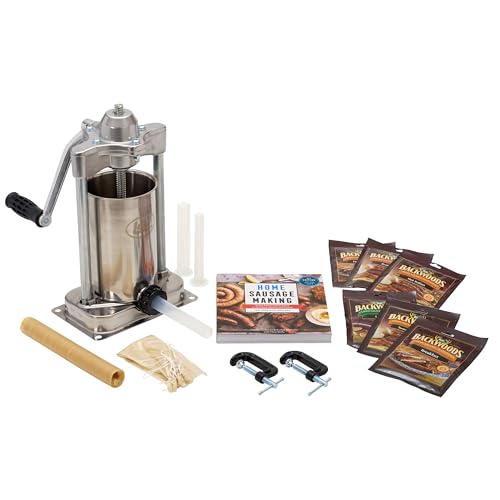
LEM Products Sausage Stuffing Starter Kit
Step up to the complete LEM outfit when you know sausage making is sticking. It bundles a larger stuffer with horns and the extras a bare 5 lb unit leaves you to buy piecemeal, so you are ready for bigger, more frequent batches out of one box.

Hakka 7 lb Vertical Sausage Stuffer, Stainless Steel
The popular value cross-shop. Two extra pounds of cylinder for a spend close to the LEM's, so it fits bigger batches or splitting with friends. Owners who ran both call the fill comparable; you trade the LEM's gear name for more room per crank.

MASTER FENG Stainless Steel Vertical Sausage Stuffer
The cheapest real vertical piston stuffer here, and the way in for someone testing whether home sausage making sticks. It fills casings the same one-column way the LEM does; you accept a lighter build and thinner support for the lower outlay.
You Might Also Need
Accessories worth grabbing alongside your purchase

