Is That Mold or Kahm Yeast? And Can You Eat It? (2026)
By June Park · Updated October 2026
Independent editorial guide. We never accept payment for coverage, though we may earn a commission if you purchase through our links.
Quick Take
Judge it by texture, not color. A flat, milky film with no fuzz and no round patches is most likely kahm yeast, which Illinois Extension calls safe. Anything fuzzy, velvety, or growing in raised circles is mold. Color will not settle it: UC Davis publishes a photo of white mold on sauerkraut, and USDA lists mold as white, blue, black, or green.
On whether you can skim it and carry on, the authorities disagree outright, and we are not going to pretend otherwise. USDA's own fermented pickle directions tell you to remove surface scum or mold promptly and keep going. UC Davis says confirmed mold means discard the batch. We land closer to USDA for a thin surface film caught early, and we discard on any of the triggers below.
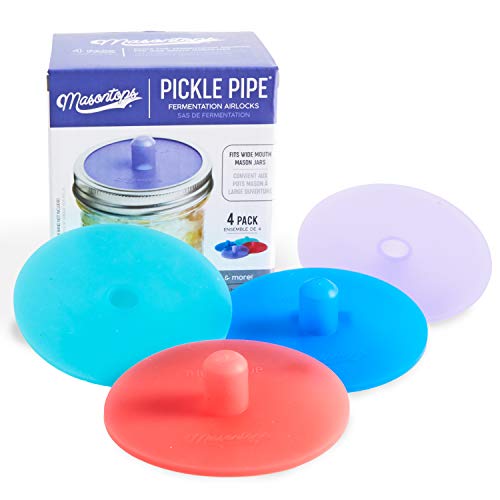
To stop it happening again, see picks for the weights and airlock lids that keep food under brine and air out.

Nearly every ferment grows something on top eventually, and the panic is always the same: is this the normal thing everybody says is fine, or the thing that means I throw away three weeks of work?
The honest answer has three parts. Telling them apart is usually possible and occasionally is not. What to do about mold is contested among people who are qualified to have an opinion. And the reason most often given for scooping it off is wrong, even when the advice itself is reasonable.
Texture tells you. Color does not.
The usable test is what the growth is made of, not what shade it is. Kahm yeast lies flat on the brine as a thin milky skin. It is not attached to itself, which gives you a physical test one commenter describes better than any diagram:
"You can’t pick up kahm with your fingers, it’s not a connected structure, just a bunch of scum floating on top." - u/kriegeeer
Mold is structured. It stands up off the surface, it is fuzzy or velvety, and it tends to grow in round colonies rather than an even sheet. Another owner draws the line the same way, by texture:
"Mold, Kahn yeast is more like a white transparent web, this is a blue fluffy coat" - u/Snoo_68687
Now the part most guides get wrong. Do not use color as the test. UC Davis Food Science publishes a photograph captioned as white mold growth on sauerkraut, and USDA's own spoilage guidance describes mold as white, blue, black, or green. Pink is worse still: UC Davis files pink films under normal yeast, while a University of California Master Food Preserver handout lists pink as a mold color. So a white film is not cleared by being white, and a tinted one is not condemned by having a tint.
Sometimes people simply call it wrong in both directions, which is worth seeing:
"Why would you even call this kham? 1000% mold. Kham is yeast." - u/LearningMan
And one more wrinkle for anyone fermenting vinegar or kombucha rather than vegetables: a firm, rubbery, coherent layer is probably not kahm at all.
"People on this sub very consistently misunderstand the cause/role of fermentation pellicles." - u/Brettanospicy
If you cannot decide after the texture test, treat it as mold. That is the cheap error.
Can you skim it off? The authorities disagree
This is the question everyone actually arrives with, and the reason it generates endless argument is that the published guidance is genuinely split. Both of these are real positions from real institutions:
- USDA, in its own directions for fermented dill pickles, says to check the container several times a week and promptly remove surface scum or mold, and that finished pickles keep four to six months refrigerated provided surface scum and molds are removed regularly.
- Ohio State University Extension has a section on exactly this question. Its short answer is to remove the molded portion and use the rest of the product.
- Oregon State University Extension splits it by quantity: small mold patches may be skimmed off, but large amounts require discarding.
- UC Davis Food Science says that if you confirm mold growth on any part of a ferment, it should be immediately discarded.
- Colorado State University Extension, writing about kimchi, says to discard if you observe indications of surface mold.
Our own read of the threads finds the community split along the same line, which is reassuring in a way. One camp skims:
"That's mold but I would just scoop it out. Then wipe some vinegar on the inside of the jar at the top. And if the ferment was still active I would keep it. Mold can't grow underwater." - u/bekarsrisen
The other does not negotiate:
"I would not listen to any comments saying it might be safe to eat, the blue parts especially worry me, toss it for sure" - u/orphanmeatman
Where we land: for a thin surface film caught early, follow USDA and Ohio State. Skim it generously with a clean spoon, get everything back under the brine, and watch it. For anything on the discard list below, stop. And if you are pregnant, elderly, feeding small children, or immunocompromised, take the UC Davis line and discard, because Ohio State specifically flags that group.
What we will not do is tell you this is settled. An article that picks one institution and calls it the experts is hiding the thing you most need to know, which is that careful people look at the same evidence and choose differently.
The cheese rule is the wrong rule here
The most common justification for skimming is an analogy to hard cheese, and it turns up in our harvest verbatim:
"Looks like kham to me which is not a big deal. Just scrape it off. Also correct on the green mold, toss that guy. Should be fine A note on mold; just like how you can cut around mold on cheese and it’s no problem, hardy and dense foods such as carrots can be isolated and removed with no issues." - u/Few_Whole7407
The instinct behind this is good and the reasoning does not hold. USDA does allow cutting mold off hard cheese, and it states why: mold generally cannot penetrate deep into the product. That is an argument about low moisture and limited diffusion. It is the opposite of a jar of vegetables sitting in brine.
Read further down the same USDA chart and the high-moisture entries are all in the discard column, including soft fruits and vegetables, where it names cucumbers directly, on the grounds that they can be contaminated below the surface. For jams and jellies the wording is blunter still: the mold could be producing a mycotoxin, and microbiologists recommend against scooping out the mold and using the remaining condiment. USDA also states plainly that molds can thrive in high-acid foods including pickles.
So the skim-and-continue advice can stand, because extension services say it about ferments specifically. The cheese comparison cannot come with it. A reader who generalizes from cheddar will apply the same logic to a moldy hot sauce ferment or a moldy jar of jam, and those are cases where USDA says discard.
One more popular claim deserves retiring. The scariest version of the opposite advice goes like this:
"unfortunately these are gone. the toxins from the mold diffuse through the whole brine." - u/AxisFlip
We could not support that for fermentation brine. The one authoritative statement about toxins diffusing through a liquid concerns beverages, it hedges itself by noting how little data exists, and the extension document that makes it declines to extend the same logic to vegetable ferments in the very same fact sheet. The caution may be reasonable. The mechanism is not established, and we are not going to invent one to win an argument.
Discard without debating it
These are the cases where the sources stop disagreeing. Any one of them and the batch goes out:
- It is slimy. USDA says discard pickles that become soft, slimy, or develop a disagreeable odor, and Oregon State says slimy kraut indicates spoilage.
- It smells putrid or just wrong. Do not taste it to check. Virginia Tech is explicit: do not taste any fermentation batch that has bad or off odors.
- There is mold on pieces sitting above the brine. Throw those pieces away rather than pushing them under.
- There is growth below the brine line or inside the jar, rather than a film on the surface.
- It is more than a thin surface film. Oregon State draws the line at large amounts.
- The pH has climbed above 4.6, if you measure it. That is the line acid-preserved food relies on.
There is also a reason to be strict that has nothing to do with eating it, and it is a fair point:
"sure a little mold won't hurt you but why introduce unnecessary amounts of spores into your kitchen, or wherever, where you have food and possibly other fermentations going on that can also get contaminated?" - u/201dberg
What actually causes it
The harvest contains three competing theories, and the useful finding is that the published guidance supports most of them while ranking them differently than hobbyists do. Taking them in order of how much authoritative weight is behind them:
Food not submerged, and air in the headspace. This carries the most support by a distance. UC Davis puts it under the heading of controlling mold growth: ensure all the ingredients stay submerged, and use weights. Ohio State notes mold grows best in the high-oxygen environment near the surface, which is why submersion limits it. Oregon State attributes white scum on kraut to insufficient weight and liquid to exclude air. One commenter had diagnosed exactly this:
"Kahm generally isn't a big deal but is indicative of improper conditions for the fermentation, and probably reflects that there is too much oxygen in the headspace." - u/Kegnaught
Not enough salt. Virginia Cooperative Extension lists low salt concentration as a cause of surface mold, and NCHFP cautions against cutting back on the salt a fermented recipe calls for. The community theory matches:
"Kahm yeast is often an indication of insufficient salt in the brine. I usually top the jar up with a 3% brine." - u/Foxcliffe
Worth knowing that salt is vegetable-specific rather than one number. Virginia Tech puts sauerkraut around 2.25 to 2.5 percent, low-salt pickles at 3 to 5, and notes cucumber fermentation wants at least 6 percent for good texture. Follow a tested recipe by weight rather than computing a percentage yourself, and use canning or pickling salt, because impurities in some natural salts can reduce the acidity of the finished product.
Moldy garlic or spices. This is the cause almost no hobbyist article mentions, and Virginia Tech lists it first, ahead of low salt. NCHFP separately names moldy garlic or spices as a cause of spoiled pickles. Virginia Tech adds that ground and flaked dried spices float to the top and may mold over time, and that older dried spices carry a higher mold load. If you keep getting surface growth in jars that are properly weighted and salted, look at the spice jar.
Fermenting too warm. Supported, but more weakly than the first three for mold specifically. Oregon State names warm conditions in its moldy kraut entry and advises fermenting below 75F. The other temperature guidance in the literature is mostly about softening rather than mold.
And one theory the sources do not support, offered by a commenter who has clearly thought about it:
"I’ve only had a little of it on top before with a hot sauce ferment. Once I skimmed it off and sprayed with alcohol it never came back. It was still a successful ferment." - u/inferno-pepper
Skimming and continuing is fine, and the alcohol spray is harmless, but do not read a single success as a method. Sanitizing the rim does not change the two variables that matter, which are whether the food is under the brine and whether there is enough salt.
Mold cannot grow under brine, and why that is only half true
This is the most repeated reassurance in fermentation, stated plainly in our harvest as part of the skimming advice above: mold cannot grow underwater. As a rule of thumb it is useful, and as an absolute it is wrong in three ways worth knowing.
Molds are aerobic, which is the half that is true, and it is exactly why submersion is the most-repeated prevention step in the published guidance. But Ohio State states it with the qualifier the folklore drops: most molds, but not all, will not grow in a low-oxygen environment. USDA adds that molds tolerate salt and sugar better than most other food invaders, and that they thrive in high-acid foods including pickles.
It also does not generalize beyond molds. Virginia Tech attributes hollow bloater pickles to yeast building up inside submerged cucumbers. NCHFP lists moldy garlic and spices as a spoilage cause, which is contamination arriving below the brine line rather than settling on top.
And the organism this ultimately matters for prefers the conditions you built on purpose. NCHFP describes Clostridium botulinum as growing in less than two percent oxygen. What holds it is not the absence of air but acid, at pH 4.6 or below. That is why surface growth is worth removing rather than tolerating: Ohio State notes some molds digest the acid and raise the pH, NCHFP says the organisms in surface scum feed on the acid and reduce its concentration, and UC Davis publishes a sauerkraut photo where the color shifted because pH rose under white mold.
Which reframes kahm yeast too. Illinois Extension calls it safe, and we will not argue with that, but safe is not the same as leave it alone. One commenter put the distinction better than the extension services did:
"I think it is just kahm yeast, but the "just" is doing some olympics-level heavy lifting there. I would absolutely not want to stir that in, but generously scoop it off with a clean spoon, and pick out those solids sticking out as well. You absolutely need something to keep the solids under the liquid." - u/KatKaleen
Pink kraut is its own thing
If your sauerkraut turns pink rather than growing anything, that is a separate documented problem and the common explanation for it is backwards.
Oregon State Extension lists pink kraut as safe unless slimy, and attributes it to yeast growth caused by excess or uneven salt distribution, or by improper coverage. Note that: excess or uneven, not too little. Most write-ups tell you to add salt, which makes the problem worse. The fix is the correct amount, mixed evenly, with the cabbage properly covered.
There is a second cause with the opposite verdict. Oregon State also notes pink can come from natural pigments in cabbage enhanced by acidity, in which case no action is needed. Virginia Tech files pink alongside brown and black as off-color kraut from spoilage organisms in an aerobic environment with brine not covering the cabbage. Safe unless slimy, and slimy is a discard.
What we would do
Judge by texture. Flat and milky, skim it generously and fix the cause. Fuzzy, raised, or in circles, work through the discard list and be honest with yourself about what you see.
Then stop fighting the symptom. Almost every case we read traces back to the same two things: food that floated above the brine, or not enough salt measured by a tested recipe. A weight that actually holds the vegetables down and a lid that lets gas out without letting air in will prevent more surface growth than any amount of skimming technique. If you are starting from scratch, our guide to mason jar fermentation lids works through the airlock options, and fermentation weights covers keeping everything submerged.
Recommended
Products related to this guide.


What owners say
Real owner reports from the threads and editorial sources we drew on for this guide.
“You can’t pick up kahm with your fingers, it’s not a connected structure, just a bunch of scum floating on top.”
— r/fermentation / u/kriegeeer
“Mold, Kahn yeast is more like a white transparent web, this is a blue fluffy coat”
— r/fermentation / u/Snoo_68687
“Why would you even call this kham? 1000% mold. Kham is yeast.”
— r/fermentation / u/LearningMan
“People on this sub very consistently misunderstand the cause/role of fermentation pellicles.”
— r/fermentation / u/Brettanospicy
“That's mold but I would just scoop it out. Then wipe some vinegar on the inside of the jar at the top. And if the ferment was still active I would keep it. Mold can't grow underwater.”
— r/fermentation / u/bekarsrisen
“I would not listen to any comments saying it might be safe to eat, the blue parts especially worry me, toss it for sure”
— r/fermentation / u/orphanmeatman
“Looks like kham to me which is not a big deal. Just scrape it off. Also correct on the green mold, toss that guy. Should be fine A note on mold; just like how you can cut around mold on cheese and it’s no problem, hardy and dense foods such as carrots can be isolated and removed with no issues.”
— r/fermentation / u/Few_Whole7407
“unfortunately these are gone. the toxins from the mold diffuse through the whole brine.”
— r/fermentation / u/AxisFlip
“sure a little mold won't hurt you but why introduce unnecessary amounts of spores into your kitchen, or wherever, where you have food and possibly other fermentations going on that can also get contaminated?”
— r/fermentation / u/201dberg
“Kahm generally isn't a big deal but is indicative of improper conditions for the fermentation, and probably reflects that there is too much oxygen in the headspace.”
— r/fermentation / u/Kegnaught
“Kahm yeast is often an indication of insufficient salt in the brine. I usually top the jar up with a 3% brine.”
— r/fermentation / u/Foxcliffe
“I’ve only had a little of it on top before with a hot sauce ferment. Once I skimmed it off and sprayed with alcohol it never came back. It was still a successful ferment.”
— r/fermentation / u/inferno-pepper