Best Food Strainer and Sauce Maker: Crank, Mill, or Electric (2026)
By June Park · Updated October 2026
Independent editorial guide. We never accept payment for coverage, though we may earn a commission if you purchase through our links.
Quick Take
For turning a late-summer glut of tomatoes and apples into sauce, most canners want a crank strainer of the Roma and Victorio pattern: clamp it to the counter, feed the hopper, and an auger presses smooth pulp through a screen while seeds and skins ride out the end. It is the fastest way to get seeds and skins out of a big harvest without blanching or hand-peeling, and one screen swap takes it from passata to applesauce to salsa base.
Two other tools earn a place. A hand-crank food mill is cheaper, simpler, and better for small batches and silky applesauce, but it asks you to cook the fruit first and does not scale to bushels. Going electric removes the crank entirely and is worth it if you process by the case, but the catch is that most affordable electric options are built to grind rather than gently separate. Which one is right comes down to your volume, your counter, and your shoulders.
Here is the crank strainer, the food mill, and the electric upgrade we would buy for this harvest season, and who each one is for. See picks ↓

It is the last stretch of summer, the tomato plants are ahead of you, and someone just handed you two more grocery bags of them. This is the week people go looking for a food strainer or sauce maker, right about when they realize peeling and seeding a bushel by hand is a lost weekend. The trouble is that the search results are either love letters to one specific machine or thin listicles that never explain how the machines differ.
They differ in one important way: how they get the seeds and skins out. A crank strainer drives food against a cone screen with an auger and ejects the waste out the end, so you can pour in cooked or even raw tomatoes and catch clean pulp underneath. A food mill presses cooked fruit through a flat perforated disc while the waste stays behind in the bowl. An electric unit does the strainer's job under a motor. Same goal, three very different amounts of money, muscle, and counter space.
This guide sorts the decision by the things that change your day: how much you are putting up, whether you want to touch a crank, what fruit you are running, and how much cleanup you will tolerate. Owner reports from canning threads run underneath each call, because the people who process bushels every fall are blunt about what these tools can and cannot do.
Three tools, one job: strainer, mill, or electric
Every option here exists to do the same thing: separate the seeds and skins from the good pulp so you are left with sauce instead of a pot of chunks. The reason there are three answers is that people arrive with very different volumes and very different tolerance for effort.
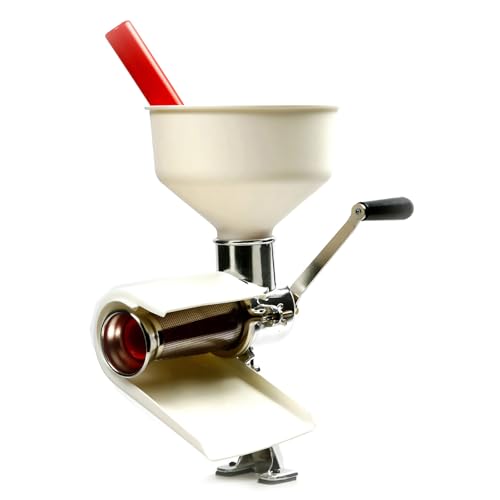
The crank strainer (the Roma, Victorio, and Norpro Sauce Master pattern) is the tool most people settle on for garden-scale canning. An auger pushes soft food through a screen and spits skins and seeds out the end, so it never clogs the way a colander does and it handles a lot of produce fast.
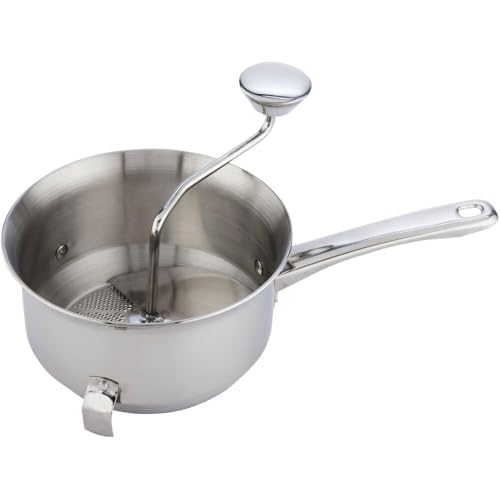
The food mill is a hand-crank bowl: a curved paddle presses cooked fruit through a disc while the waste stays in the bowl. It is cheaper, simpler, stores in a drawer, and shines on small batches and applesauce, but it will not keep up with a bushel and it needs the fruit softened first.
The electric strainer runs the crank-strainer design under a motor. It is the answer for high volume, but it costs the most and takes a real footprint, and owners are candid that the cheapest motorized options tend to grind everything instead of gently separating.
The crank strainer: fastest for a big harvest
If you are putting up sauce every fall and have counter space to clamp a machine to, the crank strainer is the default recommendation, and it earns it on speed. You feed the hopper, turn the handle, and smooth pulp pours out one spout while dry seeds and skins exit the other. First-time owners tend to be startled by how much easier it makes sauce day:
It's my first year with an actual sauce master and it's changed the game entirely. I've been getting by with an immersion blender and the world's dinkiest food mill for the last 5 years. I should have bought the food mill in the first place! Perfect texture applesauce, easiest prep, works for tomatoes as well!
The big time-saver is that you do not have to blanch and peel first. Many owners run tomatoes in raw and let the machine do the separating, which cuts a whole step out of the process:
Foley would be ok for small batches, it's what my mom used and still does, but for anything very large I will use this every time. You don't even have to cook the tomatoes first, just run em through raw and seeds & skins are separated. If you clean it right away it's not bad.
At real volume the difference is dramatic. Canners who used to spread tomato day across an entire weekend describe finishing in a single session once they moved to a strainer, especially with a motor added:
the Tomato machine for berry jams, tomato products, apple things... best canning tool I ever purchased (+16 yrs ago). I later bought the motor and use it every year. With the traditional style mill (OXO) tomatoes used to take 3 days - now we're finished after a single (long) day!
For a fuller read on the pattern-defining machine, including where the plastic build gives owners pause, see our review of the Roma food strainer. It is the one most people cross-shop first, and it is our top pick below for a reason.
The food mill: simpler for small batches and applesauce
Not everyone needs a clamp-on machine, and for smaller kitchens the hand-crank food mill is often the smarter, cheaper buy. It breaks down to a few pieces, stores in a drawer, and gives you fine control over texture, which is why applesauce lovers reach for it. The tradeoff is that it wants the fruit cooked soft before it will mill cleanly:
It is easy enough if you've cooked the tomatoes or apples or berries first. Doesn't work well on raw fruits.
What owners like is how little there is to go wrong. There is no auger to jam, no clamp to slip, and nothing to plug in, so cleanup and storage barely register:
my favorite is still the crank foley mill (looks sort of like a saucepan with crank in the middle). It's simple to use, efficient, easy to clean, no complicated assembly, no leaks from worn or improperly inserted gaskets, practically no wear down of parts over time.
It is also fine enough for jobs the bigger machines fumble, like seedless berry jam, and for a canner just getting started it is a low-risk way to commit to the habit:
If you are committing to canning a tomato mill is well worth the investment. Even a hand crank one. I like mine better than the attachment for the kitchen aid mixer. Also, it’s fine enough to do seedless raspberry jam…and I love that
If the mill route sounds like your speed, our Norpro food mill review walks through the discs, the labor ceiling, and where the thin stainless flexes. It is the budget pick in the list below.
When to consider going electric
The single thing every crank owner eventually complains about is the crank, so the obvious upgrade is a motor. If you process sauce by the case, or your hands and shoulders are done with an hour of hand-milling, electric is a real quality-of-life change:
You can buy an electric motor to replace the hand crank too. Worth every penny for the amount of time it saves, let alone no more hand cranking.
For most home canners it is not an either-or. A crank strainer that accepts a bolt-on motor lets you start manual and add power later, once your volume justifies it:
Very easy to manually crank but the motor is nice if you're making several batches over a couple days
Go in with clear eyes, though, because electric is where the marketing outruns the reality. Owners repeatedly warn that the affordable motorized units are built to grind, not to gently separate, which is the wrong behavior for a clean puree:
Unfortunately the only electric mills on the market are more of the grinding variety. I use the hand crank food mill to process apples into sauce because I don't then have to go to the trouble of peeling apples I just quarter them and clean out any worm damage. The mill is gentle enough to separate most of the skins and few seeds that make it past the cutting process.
The same caution applies to running a stand-mixer attachment as your electric solution: it is fine for a few pounds, but it is not built for volume and will overheat if you push it:
The Kitchenaid mill can only be ran about 10 minutes at a time before your Kitchenaid starts to get uncomfortably hot. If you’re only doing a few pounds at a time, this is not a problem, sally forth and continue. If not, you’ll likely find yourself regretting the purchase.
The takeaway: if you process at high volume, buy a purpose-built electric strainer rather than the cheapest motorized gadget. The Weston Deluxe Electric in the picks below runs the same proven auger-and-screen design under a motor, which is the version worth paying for.
Screens, attachments, and the grape problem
Part of why the crank strainer pattern wins is that a single machine changes jobs by swapping the screen. The standard cone handles tomato sauce and applesauce, and manufacturers sell berry, pumpkin, and salsa screens that widen or narrow the holes for different produce. That versatility is real, but it comes with a rule owners learn the hard way: match the screen and the spiral to the fruit, or it jams.
Grapes are the classic trap. The seeds are too big and hard for a standard setup, and forcing them through grinds the pits into the puree or binds the machine:
I have a Norpro berry screen but when I try to put cooked seeded grapes through, it jams, grinding the seeds into meal. What am I doing wrong?
The fix is not more muscle, it is the right accessory. These machines have a dedicated grape spiral, shorter than the standard one, made specifically so the seeds can drop out instead of packing in:
You might want to try the accessory pack with the grape spiral. It's a little bit shorter than the spiral the machine comes with. I'm assuming that's so the seeds can fall out without jamming it up.
So before you buy, be clear about what you are running. Tomatoes, apples, and soft berries are what these machines handle best. Thick-skinned grapes, hard pits, and stone fruit need the correct screen and spiral, or a different tool entirely, which brings us to the one job all of these machines share a limit on.
Throughput, batch size, and what each tool cannot do
Be honest about your volume before you spend, because it is the number that decides everything. A food mill is perfect for a few pounds of berries or one pot of applesauce and miserable across a bushel. A crank strainer eats bushels and is overkill for a single pot. An electric strainer is built for the case-by-case canner and wasted money for the occasional cook.
There is also a hard limit worth stating plainly, because none of these machines get around it: they separate, they do not reduce. A strainer or a mill will pull the seeds and skins out of watery tomatoes and hand you thin pulp, and you still have to cook that pulp down on the stove to sauce thickness. A surprising amount of sauce-day time goes right there, at the stove, long after the straining is done.
And every tool has a fruit it should not touch. Grapes are the recurring example, and owners are emphatic that the wrong machine turns a grape batch into a mess while the right one handles it fine:
Don't use it for grapes, people. Fine time to note that steam juicers and the hand-cranked food mill are A+ for grapes. But not, I repeat NOT, the KitchenAid food mill attachment.
If you want to estimate how many jars a haul will yield before you commit a weekend to it, our canning yield calculator turns pounds of produce into finished jars, which makes it much easier to judge whether you need a mill, a strainer, or a motor.
Cleanup and living with it through the season
The tool you dread washing is the tool you stop using in September, so cleanup matters more than spec sheets suggest. The food mill wins here: it comes apart into a few pieces, rinses in the sink, and has no motor housing or clamp to fuss with. The crank strainer takes a bit more, since the screen wants a rinse mid-batch so it does not clog and the clamp needs a solid counter edge, but it still breaks down to a handful of parts.
Electric units are the most capable and the most to clean, with a motor housing to keep dry and pulp that can work into vents if you overfill. None of it is hard, but it is worth planning your station: set up over the sink or on a covered counter, keep your pulp bowl and waste bowl at the right heights so nothing splatters, and rinse screens between batches. Do that and any of these tools stays a pleasure to use all the way through apple season.
Which strainer suits your volume
Match the tool to your harvest and your patience, and the decision gets simple:
Putting up real quantities of tomato sauce, salsa, and applesauce every fall, with counter space to clamp a machine? Get the crank strainer. It is the fastest, most versatile answer for garden-scale canning, and it is the tool most owners land on.
Doing smaller batches, tight on storage, or mostly making applesauce and seedless jam? Get the hand-crank food mill. It costs less, stores small, and gives you the texture control the bigger machines do not.
Processing by the case, or done with hand-cranking for good? Step up to a purpose-built electric strainer rather than the cheapest motorized gadget, and expect to pay and store accordingly.
Whichever you choose, the straining is only half of sauce day. Tomatoes need added acid to be safe in a boiling-water bath, so if you are newer to putting up jars, start with our guide to the best water bath canner for beginners so all that saucing makes it safely onto the shelf.
Recommended
Products related to this guide.


What owners say
Real owner reports from the threads and editorial sources we drew on for this guide.
“It's my first year with an actual sauce master and it's changed the game entirely. I've been getting by with an immersion blender and the world's dinkiest food mill for the last 5 years. I should have bought the food mill in the first place! Perfect texture applesauce, easiest prep, works for tomatoes as well!”
— r/Canning / u/kjaereste914
“Foley would be ok for small batches, it's what my mom used and still does, but for anything very large I will use this every time. You don't even have to cook the tomatoes first, just run em through raw and seeds & skins are separated. If you clean it right away it's not bad.”
— r/Canning / u/Jeyne42
“the Tomato machine for berry jams, tomato products, apple things... best canning tool I ever purchased (+16 yrs ago). I later bought the motor and use it every year. With the traditional style mill (OXO) tomatoes used to take 3 days - now we're finished after a single (long) day!”
— r/Canning / u/barking_spider246
“It is easy enough if you've cooked the tomatoes or apples or berries first. Doesn't work well on raw fruits.”
— r/Canning / u/HighColdDesert
“my favorite is still the crank foley mill (looks sort of like a saucepan with crank in the middle). It's simple to use, efficient, easy to clean, no complicated assembly, no leaks from worn or improperly inserted gaskets, practically no wear down of parts over time.”
— r/Canning / u/Apprehensive-Web8176
“If you are committing to canning a tomato mill is well worth the investment. Even a hand crank one. I like mine better than the attachment for the kitchen aid mixer. Also, it’s fine enough to do seedless raspberry jam…and I love that”
— r/Canning / u/Illustrious_Award854
“You can buy an electric motor to replace the hand crank too. Worth every penny for the amount of time it saves, let alone no more hand cranking.”
— r/Canning / u/Shameel579
“Very easy to manually crank but the motor is nice if you're making several batches over a couple days”
— r/Canning / u/SirYardley
“Unfortunately the only electric mills on the market are more of the grinding variety. I use the hand crank food mill to process apples into sauce because I don't then have to go to the trouble of peeling apples I just quarter them and clean out any worm damage. The mill is gentle enough to separate most of the skins and few seeds that make it past the cutting process.”
— r/Canning / u/TedMittelstaedt
“The Kitchenaid mill can only be ran about 10 minutes at a time before your Kitchenaid starts to get uncomfortably hot. If you’re only doing a few pounds at a time, this is not a problem, sally forth and continue. If not, you’ll likely find yourself regretting the purchase.”
— r/Canning / u/mckenner1122
“I have a Norpro berry screen but when I try to put cooked seeded grapes through, it jams, grinding the seeds into meal. What am I doing wrong?”
— r/Canning / u/likes2milk
“You might want to try the accessory pack with the grape spiral. It's a little bit shorter than the spiral the machine comes with. I'm assuming that's so the seeds can fall out without jamming it up.”
— r/Canning / u/Aimer1980
Sources
Manufacturer listing for the Model 250 strainer (sold as Roma, Victorio, and Johnny Apple), checked for current specs and screen accessories · Manufacturer listing for the Norpro Stainless Steel Food Mill, checked for disc sizes and capacity · National Center for Home Food Preservation (NCHFP), USDA Complete Guide to Home Canning (tomatoes require added acid for boiling-water canning)