Roma
Roma Food Strainer Reviews (2026)
By Ruth Alvarez · Updated October 2026
Independent editorial review. We never accept payment for coverage, though we may earn a commission if you purchase through our links.

Verdict
Owners of this classic clamp-on strainer, sold as the Roma, the Victorio, and now the Johnny Applesauce Maker, are broadly happy with it, and the praise centers on speed. It turns a huge tomato haul into smooth, seedless, skinless sauce far faster than a food mill or peeling by hand, and the same screen handles applesauce and berry purees. The gripes are about the build and the effort. Mostly plastic body and gears, a clamp that slips, screens that clog and want rinsing, and a hand crank that makes a bushel into real work, which is why so many owners add the electric motor. Failures do show up over the years: cracked plastic pieces, leaking gaskets, rusting springs. Just as many owners are a decade or two deep on a single gasket and say they would buy the same one again. If we were buying, we would too, with the metal-parts upgrade.
Read full take ↓Similar canning tools
The Roma Sauce Maker and Food Strainer is the clamp-on crank that fills tomato threads every September, right about when someone works out that peeling and seeding a bushel by hand costs a whole weekend. Bolt it to the counter, drop cooked or even raw tomatoes into the hopper, turn the handle. A spinning auger presses smooth pulp through a screen and the seeds and skins ride out the end. Same classic design that has sold for decades as the Victorio Strainer and now as the Johnny Applesauce Maker, and for putting up the garden harvest it's the tool most canners settle on.
Owners love it for speed. It turns a mountain of tomatoes into passata, sauce, and salsa base in a fraction of the time a food mill or a colander takes, and the same screen does applesauce and seedless berry jam. They gripe about the build and the effort. A mostly-plastic body and gears that feel cheap in the hand, a base that slips, screens that clog, and a crank that makes a big batch into a workout. We weigh both below, and point you at the motorized and heavier-built alternatives if turning a handle for an hour is not your idea of a Saturday.
The short version
A great harvest-season tool with one caveat: the build is more plastic than you want for the money. A couple hundred owner comments about this style of strainer all point the same way. The detail follows.
What's good:
- Separates seeds and skins from smooth pulp in one pass, so a bushel of tomatoes becomes sauce with no blanching or hand-peeling.
- Far faster than a food mill or a colander; owners describe fifteen-minute jobs that used to take an hour or two.
- One screen swap and it does applesauce, salsa base, and seedless berry purees too, not just tomatoes.
- A bolt-on electric motor is available if hand-cranking a big harvest gets old.
What's not:
- The body and gears are mostly plastic and feel cheap to some owners, and the clamp or suction base can slip on a busy counter.
- Screens clog if you do not rinse them mid-batch, and the wrong fruit (raspberry seeds, grapes) can jam or burst a screen.
- Hand-cranking a big batch is a real arm-and-shoulder workout.
- Plastic clips, gaskets, and springs are the parts owners watch for wear over the years.
Who it's for
The Roma fits a specific canner well and frustrates a different one. Know which of those you are before you buy.
Buy it for:
- Putting up the garden harvest: bushels of tomatoes into sauce and passata, plus applesauce and salsa base, a few weekends each fall.
- Anyone tired of peeling, seeding, or straining by hand and ready for a tool that does the whole job in one pass.
- Households doing real but not industrial volume, where a hand crank (or a cheap motor add-on) is enough.
Skip it if:
- You process by the case and never want to touch a crank; the motorized Weston Deluxe Electric strainer runs the same design hands-free.
- You only need to seed a few pounds of berries or one pot of applesauce; a stainless food mill is simpler and stores small.
- You want the sturdiest build for the money over the long haul; the Johnny Applesauce Maker version and its metal-auger upgrade are worth pricing first.
The specs that matter
Simple machine. Three things about it decide whether it earns its counter space:
The auger-and-screen system: a corkscrew auger drives soft food against a perforated cone screen, pushing pulp through and ejecting seeds and skins out the end. That is the trick, and it's why one machine makes tomato sauce, applesauce, and seedless jam on a screen swap.
The clamp or suction base: it anchors to a countertop or table edge so you crank one-handed and feed with the other. Owners fight with this part more than any other. A base that walks or slips mid-batch is the difference between a smooth run and a mess on the floor.
Plastic body with an optional metal auger: the standard unit is largely plastic, which keeps it light and cheap and is also the source of every durability worry in this review. A stainless or metal-auger upgrade exists for that reason, and heavy users say it's the version to get.
How well it preserves
Turning a garden haul into sauce is the job, and the strainer's reputation is built on doing it fast. The auger separates seeds and skins from pulp in a single pass. No blanching, no peeling, no scooping seeds; you feed the hopper and catch smooth sauce underneath. Owners who came from a food mill are the most emphatic about the time it saves:
We did a food mill for 2 years with our tomatoes. Then we got a tomato strainer and didn't look back. The food mill was a huge pain to use. Hated it. We do like 300-400lbs though. The tomato strainer is great. We can get through in 15-20 mins what took 1-2 hrs in the food mill.
Volume is where it pulls ahead. Add the optional motor and people push a bushel through in under an hour, often without precooking the tomatoes at all, which cuts a whole step out of sauce day:
We have the Vitorio strainer works great for tomatoes and other soft fruits. Also got the motor so 100+ lbs. Of tomatoes done in less than an hour. No need to precook. We also do grapes with the proper attachments. Applesauce is easy once apples are precooked.
Tomatoes are only part of it. The same machine does applesauce, salsa base, and berry purees, and the praise for how fast and clean it runs holds across all of them:
I have the Weston and it was a total game changer for tomato sauce and apple sauce. So fast. So easy to clean.
I've got the Victorio food mill. It works really well for tomatoes. I went through about 50lbs in no time flat. It even has an electric motor option that you can get.
Two limits. A screen clogs if you don't rinse it mid-batch, and thin tomatoes come out thin; you still cook the pulp down afterward. For the core job, getting seeds and skins out of a mountain of produce fast, the Roma does it as well as anything in its class.
Built to last
Go into this axis with eyes open. It's why the number below sits under the others. The everyday build is mostly plastic, and owners who love the machine still name the parts they keep an eye on. One lays out the praise and the worry about as plainly as it gets:
I have the Weston food strainer and tomato press. I've used it for a few seasons with tomatoes only. It works great and I love it (my previous method was water bath and scoop seeds out). Can be a little messy but it's fairly quick. My biggest concern is how long it's going to last, there are some plastic parts that I can see breaking. Specifically, the clear end-of-the-line piece that the waste comes out clips onto the metal mesh part. Every single time I'm scared that a clip is going to break. And sometimes while cranking the shaft it feels a little flimsy. I try and take good care of my stuff so it lasts as long as possible. That being said, if it breaks and replacement parts aren't available or too are expensive then I would look for something similar in design but less plastic components. Good luck in your search!
Over years of hard use, failures cluster at the seals and the moving parts rather than the design. Even a two-decade unit that has run thousands of pounds starts showing it:
We have 3000+ lbs of tomatoes and blackberries through our Victorio mill, purchased around ~2005. It still works fine but the o-ring seals are failing (drips near handle) and the internal spring is rusting. When it completely fails I'm 90% sure I'll replace it with the same/similar model. It's been a workhorse and I'd recommend anything with a similar design.
Treated well, though, these last. Plenty of owners are ten or thirteen years deep on a single gasket, and their only recurring annoyance is clearing the occasional clog:
I have the Victorio strainer with a motor so I don't have to crank. You can buy it on Amazon--the name has changed and it's now the Johnny Applesauce Maker. I LOVE mine. Seriously. I've owned her for 13 years and only ever replaced the gasket. She leaks a bit and sometimes she gets stopped up and clearing the blockage is a pain, but I have strong core memories of peeling and seeding tomatoes by hand, and never again, I say! :P
The add-ons go soft first. The bolt-on motor attachment draws the loudest complaints, flimsy and finicky enough that heavy users abandon it for a sturdier machine:
later I got a motor attachment for that unit Weston 01-0101 Roma Two-Speed Motor Attachment - 120V, 90W but I found it finicky and not very well made. the switch was dodgy and the unit would overbalnance the whole strainer assembly if one was not careful in its use, and glop would get into the air vents. also very noisy.
Screens are unforgiving about what you feed them. Grapes and raspberry seeds are the classic way to jam or burst one, sometimes on the first run:
I used an OXO hand crank food mill for a few years and finally sprung for a Weston electric food mill. I broke it the first time I used it because raspberry seeds got jammed and I didn't realize they should have been coming out the end.
A tool that survives thousands of pounds of tomatoes is not fragile, so none of this makes the Roma a bad buy. The plastic-heavy build is still real, and it's why owners keep pointing at the metal-parts upgrade as the version worth paying for:
That's what I have. It's great! There's a more expensive version of it from the same company that I might splurge on next year that I think had more metal parts.
Living with it
The Roma is easy to run and easy to clean. The crank is the only thing standing between you and a smooth sauce day. Clamp it down, feed it, and afterward it breaks into a handful of pieces that rinse in the sink. Hand-milling a big harvest, though, is a workout in itself, which is why so many owners end up adding the electric motor:
I bought the Johnny Applesauce Maker with the electric attachment. Game changer for sure. The electric attachment cuts down on wear & tear on my hands & arms when doing sauces. My tomatoes were a breeze. The applesauce turned out fantastic. I vacillated on the electric attachment since it added to the cost. But when doing huge batches of things, I'm so happy with my choice.
That motor upgrade comes up again and again as the one change that turns sauce day from a chore into a set-and-feed job, especially for anyone working through dozens of pounds:
Second this brand! Mine is probably as old as yours. I got THE MOTOR (that's what they call it) a couple of years ago and it's a real game changer.
By hand, most owners still call the trade worth it against peeling and seeding the old way, and the versatility across sauces keeps the machine in rotation:
I have the Johnny Applesauce food mill with the motor and it is great. I've only ever used it for applesauce and tomato sauce but there are other attachments you can purchase as well.
Minor gripes, worth naming so you can plan around them. It splatters if the collection bowls sit at the wrong height. The screen wants a rinse between batches or it clogs. The clamp needs a solid counter edge to grip. Set up over the sink or on a covered counter, keep the pulp bowl close, and cleanup stays quick.
How it compares
Four units get cross-shopped against the Roma most often.
Versus the Weston Deluxe Electric Tomato Strainer: the no-crank upgrade. Same auger-and-screen design under an electric motor, so you feed a bushel hands-free instead of turning a handle for an hour. It costs more and takes more space. If you put up sauce by the case, it deletes the complaint owners voice most.
Versus the Johnny Apple Sauce Maker: the closest like-for-like, since it's essentially the same classic strainer under a newer name (formerly the Victorio). Owners run these a decade-plus on one gasket, and the separate bolt-on motor works the same way the Roma's does. Price the two against each other and buy whichever is cheaper or better built that week.
Versus the Enhon Manual Tomato Strainer: the budget floor. Same clamp-and-crank format separating seeds and skins in one pass, at the lowest outlay here. You trade build quality for the price, so expect more plastic and a shorter life, but it still turns a garden glut into sauce without the food-mill grind.
Versus a stainless steel food mill: a different tool for a smaller job. An over-the-bowl mill handles a few pounds of berries or one pot of applesauce, breaks down for the dishwasher, and needs no clamping or assembly. Slower for bushels. For the little batches the big strainer is overkill on, it's the simpler pick.
Using it well
Set the Roma up properly and it stops fighting you. Clamp it to a solid counter edge or over the sink so the base can't walk, and set your pulp bowl and waste bowl at the right heights before you start so nothing splatters. Raw tomatoes run fine, but a quick cook softens them and cuts separation in the jar later. Rinse the screen when it starts to clog. Feed steadily instead of forcing a big load at once, and keep grapes and hard seeds out unless you have the screen made for them. After straining, you still cook the pulp down to the thickness you want before filling jars.
Preserving that sauce has its own rules, and tomatoes need added acid to be safe in a boiling-water bath. New to putting up jars? Start with our guide to the best water bath canner for beginners, which walks through the pot, the process, and getting a reliable seal so all that saucing doesn't go to waste.
The Roma verdict
We recommend the Roma Sauce Maker and Food Strainer for the job it was built to do: turning the garden harvest into sauce. It separates seeds and skins from a huge tomato haul in one pass, does applesauce and salsa base on a screen swap, and gives back the hours that peeling and hand-straining used to eat. For a canner staring down a bushel every fall, that speed decides it, and performance and everyday ease are where this machine is strong.
The build is what keeps it out of rave territory. Plastic body and gears that feel cheap, a base that slips, screens that clog, and a crank that becomes real work at volume. That is why durability is the softer axis here, and why so many owners end up bolting on the motor or eyeing the metal-parts upgrade. Buy it knowing you are getting a fast, versatile harvest tool with a plasticky build, not an heirloom. On those terms it earns its counter space, and if we were buying one today we would pay the extra for the motorized or sturdier version.
Our Ratings
Overall score
The Roma does the one job garden canners need most, and owners are consistent about it. Clamp it down, feed in cooked or even raw tomatoes, and it separates seeds and skins from smooth pulp in a single pass, no blanching and no hand-peeling. People who moved over from a food mill describe getting through in fifteen minutes what used to take an hour or two, and the same screen handles applesauce, salsa base, and berry purees. For turning a bushel into sauce, this is the machine's strongest axis.
The soft spot. The body and gears are mostly plastic, the clamp or suction base slips on a busy counter, and screens clog if you do not rinse them. Owners report cracked end pieces, failing o-ring seals, and rusting springs over the years. Plenty of these same strainers are ten and twenty years old and have run thousands of pounds, so fragile is the wrong word. The plastic-heavy build is still why this number sits below the others, and why the metal-auger upgrade earns its price at real volume.
Day to day the Roma is straightforward. It clamps to a counter, breaks down for cleaning, and turns tomatoes into sauce far faster than peeling by hand. The crank is the catch. Hand-milling a big harvest is tiring work, and owners who bolt on the electric motor talk about it like they got their fall weekends back. Rinse the screen as you go, set your bowls to catch the splatter, and it's an easy tool to live with for household batches.
Roma Food Strainer Reviews (2026) on Amazon.
What People Are Saying
Owners of this classic clamp-on strainer, sold as the Roma, the Victorio, and now the Johnny Applesauce Maker, are broadly happy with it, and the praise centers on speed. It turns a huge tomato haul into smooth, seedless, skinless sauce far faster than a food mill or peeling by hand, and the same screen handles applesauce and berry purees. The gripes are about the build and the effort.
Mostly plastic body and gears, a clamp that slips, screens that clog and want rinsing, and a hand crank that makes a bushel into real work, which is why so many owners add the electric motor. Failures do show up over the years: cracked plastic pieces, leaking gaskets, rusting springs. Just as many owners are a decade or two deep on a single gasket and say they would buy the same one again.
If we were buying, we would too, with the metal-parts upgrade.
We weight candid owner reports from Reddit and preservation forums above brand-influenced editorial coverage, then reach our own verdict from them. The quotes below are the evidence; the rating and the take are ours.
What Reddit Is Saying
“I have the Weston and it was a total game changer for tomato sauce and apple sauce. So fast. So easy to clean.”View thread →
“We did a food mill for 2 years with our tomatoes. Then we got a tomato strainer and didn't look back. The food mill was a huge pain to use. Hated it. We do like 300-400lbs though. The tomato strainer is great. We can get through in 15-20 mins what took 1-2 hrs in the food mill.”View thread →
“We have the Vitorio strainer works great for tomatoes and other soft fruits. Also got the motor so 100+ lbs. Of tomatoes done in less than an hour. No need to precook. We also do grapes with the proper attachments. Applesauce is easy once apples are precooked.”View thread →
“I bought the Johnny Applesauce Maker with the electric attachment. Game changer for sure. The electric attachment cuts down on wear & tear on my hands & arms when doing sauces. My tomatoes were a breeze. The applesauce turned out fantastic. I vacillated on the electric attachment since it added to the cost. But when doing huge batches of things, I'm so happy with my choice.”View thread →
“I've got the Victorio food mill. It works really well for tomatoes. I went through about 50lbs in no time flat. It even has an electric motor option that you can get.”View thread →
“I have the Johnny Applesauce food mill with the motor and it is great. I've only ever used it for applesauce and tomato sauce but there are other attachments you can purchase as well.”View thread →
“Second this brand! Mine is probably as old as yours. I got THE MOTOR (that's what they call it) a couple of years ago and it's a real game changer.”View thread →
“That's what I have. It's great! There's a more expensive version of it from the same company that I might splurge on next year that I think had more metal parts.”View thread →
“I have the Victorio strainer with a motor so I don't have to crank. You can buy it on Amazon--the name has changed and it's now the Johnny Applesauce Maker. I LOVE mine. Seriously. I've owned her for 13 years and only ever replaced the gasket. She leaks a bit and sometimes she gets stopped up and clearing the blockage is a pain, but I have strong core memories of peeling and seeding tomatoes by hand, and never again, I say! :P”View thread →
“We have 3000+ lbs of tomatoes and blackberries through our Victorio mill, purchased around ~2005. It still works fine but the o-ring seals are failing (drips near handle) and the internal spring is rusting. When it completely fails I'm 90% sure I'll replace it with the same/similar model. It's been a workhorse and I'd recommend anything with a similar design.”View thread →
“I have the Weston food strainer and tomato press. I've used it for a few seasons with tomatoes only. It works great and I love it (my previous method was water bath and scoop seeds out). Can be a little messy but it's fairly quick. My biggest concern is how long it's going to last, there are some plastic parts that I can see breaking. Specifically, the clear end-of-the-line piece that the waste comes out clips onto the metal mesh part. Every single time I'm scared that a clip is going to break. And sometimes while cranking the shaft it feels a little flimsy. I try and take good care of my stuff so it lasts as long as possible. That being said, if it breaks and replacement parts aren't available or too are expensive then I would look for something similar in design but less plastic components. Good luck in your search!”View thread →
“later I got a motor attachment for that unit Weston 01-0101 Roma Two-Speed Motor Attachment - 120V, 90W but I found it finicky and not very well made. the switch was dodgy and the unit would overbalnance the whole strainer assembly if one was not careful in its use, and glop would get into the air vents. also very noisy.”View thread →
“I used an OXO hand crank food mill for a few years and finally sprung for a Weston electric food mill. I broke it the first time I used it because raspberry seeds got jammed and I didn't realize they should have been coming out the end.”View thread →
Frequently asked questions
Is the Roma Food Strainer worth it?
Day to day the Roma is straightforward. It clamps to a counter, breaks down for cleaning, and turns tomatoes into sauce far faster than peeling by hand. The crank is the catch.
How is the Roma Food Strainer built?
The soft spot. The body and gears are mostly plastic, the clamp or suction base slips on a busy counter, and screens clog if you do not rinse them. Owners report cracked end pieces, failing o-ring seals, and rusting springs over the years.
What is the Roma Food Strainer best suited for?
The Roma does the one job garden canners need most, and owners are consistent about it. Clamp it down, feed in cooked or even raw tomatoes, and it separates seeds and skins from smooth pulp in a single pass, no blanching and no hand-peeling. People who moved over from a food mill describe getting through in fifteen minutes what used to take an hour or two, and the same screen handles applesauce, salsa base, and berry purees.
What do real owners say about the Roma Food Strainer?
Owners of this classic clamp-on strainer, sold as the Roma, the Victorio, and now the Johnny Applesauce Maker, are broadly happy with it, and the praise centers on speed. It turns a huge tomato haul into smooth, seedless, skinless sauce far faster than a food mill or peeling by hand, and the same screen handles applesauce and berry purees. The gripes are about the build and the effort.
Options Worth Checking Out

Weston Deluxe Electric Tomato Strainer
No crank at all. This motorized Weston runs the same auger-and-screen design under electric power, so you feed a bushel hands-free while seeds and skins spit out the end. Built for the canner putting up sauce by the case every fall.
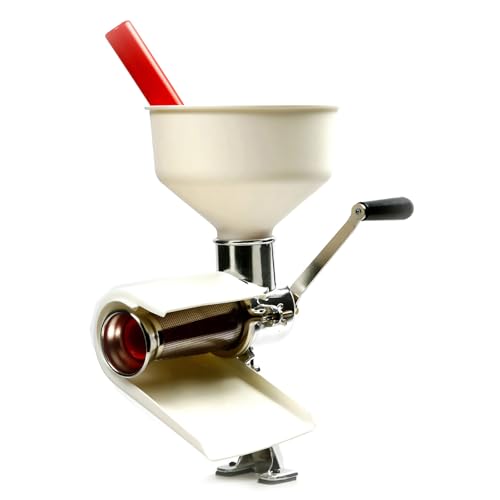
Norpro "The Original" Sauce Master
The other long-running clamp-on crank, and the one to cross-shop against this design. Same auger-through-a-screen idea for separating skins and seeds, at a lower price, though you give up the deep accessory range the Model 250 pattern has built up over the years.

Enhon Manual Tomato Strainer and Sauce Maker
The cheapest way into strainer-style saucing. Same clamp-to-the-counter crank format, same one-pass separation of seeds and skins, lowest outlay here. Expect more plastic and a shorter life. It still turns a garden glut into passata without the food-mill grind.
You Might Also Need
Accessories worth grabbing alongside your purchase
