KitchenAid
KitchenAid Fruit & Vegetable Strainer Review (2026)
By Theo Marchetti · Updated October 2026
Independent editorial review. We never accept payment for coverage, though we may earn a commission if you purchase through our links.

Verdict
Home canners who own a KitchenAid are broadly positive about this attachment, and the strongest endorsements come from people who switched to it from hand-crank mills, citing both the saved effort and a meaningfully higher pulp yield. The criticism is equally consistent and is about the experience rather than the result: it makes a mess, the hopper is small, and cleanup is fiddly. Two recurring points deserve untangling. Owners contradict each other on overheating, and the reports line up with mixer size rather than with the attachment, since larger bowl-lift machines run it for hours while smaller ones want batches and rest. And the durability complaint about plastic components sits alongside multi-year trouble-free reports, with seasonal use appearing to be the dividing line. The people who outgrow it move to dedicated motorized mills, which is a volume decision rather than a verdict on the attachment.
Read full take ↓Similar canning tools
If you already own a KitchenAid stand mixer and you are staring down a harvest of tomatoes, the Fruit & Vegetable Strainer attachment is the obvious question. It turns the mixer you already have into a motorized food mill: cooked tomatoes or apples go in the hopper, puree comes out one side, skins and seeds get ejected out the other, and your arm never touches a crank.
Owners who process real volume are largely sold on it, and the recurring word is speed. The complaints are just as consistent: it makes a mess, the hopper is small, and cleanup is fiddly. There is also a durability argument about plastic that turns out to be aimed at the wrong part. There is also a flat contradiction in the owner reports about whether it overheats your mixer, which turns out to be the most useful thing to untangle here.
What it actually is
Worth getting straight before you spend anything, because it is the single most important thing about this product and no retail listing says it plainly: the strainer is not a standalone attachment. It mounts onto the Food Grinder attachment, which is what actually connects to the mixer's power hub. Without that grinder you have half a tool, and the grinder is a separate purchase.
That matters more than it should right now, because KitchenAid's own plastic grinder is hard to buy new, and the older FGA grinder some people have inherited is not compatible with this strainer at all. So price the pair, not the strainer, and check what grinder you already own before ordering. If you do not already have a compatible grinder, a complete hand-crank mill is very likely the better buy, and we say so in the picks below.
In use it is a simple auger-and-screen design, the same principle as a hand-crank Roma or Victorio strainer, with your mixer's motor doing the turning. Soft cooked fruit goes in, the auger presses pulp through a perforated screen, and the skins and seeds travel down the screen and out the end.
The case for it: speed and yield
The people who like this attachment tend to be people who arrived from a hand crank, and the comparison is not close. The most common story is someone who cycled through cheap crank mills first:
I have the kitchenaid one. I've gone through around 10 different hand crank one's and decided it was time to invest. It's pretty slick, IMO. I use it mostly for tomatoes and berry jams (I hate the seeds).
Beyond the arm-saving, the recurring technical praise is yield. An auger driven by a mixer motor presses harder and more consistently than a tired wrist does, and owners notice how much less pulp ends up in the waste:
I have to disagree. The difference for me changing from an over the bowl one to the Kitchen Aid attachment was huge. For one, how tired your arm gets, and for two, the amount less waste. The Kitchen Aid squeezes every bit of pulp
For anyone putting up a real garden harvest rather than a few pounds, that combination of speed and yield is the whole argument, and it is a strong one:
I bought a food mill attachment for my kitchen aid mixer which was a game changer for canning. Another good purchase was the largest stock pot I could realistically fit on the stove for cooking down tomato sauce.
The overheating question, resolved
Here is where owner reports flatly contradict each other, and it is worth spending a moment on because it decides whether this attachment suits you. Some owners describe the mixer getting uncomfortably hot after a short run. Others report the opposite, in strong terms:
I think that depends on which KitchenAid mixer you have. I have a Professional 600 and I’ve run the fruit and vegetable strainer for hours when I’ve had a large amount of tomatoes to process. It didn’t get overly hot and ran just
And from a second owner on an older, ordinary machine:
I also have an ordinary 10year old kitchen aid mixer that I use with the veggie and fruit strainer attachment. It does get warm (which is normal), but has never overheated. I LOVE my veggie and fruit strainer attachment!
Read together, the pattern is that the variable is the mixer rather than the attachment, and the reports line up with motor size. A Professional 600 is a 575-watt bowl-lift machine; a tilt-head Artisan is 325 watts. KitchenAid does not publish a duty cycle or a maximum run time for either, so we are describing owner experience and a wattage gap, not a rated difference.
What KitchenAid does say is the useful part. A mixer head feeling warm is normal, but if it is too warm to touch comfortably you should stop, because continuing to run it that hot risks damaging the machine, and it takes something like 30 to 45 minutes to cool properly. Some models will shut themselves off on a thermal switch. Treat that as the rule rather than guessing: run until it is uncomfortably warm, then rest it, and expect a smaller mixer to reach that point sooner.
The real complaints: mess, hopper, cleanup
The criticism is consistent and worth taking seriously, because none of it is about whether the thing works. It is about what using it is actually like:
The kitchen aid attachment works ok. It makes a huge mess and is slow AF.
The mess is structural rather than a defect. Pulp exits one way and waste another, both under pressure, so you are managing two streams plus splatter. The hopper is the other constraint, and it is the thing that pushes high-volume growers toward dedicated machines:
I use an attachment on my kitchen aid but am eyeing the Vevor tomato mill for next year. We grow a ton, and the hopper isn't big on the kitchen aid.
Set-up placement solves a surprising amount of it. One owner's arrangement is worth copying:
It’s not that tall, I usually set up the kitchenaid right next to my stove and then have a separate collection jar and then just dump from that to my stockpot. It’s easy to pause the tomato mill to quickly empty your juice.
Cleanup stays fiddly regardless. Even owners who love the attachment concede the point, and it is the single most repeated caveat attached to an otherwise positive verdict:
I absolutely love the Kitchenaid attachment for this! It's kind of a pain to clean, but it's worth it to me when I have a lot of tomatoes to process.
Puree or juice: pick the right screen
One failure mode comes up often enough to name, because it reads as a defect and usually is not:
I have a KitchenAid stand mixer. I have the attachment, but I ended up with juice- no puree for sauce. I have no idea what I did wrong. 🙄
Getting thin juice instead of sauce is almost always a screen and preparation problem rather than a broken attachment. The strainer is sold with screens for different jobs, and tomatoes that go in raw or barely warmed give up water rather than pulp. Cook the tomatoes down first so they break properly, use the screen intended for sauce rather than juice, and expect to reduce the result on the stove afterwards regardless. No mill produces finished thick sauce in one pass.
Durability: the plastic question
This is the axis where owners split hardest, and it needs one correction before the complaints make sense. The strainer cone itself has been plastic across generations, so this is not a case of a metal part being cheapened. The metal-to-plastic story belongs to the grinder body it mounts on, where KitchenAid sells a plastic grinder and a separate all-metal one. That is what owners are usually describing:
I bet those attachments were made a lot better than what’s available today. Our kitchen aid mixer doesn’t get a ton of use. My grinder attachment is pretty thin metal.
Against that, there are long-run reports from owners using the plastic version without trouble, and the usage pattern in them matters:
I've had and used our Kitchen Aid food mill attachment (with its plastic components) for the past 8 years without issue.
Our read is that both are true. Seasonal use, a few weekends a year during harvest, is well within what these components handle, and the eight-year reports are typically exactly that. Push it toward year-round or commercial-adjacent volume and the plastic becomes the limiting factor, which is precisely when owners start describing an upgrade:
After using the KitchenAid food mill for ages, we leveled up to a 1/3 hp Fabio Leonardi. The thing is a beast and now I can mill up gallons in minutes
Before you can what comes out of it
One safety point that has nothing to do with the attachment and everything to do with what you do next, because this tool makes an unsafe shortcut convenient.
Heat the fruit before you mill it. Every USDA tomato procedure heats tomatoes before pressing, typically simmering about five minutes, then presses them hot and reheats the result to boiling before it goes in jars. There is no tested procedure for milling raw tomatoes and canning what comes out. The attachment will happily process raw fruit, which is a convenience feature, not a canning workflow.
Acidify every jar, every time. Some tomatoes are now known to test above pH 4.6, so tested recipes require added acid: 2 tablespoons of bottled lemon juice or half a teaspoon of citric acid per quart, half that per pint. Use bottled juice rather than fresh, because fresh varies in acidity. The requirement holds even if you pressure can, which is the step people most often skip.
Milling produces an ingredient, not a recipe. Processing time comes from the tested recipe for the specific product you have made. Standard tomato sauce has a boiling-water option, but reduce it down toward paste and you have left that process behind, because paste has its own recipe and its own times. Add onions, peppers, garlic or celery and you are into pressure-canning territory regardless of how acidic the tomatoes were.
Two more worth knowing. A strainer makes soft and bruised fruit tempting to use up, so it is worth repeating that canning is not a way to rescue overripe or spoiling tomatoes, and tomatoes from dead or frost-killed vines should not be canned at all. And on the machine itself, KitchenAid warns against running slip-skin grapes such as Concord through this attachment, because they can damage the strainer or the mixer.
For applesauce the picture is simpler: cook the apples tender, press, and process by the tested times. No added acid is required for safety there, though using fresh, sound apples matters.
Who should buy it
The value case is unusually clean because most of the cost is already on your counter. You are buying an attachment, not a machine, and against a dedicated motorized mill it is a fraction of the price:
I really like the kitchenaid attachment, and it has multifunctionality beyond the fruit and veggie straining. But- it's pricey. Seems to be very durable and well built though.
Buy it if you already own a KitchenAid and a compatible food grinder, you process a garden's worth of tomatoes or apples once or twice a year, and you are currently doing it by hand or through a sieve. In that situation it is transformative and the money is small, because most of the machine is already on your counter.
Think harder if you are starting from nothing. You are buying a strainer plus a grinder plus a mixer to run them, and the grinder in particular is awkward to source new right now, which is a poor position for a tool you need working during a two-week harvest window. A complete hand-crank mill costs less, arrives whole, and does not care how hot your motor is getting. Skip the attachment entirely if you mill only a few pounds at a time, where a cheap hand mill is simply less to wash, or if you are processing at real volume, where the small hopper and the plastic will push you toward a dedicated machine soon enough.
Our Ratings
Overall score
It does the core job well, and it is the correct class of tool for the work: USDA tomato procedures call for pressing through a sieve or food mill, and explicitly warn against a blender or food processor because those beat air into the tomatoes. Driven by a mixer motor the auger presses harder than a wrist does, so pulp yield is high and little usable fruit leaves in the waste. The performance complaint owners report, thin juice instead of sauce, traces to screen choice and to fruit that was not cooked down enough first, not to the tool.
Mixed, and it needs a correction to read fairly. The strainer cone has always been plastic, so this is not a cheapened part; the metal-versus-plastic argument belongs to the grinder body it bolts onto, where an all-metal version is sold separately. Owner reports split by duty rather than by luck: seasonal harvest use draws unbothered multi-year reports, while heavy use finds the limit of the plastic. The bigger practical knock is that the whole assembly depends on a grinder that is currently awkward to buy new.
Easier than a crank mill, and tedious in ways the product photos never show. Owners consistently describe a mess, since pulp and waste exit under pressure in different directions, and cleanup is fiddly enough that even enthusiasts flag it. The hopper is small, so volume users spend the session feeding it. Placement helps more than people expect. The value case is strong only if you already own both the mixer and a compatible grinder; buying the whole chain from scratch is worse value than a complete hand-crank mill.
KitchenAid Fruit & Vegetable Strainer on Amazon.
What People Are Saying
Home canners who own a KitchenAid are broadly positive about this attachment, and the strongest endorsements come from people who switched to it from hand-crank mills, citing both the saved effort and a meaningfully higher pulp yield. The criticism is equally consistent and is about the experience rather than the result: it makes a mess, the hopper is small, and cleanup is fiddly. Two recurring points deserve untangling.
Owners contradict each other on overheating, and the reports line up with mixer size rather than with the attachment, since larger bowl-lift machines run it for hours while smaller ones want batches and rest. And the durability complaint about plastic components sits alongside multi-year trouble-free reports, with seasonal use appearing to be the dividing line. The people who outgrow it move to dedicated motorized mills, which is a volume decision rather than a verdict on the attachment.
We weight candid owner reports from Reddit and preservation forums above brand-influenced editorial coverage, then reach our own verdict from them. The quotes below are the evidence; the rating and the take are ours.
What Reddit Is Saying
“I have the kitchenaid one. I've gone through around 10 different hand crank one's and decided it was time to invest. It's pretty slick, IMO. I use it mostly for tomatoes and berry jams (I hate the seeds).”View thread →
“I have to disagree. The difference for me changing from an over the bowl one to the Kitchen Aid attachment was huge. For one, how tired your arm gets, and for two, the amount less waste. The Kitchen Aid squeezes every bit of pulp”View thread →
“I bought a food mill attachment for my kitchen aid mixer which was a game changer for canning. Another good purchase was the largest stock pot I could realistically fit on the stove for cooking down tomato sauce.”View thread →
“I think that depends on which KitchenAid mixer you have. I have a Professional 600 and I’ve run the fruit and vegetable strainer for hours when I’ve had a large amount of tomatoes to process. It didn’t get overly hot and ran just”View thread →
“I also have an ordinary 10year old kitchen aid mixer that I use with the veggie and fruit strainer attachment. It does get warm (which is normal), but has never overheated. I LOVE my veggie and fruit strainer attachment!”View thread →
“I absolutely love the Kitchenaid attachment for this! It's kind of a pain to clean, but it's worth it to me when I have a lot of tomatoes to process.”View thread →
“I've had and used our Kitchen Aid food mill attachment (with its plastic components) for the past 8 years without issue.”View thread →
“I really like the kitchenaid attachment, and it has multifunctionality beyond the fruit and veggie straining. But- it's pricey. Seems to be very durable and well built though.”View thread →
“It’s not that tall, I usually set up the kitchenaid right next to my stove and then have a separate collection jar and then just dump from that to my stockpot. It’s easy to pause the tomato mill to quickly empty your juice.”View thread →
“After using the KitchenAid food mill for ages, we leveled up to a 1/3 hp Fabio Leonardi. The thing is a beast and now I can mill up gallons in minutes”View thread →
“The kitchen aid attachment works ok. It makes a huge mess and is slow AF.”View thread →
“I use an attachment on my kitchen aid but am eyeing the Vevor tomato mill for next year. We grow a ton, and the hopper isn't big on the kitchen aid.”View thread →
“I have a KitchenAid stand mixer. I have the attachment, but I ended up with juice- no puree for sauce. I have no idea what I did wrong. 🙄”View thread →
“I bet those attachments were made a lot better than what’s available today. Our kitchen aid mixer doesn’t get a ton of use. My grinder attachment is pretty thin metal.”View thread →
Frequently asked questions
Is the KitchenAid Fruit & Vegetable Strainer worth it?
Easier than a crank mill, and tedious in ways the product photos never show. Owners consistently describe a mess, since pulp and waste exit under pressure in different directions, and cleanup is fiddly enough that even enthusiasts flag it. The hopper is small, so volume users spend the session feeding it.
How is the KitchenAid Fruit & Vegetable Strainer built?
Mixed, and it needs a correction to read fairly. The strainer cone has always been plastic, so this is not a cheapened part; the metal-versus-plastic argument belongs to the grinder body it bolts onto, where an all-metal version is sold separately. Owner reports split by duty rather than by luck: seasonal harvest use draws unbothered multi-year reports, while heavy use finds the limit of the plastic.
What is the KitchenAid Fruit & Vegetable Strainer best suited for?
It does the core job well, and it is the correct class of tool for the work: USDA tomato procedures call for pressing through a sieve or food mill, and explicitly warn against a blender or food processor because those beat air into the tomatoes. Driven by a mixer motor the auger presses harder than a wrist does, so pulp yield is high and little usable fruit leaves in the waste. The performance complaint owners report, thin juice instead of sauce, traces to screen choice and to fruit that was not cooked down enough first, not to the tool.
What do real owners say about the KitchenAid Fruit & Vegetable Strainer?
Home canners who own a KitchenAid are broadly positive about this attachment, and the strongest endorsements come from people who switched to it from hand-crank mills, citing both the saved effort and a meaningfully higher pulp yield. The criticism is equally consistent and is about the experience rather than the result: it makes a mess, the hopper is small, and cleanup is fiddly. Two recurring points deserve untangling.
Options Worth Checking Out
KitchenAid Fruit & Vegetable Strainer (KSMFVSP)
The right buy only if you already own a compatible KitchenAid food grinder, since the strainer mounts on that rather than the mixer and does nothing without it. For someone with the grinder already, it turns a harvest of tomatoes into a fast job. Check your grinder model first.

Roma / Johnny Apple Food Strainer (Model 250)
The better buy for most people, and a complete tool out of the box rather than an attachment that needs a base you may not own. Same auger-through-a-screen principle, nothing to overheat, and a deep accessory range for berry and salsa screens. The cost is your arm on the crank.
Norpro "The Original" Sauce Master
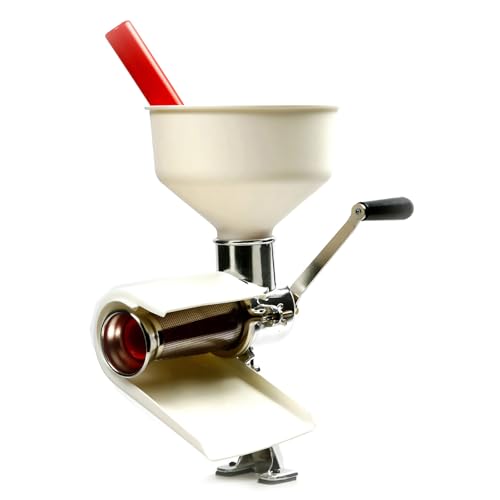
The cheapest sensible way to separate skins and seeds. Same auger-through-a-screen principle at a much lower price, though the accessory range behind it is thinner and you are back to turning a handle.