Presto
Presto Precise Digital Pressure Canner Reviews (2026)
By Theo Marchetti · Updated October 2026
Independent editorial review. We never accept payment for coverage, though we may earn a commission if you purchase through our links.

Verdict
Owners who actually run a Presto Precise tend to like it a lot. It's foolproof to operate, easy on glass-top and induction stoves, and it quietly cans stock, beans, and meals in a jar for people who follow the manual. The loud debate is about proof, not enjoyment. Presto says the unit meets USDA canning guidelines, yet independent extension testing is still incomplete, so the big canning communities flair it as untested rather than endorsed. A real minority also worry about the electronics: no gauge to verify, no replacement parts, reports of failed boards, plus scattered notes about siphoning and altitude. Weighing all of that, we read it as a machine people are glad to own that still carries an asterisk no stovetop canner does.
Read full take ↓Similar pressure canners
The Presto Precise Digital Pressure Canner keeps showing up in canning threads with a question mark attached. Plug it in, load your jars, choose a preset, and it regulates the pressure and the timing electronically. No dial to watch. No weighted jiggler to listen for. It's one of the very few electric units built specifically to pressure can low-acid foods like meat, beans, and stock, which is the thing a standard multicooker cannot safely claim. For newer canners, and for anyone stuck with a glass-top or induction stove, that combination is the draw.
It's also the most argued-about canner in the hobby. Presto says the unit was developed to meet USDA canning guidelines, but independent testing by the university extension services is still incomplete, so the big canning communities file it under untested rather than proven. It wins over the people who actually run one, and it cans quietly and safely for people who follow the manual. The caveats are real too: price, altitude, and the plain fact that electronics are doing a job a gauge used to do where you could see it and test it. We weighed both sides.
The short version
It's a likeable machine carrying one asterisk no stovetop canner has to. A couple hundred owner comments later, that's still the shape of it.
What's good:
- Regulates pressure and processing electronically, so there is no dial to babysit and no weighted jiggler to time by ear.
- Built to pressure can low-acid foods like meat, beans, and stock, which most electric multicookers cannot safely do.
- Hands-off from start to finish: load the jars, pick a preset, walk away, and listen for the beeps.
- Doubles as a small-batch water bath canner without heating up and humidifying the whole kitchen.
What's not:
- Independent safety testing is still incomplete, so the major canning communities flair it as untested rather than endorsed.
- Priced close to a rebuildable stovetop canner that holds the same seven quart jars.
- All-electronic, so a failed board or sensor can end the machine, and owners report Presto does not sell replacement parts.
- Some owners see more siphoning than a stovetop canner, and higher altitude adds open questions.
Who it's for
One kind of canner will love this machine. Another will resent every dollar. Work out which you are first.
Buy it for:
- Glass-top or induction cooktops that a heavy stovetop canner can crack or simply cannot heat correctly.
- Brand-new canners who want the pressure and the timing handled for them instead of learning to read a gauge.
- Stock, beans, and meals in a jar a handful of times a season, plus easy small-jar water bathing.
Skip it if:
- You want the lowest cost per jar; a stovetop Presto 01781 holds the same seven quarts for a fraction of the money.
- You want a canner you can trust for decades and repair yourself; the All American 921 has no electronics to fail.
- You live at high altitude and want processing you can fully verify; the unproven-testing gap hits hardest there.
The specs that matter
Three design choices shape what this canner is like to own. Here's what each one buys you at the counter:
Electronic pressure regulation in place of a gauge or jiggler: an internal sensor brings it up to canning pressure, holds it, times the process, and counts down the cool-off, all on its own. That's why owners call it foolproof. It's also why skeptics point out that you cannot independently verify what it's doing.
Built for low-acid pressure canning, not for cooking: owners clarify this constantly, because people keep confusing it with a multicooker. The tested recipes for stock, beans, carrots, and meals in a jar are printed in the manual, which is what separates it from an Instant Pot you should never can in.
A full 23-quart capacity that holds seven quart jars: it takes the same seven quart jars per load as a stovetop 23-quart Presto, so full runs of stock, beans, and meals in a jar are on the table. No small-batch compromise. It also frees the stove entirely while it runs.
How well it preserves
For people canning at or near sea level and following the manual, the Presto Precise does the job it promises. It brings jars up to full canning pressure, holds it, and runs the tested low-acid recipes that a plain multicooker has no business attempting. Owners who use it for ingredients like stock and beans are consistently happy with the results.
I have one of these, and I absolutely love it. I do use it mostly for water bath canning... but with the automatic timing once it comes to a boil, it is wayyyy worth it to me. You just listen for the beeps. Plus, it clears up space on the stove to work on your next batches while it's processing. I do use it for pressure canning also, but I'm mostly an ingredients pressure canner. Stock, beans, etc. Those recipes are all in the manual, and I'm at sea level, so I feel comfortable doing it.
I use the same canner and used the ball recipe with no issues. I don’t recall it being raw pack though.
Building pressure isn't the open question. Proving that it processed your food to the same standard a stovetop canner would is. Presto says the unit meets USDA canning guidelines, but it has not released its testing data, and the extension services are still working on independent verification. The most balanced framing in the whole community treats it as unproven rather than condemned:
No testing has been done of this device by any reputable, independent authority. It does not meet the standards of pressure canners that tested recipes were developed for (stove top, and large enough to hold at least four upright quart jars). That being said, Presto has been in the home canning business for many decades. We are not aware of any reports of spoiled food or food borne illness in people who used this device but otherwise followered safe recipes and practices. For that reason, on this sub we consider this product to be a "use at your own risk" one, and we typically flair posts regarding it as untested rather than unsafe.
Understand that untested status before you buy, and understand why the caution exists rather than writing it off as gatekeeping. Other electric canners have claimed safety and then failed lab testing. That history is why canners are asked to wait for data instead of a company's word:
A note to all that are confused by the unsafe flair regarding this model due to the company stating that they have done testing and that the model meets USDA standards of safety. Presto says that the Presto Digital Pressure Canner meets the USDA standards but has so far refused requests to release any of the data on the testing specifics/data to any public individuals or to extensions/NCHFP. Further the USDA does not test or endorse any particular type or model of pressure canners but the NCHFP does backed up by testing data. Until the Presto company releases it's testing studies data or until the NCHFP testing is complete (it is currently ongoing) we can not endorse this canner in this community which as a mission statement only endorses proven scientifically tested practices and recipes. Other companies have claimed that their electric canners are safe without releasing testing and the NCHFP testing came back with unsafe findings (for example the Instant Pot Max testing found that the device fluctuated in temperate sometimes while in the middle of a canning cycle without the user being able to tell). So even if this model looks more promising we will not allow them to be promoted as safe in this community until such time as we can get data proving it has been tested safe (and not just a company’s word for it).
On top of the testing question, two practical performance quirks show up in owner reports. The first is siphoning, liquid pulling out of the jars during processing, which a few owners notice more with the digital canner than with their stovetop unit:
I have one. I like it. No canners are approved by the USDA as the USDA does not have an approval process for ANY canner, stovetop or otherwise, they only have guidelines to follow. People who are strict approval only canners, especially on here, get very touchy about this but 🤷🏻♀️ the USDA themselves said the aforementioned bit about NOT having any approval process. I do notice there is a touch more siphoning than I have experienced with my stove top canner, however others in the presto group on fb have not. It is quite fool proof to use, and I love the laminated sheet that came with it that I keep nearby to refresh on the process when I use it. It's great for small batch water bathing especially, since I don't have to heat up and humidify my whole house just by boiling a pot of water. It is a canner only, NOT for cooking, which I did notice you called it a pressure cooker so I wanted to clarify that point.
The second is altitude. The tested recipes were written for stovetop canners, and one owner canning at 5,500 feet ran into trouble even after Presto assured them the internal sensor would compensate:
Raw Pack with Boiling Broth 1” head space Used Presto Precise digital pressure canner 75min. 5,500 ft elevation. Before proceeding I Called Presto and they said the cooker would self pressurize correctly based off an internal sensor. Made pressure Canned Broth and tomato soup, never had this happen before. Any ideas?
None of this means the machine fails to preserve. For sea-level canners running manual recipes, owner outcomes are good. The further you get from those conditions, though, the more the missing independent data matters. That's why performance here earns a solid score rather than a top one.
Built to last
The weakness here is baked into the design rather than being bad luck. Everything rides on a control board and a temperature sensor. There's no dial you can read mid-cycle and no gauge you can send off to be tested for accuracy, so if the electronics drift or quit, you often can't tell, and there are no replacement parts to bring a dead unit back:
If it fails, you have no way of knowing. You can’t even test it (like you can the gauges on a regular Presto) to see if it’s “factory accurate.” I think they look cool. I love the “idea” of them. But especially since they’re used for low-acid foods that need to be processed as safely as possible, I can’t really justify it. As an aside, they also do not make replacement parts. Another user in another sub had the MoBo go out and was told, “Welp, sorry. Here’s a $10 off coupon to get a new one!” That’s not my jam for sure.
Experienced preservers are the most skeptical, and their worry is specifically about consumer-grade electronics holding their calibration over years of use, not about the idea being bad. One Master Food Preserver lays out why she doesn't trust the long-term reliability:
As a Master Food Preserver and long time Instant Pot yogurt maker, I will add that I am highly skeptical of the electronics being reliable over the long term. I use an Instant Pot to make yogurt by the gallon (yes, I eat a lot of Greek yogurt). The 'yogurt' button supposedly reaches 180F during the pasteurization step. My IP - used only for yogurt 2 or 3 times per month - does not reach 180 any more. The first year was fine - after that, it is a crap shoot what temperature the IP decides to reach (usually 155-165F-ish) I have to 'low saute' to reach 180. This is a common problem with IP yogurt making (search the InterWebs) I wouldn't trust any other consumer-grade electronic food processing to be reliable over the long term. I have brought up this issue in MFP classes and put this information out to the public whenever I can.
The hardware snags new owners hit are usually smaller than that, often a lid or seal that isn't seating right on an older unit:
Interesting thread for me to come across because I just bought one! One of the cans has had the lid pop up and down multiple times. Currently it appears sealed but I'm not certain. Being new to canning, is that normal?
And Presto's customer service has a decent reputation for making those problems right, including upgrading older canners to the newer no-attached-gasket sealing design at no charge:
Call or email Presto support and they can send you a new gasket and lid. They had issues with sealing like you’ve described on older units, and changed the design. The current design has a lid with no attached gasket and a gasket that sits on a ring - the gasket is placed between the lid and bowl but is never attached to either. If you have anything else then your problem will be solved by this upgrade. They’ll most likely upgrade the parts you need to the newer design for free.
Weigh it like this. The Presto Precise is a capable machine with a finite, unrepairable lifespan. If the canner in your head is one you buy once and hand to your kids in thirty years, buy something else, and the durability number below is why.
Living with it
Everyday use is what earns the Presto Precise its fans, and it's why people who buy one rarely regret it. There's no pressure to hold by hand and nothing to time by ear. Load the jars, pick a preset, wait for the beeps. For a nervous beginner that's approachable in a way a stovetop canner simply isn't, and the gentle learning curve is the entire point. People who were intimidated by a dial-gauge canner finally get going:
I am brand new to canning and I bought the digital presto canner. I did a lot of research and I feel confident that this was a safe choice for me and my family. These videos in particular helped: https://youtu.be/CIpba9yA8eA https://youtu.be/D5B2pdreoQk I've done two batches so far (again, very new!) And my second batch was broth with tattler lids which is so far a success.
I use it too and love it! Much more accessible to people imo in the sense of taking up time so hopefully someday can be fully tested and backed by official resources.
It's kind to a glass-top or induction stove too, since it never sits on the burner, and it frees the cooktop for the rest of your prep while it runs. Owners are also quick to correct anyone who calls it a pressure cooker, because it only cans:
I have one of these and it’s only for canning only, not cooking. Are you sure you’re not confusing this with a pressure cooker?
The gripes are worth naming. It runs one electronic cycle at a time, and at least one owner calls it inefficient for volume canning. Put up a big harvest and the wait between loads adds up:
No. But you can use it to water bath small jars, also it's not efficient imo.
A small enthusiast streak bends it to jobs it wasn't programmed for, like coaxing it into a plain pressure-cook cycle. That says something about how much people like the hardware, even as they push past the manual:
While it only has programming for canning, you can use it as a pressure cooker. I put the stuff in, always using the canning rack, and set it for a 90 minute pressure canning cycle. When the display reads "insert jars" you can press and hold the arrow (right) button until it says "heat." You don't have to vent it, although it will go through the 10 minute count down, and you will have to press the arrow button at the end for it to start the pressure canning stage.
How it compares
Three canners come up most when people cross-shop this one. Here's how it stacks up against each.
Versus the All American 921: the buy-it-for-life opposite. No electronics at all, a metal-to-metal seal instead of a gasket, a dial you can test, and a machine you can rebuild, so it will outlast everything in this comparison. You pay more up front and you get real weight, enough to rule it out on many glass-top stoves. Nothing about it can silently drift or die.
Versus the Presto 01781 23-Quart stovetop: the value pick, and the canner the whole hobby recommends. It holds the same seven quart jars as the digital for a fraction of the Precise's price. The trade is that you manage the pressure yourself, and it needs a stove that can take the weight and the heat, which is the exact problem the digital unit solves.
Versus the Presto Precise 16-Quart Digital: the smaller, cheaper sibling with the same electronic canning and the same caveats. If the appeal is hands-off electric canning but the 23-quart's price or footprint is more than you want, the 16-quart is the lighter commitment for the same experience.
Using it well
A few habits keep this machine on the right side of the line. Can only the tested recipes printed in its own manual, since those were written for this appliance, and stick to ingredient packs like stock, beans, and plain meat rather than dense or improvised mixes. Follow the machine's headspace guidance closely to cut down on siphoning. If you're above about 1,000 feet, call Presto and confirm the adjustment before you commit a batch instead of assuming the sensor handles it. Treat it as a canner only. Keep the laminated process card nearby, and run a water-only test cycle when the unit is new so a sealing issue shows up before there's food on the line.
Shopping electric because of a glass-top or induction stove? Worth seeing the whole field before you spend. Our guide to the best pressure canner for a glass-top or induction stove walks through which canners work on which cooktops, and where the digital Presto fits against the stovetop options.
Who the Precise suits
The Presto Precise takes the intimidation out of pressure canning, sits happily beside a glass-top or induction stove, and lets a brand-new canner put up stock and beans without ever touching a dial. Ease of use is what it's selling, and the owners who bought one for that reason are by and large glad they did. Can near sea level, by the book, and it delivers.
Two things should keep your eyes open. Independent testing still hasn't caught up to Presto's own claims, so the most careful canning communities treat it as unproven. And it's all electronics, with no gauge to verify and no parts to repair, which gives it a shelf life. For a glass-top household that wants hands-off canning and follows the manual, we think it's worth the money. If you want the lowest cost per jar, or a canner you'll still be using in twenty years, we would buy the stovetop 01781 or an All American instead.
Our Ratings
Overall score
It holds pressure electronically and processes low-acid foods like stock, beans, and meat that a plain multicooker cannot safely can. That's the core job, and it does it. Independent verification is the one thing it can't give you. Presto says the unit meets USDA canning guidelines but hasn't released its data, independent extension testing is still incomplete, and a few owners report more siphoning than a stovetop unit plus open questions at higher altitude. Sea level and by the manual, it performs well. Move away from those conditions and the missing data starts to matter.
The soft spot is baked into the design. Everything rides on a control board and a temperature sensor rather than a gauge you can read or test, so if the electronics drift or die you often can't tell, and owners note Presto doesn't sell replacement parts. Failed boards, regulator trouble, and flat skepticism from experienced preservers come up often enough that you should plan on a finite, unrepairable lifespan. This is not a canner you hand down.
This is what wins the Presto Precise most of its fans. No dial to babysit, no jiggler to listen for. Load jars, choose a preset, wait for the beeps, which makes it approachable for a brand-new canner and easy on glass-top and induction stoves. Price and throughput are the trade. It costs about as much as a stovetop canner you could hand down and runs one electronic cycle at a time, and a couple of owners call it slow or inefficient for big runs.
Presto Precise Digital Pressure Canner Reviews (2026) on Amazon.
What People Are Saying
Owners who actually run a Presto Precise tend to like it a lot. It's foolproof to operate, easy on glass-top and induction stoves, and it quietly cans stock, beans, and meals in a jar for people who follow the manual. The loud debate is about proof, not enjoyment.
Presto says the unit meets USDA canning guidelines, yet independent extension testing is still incomplete, so the big canning communities flair it as untested rather than endorsed. A real minority also worry about the electronics: no gauge to verify, no replacement parts, reports of failed boards, plus scattered notes about siphoning and altitude. Weighing all of that, we read it as a machine people are glad to own that still carries an asterisk no stovetop canner does.
We weight candid owner reports from Reddit and preservation forums above brand-influenced editorial coverage, then reach our own verdict from them. The quotes below are the evidence; the rating and the take are ours.
What Reddit Is Saying
“I have one of these, and I absolutely love it. I do use it mostly for water bath canning... but with the automatic timing once it comes to a boil, it is wayyyy worth it to me. You just listen for the beeps. Plus, it clears up space on the stove to work on your next batches while it's processing. I do use it for pressure canning also, but I'm mostly an ingredients pressure canner. Stock, beans, etc. Those recipes are all in the manual, and I'm at sea level, so I feel comfortable doing it.”View thread →
“I use the same canner and used the ball recipe with no issues. I don’t recall it being raw pack though.”View thread →
“I have one. I like it. No canners are approved by the USDA as the USDA does not have an approval process for ANY canner, stovetop or otherwise, they only have guidelines to follow. People who are strict approval only canners, especially on here, get very touchy about this but 🤷🏻♀️ the USDA themselves said the aforementioned bit about NOT having any approval process. I do notice there is a touch more siphoning than I have experienced with my stove top canner, however others in the presto group on fb have not. It is quite fool proof to use, and I love the laminated sheet that came with it that I keep nearby to refresh on the process when I use it. It's great for small batch water bathing especially, since I don't have to heat up and humidify my whole house just by boiling a pot of water. It is a canner only, NOT for cooking, which I did notice you called it a pressure cooker so I wanted to clarify that point.”View thread →
“I am brand new to canning and I bought the digital presto canner. I did a lot of research and I feel confident that this was a safe choice for me and my family. These videos in particular helped: https://youtu.be/CIpba9yA8eA https://youtu.be/D5B2pdreoQk I've done two batches so far (again, very new!) And my second batch was broth with tattler lids which is so far a success.”View thread →
“I use it too and love it! Much more accessible to people imo in the sense of taking up time so hopefully someday can be fully tested and backed by official resources.”View thread →
“I’ve been borrowing my son’s canner and bought this after I read about it and visited some forums. Yeah, it would be hard to justify if I had two already. It’s cool you took the class! I have been canning up a storm and learn something new everyday. Super, fun hobby!”View thread →
“Call or email Presto support and they can send you a new gasket and lid. They had issues with sealing like you’ve described on older units, and changed the design. The current design has a lid with no attached gasket and a gasket that sits on a ring - the gasket is placed between the lid and bowl but is never attached to either. If you have anything else then your problem will be solved by this upgrade. They’ll most likely upgrade the parts you need to the newer design for free.”View thread →
“Interesting thread for me to come across because I just bought one! One of the cans has had the lid pop up and down multiple times. Currently it appears sealed but I'm not certain. Being new to canning, is that normal?”View thread →
“I have one of these and it’s only for canning only, not cooking. Are you sure you’re not confusing this with a pressure cooker?”View thread →
“While it only has programming for canning, you can use it as a pressure cooker. I put the stuff in, always using the canning rack, and set it for a 90 minute pressure canning cycle. When the display reads "insert jars" you can press and hold the arrow (right) button until it says "heat." You don't have to vent it, although it will go through the 10 minute count down, and you will have to press the arrow button at the end for it to start the pressure canning stage.”View thread →
“No testing has been done of this device by any reputable, independent authority. It does not meet the standards of pressure canners that tested recipes were developed for (stove top, and large enough to hold at least four upright quart jars). That being said, Presto has been in the home canning business for many decades. We are not aware of any reports of spoiled food or food borne illness in people who used this device but otherwise followered safe recipes and practices. For that reason, on this sub we consider this product to be a "use at your own risk" one, and we typically flair posts regarding it as untested rather than unsafe.”View thread →
“A note to all that are confused by the unsafe flair regarding this model due to the company stating that they have done testing and that the model meets USDA standards of safety. Presto says that the Presto Digital Pressure Canner meets the USDA standards but has so far refused requests to release any of the data on the testing specifics/data to any public individuals or to extensions/NCHFP. Further the USDA does not test or endorse any particular type or model of pressure canners but the NCHFP does backed up by testing data. Until the Presto company releases it's testing studies data or until the NCHFP testing is complete (it is currently ongoing) we can not endorse this canner in this community which as a mission statement only endorses proven scientifically tested practices and recipes. Other companies have claimed that their electric canners are safe without releasing testing and the NCHFP testing came back with unsafe findings (for example the Instant Pot Max testing found that the device fluctuated in temperate sometimes while in the middle of a canning cycle without the user being able to tell). So even if this model looks more promising we will not allow them to be promoted as safe in this community until such time as we can get data proving it has been tested safe (and not just a company’s word for it).”View thread →
“If it fails, you have no way of knowing. You can’t even test it (like you can the gauges on a regular Presto) to see if it’s “factory accurate.” I think they look cool. I love the “idea” of them. But especially since they’re used for low-acid foods that need to be processed as safely as possible, I can’t really justify it. As an aside, they also do not make replacement parts. Another user in another sub had the MoBo go out and was told, “Welp, sorry. Here’s a $10 off coupon to get a new one!” That’s not my jam for sure.”View thread →
“As a Master Food Preserver and long time Instant Pot yogurt maker, I will add that I am highly skeptical of the electronics being reliable over the long term. I use an Instant Pot to make yogurt by the gallon (yes, I eat a lot of Greek yogurt). The 'yogurt' button supposedly reaches 180F during the pasteurization step. My IP - used only for yogurt 2 or 3 times per month - does not reach 180 any more. The first year was fine - after that, it is a crap shoot what temperature the IP decides to reach (usually 155-165F-ish) I have to 'low saute' to reach 180. This is a common problem with IP yogurt making (search the InterWebs) I wouldn't trust any other consumer-grade electronic food processing to be reliable over the long term. I have brought up this issue in MFP classes and put this information out to the public whenever I can.”View thread →
“No. But you can use it to water bath small jars, also it's not efficient imo.”View thread →
“Raw Pack with Boiling Broth 1” head space Used Presto Precise digital pressure canner 75min. 5,500 ft elevation. Before proceeding I Called Presto and they said the cooker would self pressurize correctly based off an internal sensor. Made pressure Canned Broth and tomato soup, never had this happen before. Any ideas?”View thread →
Frequently asked questions
Is the Presto Precise Digital Pressure Canner worth it?
This is what wins the Presto Precise most of its fans. No dial to babysit, no jiggler to listen for. Load jars, choose a preset, wait for the beeps, which makes it approachable for a brand-new canner and easy on glass-top and induction stoves.
How is the Presto Precise Digital Pressure Canner built?
The soft spot is baked into the design. Everything rides on a control board and a temperature sensor rather than a gauge you can read or test, so if the electronics drift or die you often can't tell, and owners note Presto doesn't sell replacement parts. Failed boards, regulator trouble, and flat skepticism from experienced preservers come up often enough that you should plan on a finite, unrepairable lifespan.
What is the Presto Precise Digital Pressure Canner best suited for?
It holds pressure electronically and processes low-acid foods like stock, beans, and meat that a plain multicooker cannot safely can. That's the core job, and it does it. Independent verification is the one thing it can't give you.
What do real owners say about the Presto Precise Digital Pressure Canner?
Owners who actually run a Presto Precise tend to like it a lot. It's foolproof to operate, easy on glass-top and induction stoves, and it quietly cans stock, beans, and meals in a jar for people who follow the manual. The loud debate is about proof, not enjoyment.
Options Worth Checking Out

All American 921 21-Quart Pressure Canner
The last-canner-you-buy answer if the Presto's electronics worry you. A metal-to-metal seal means no gasket to replace and no board to fail, and the dial can be tested for accuracy. Heavier, pricier, and not for glass-top stoves. Close to indestructible.

Presto 01781 23-Quart Pressure Canner and Cooker
The stovetop canner the whole hobby recommends. It holds the same seven quart jars as the digital unit for a fraction of the price, and its dial gauge can be tested for accuracy. You run the pressure yourself, and you need a stove that takes the weight and the heat.
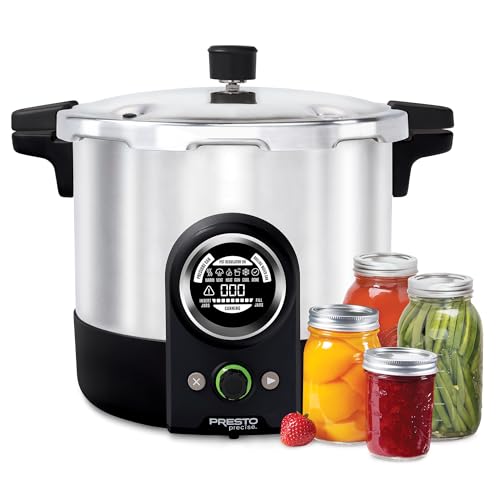
Presto Precise 16-Quart Digital Pressure Canner
The smaller, cheaper sibling. Same electronic hands-off canning, same untested caveat. Want a glass-top-friendly digital canner without the 23-quart's price or footprint? This is the lighter commitment.
You Might Also Need
Accessories worth grabbing alongside your purchase