Presto
Presto 16-Quart Pressure Canner Reviews (2026)
By Ruth Alvarez · Updated October 2026
Independent editorial review. We never accept payment for coverage, though we may earn a commission if you purchase through our links.

Verdict
Owners of the 16-quart Presto skew positive, and the praise is consistent: it holds pressure reliably, cans a household batch of seven quarts or seven to eight pints without drama, and its lighter, shorter body fits smaller stoves and cupboards the 23-quart cannot. Beginners in particular find it forgiving, especially once they swap in a weighted rocker and hold pressure by ear. The recurring caveat is capacity. A steady stream of owners who bought the 16 end up wishing they had sized up to the 23-quart so they could double-stack pints, and the aluminum draws its own knocks: it can pit in hard water, the rubber gasket is a wear part, a dial gauge needs testing every year, and it will not work on induction. What that adds up to: a good small-kitchen starter, and the wrong buy the moment your garden gets ambitious.
Read full take ↓Similar pressure canners
The Presto 01755 16-Quart Aluminum Pressure Canner is the small, sensible way into pressure canning. It's the shorter, lighter sibling of the 23-quart Presto that gets recommended everywhere, and it runs on the same simple idea: an aluminum pot, a locking lid with a rubber gasket, and either a dial gauge or a weighted rocker on top. The 16 in the name is how much water it holds, not how many jars, so a real batch is about seven quarts, or seven to eight pints, at a time.
That modest capacity is the whole story here, good and bad. For someone with a smaller stove, a tight cupboard, and no plan to put up a truckload of green beans, the 16-quart is easy to love and easy to lift. But a steady chorus of owners who bought it end up wishing they had sized up to the 23-quart so they could double-stack pints, and the aluminum body brings its own tradeoffs around hard water, gasket upkeep, and stovetops. This review weighs both: what the little Presto does well, where it comes up short, and who should buy the bigger one instead.
The short version
Read a few hundred owner comments about this canner and the same sentence keeps surfacing: I wish I had bought the 23. Everything else about the little Presto is well liked, forgiving, and cheap to keep running. Capacity is the thing people regret.
What's good:
- Light and short enough to fit smaller stoves and cupboards, and easy to lift when it is full.
- Simple, proven design that beginners get comfortable with fast, especially with a weighted rocker.
- Heats up and reaches pressure a little faster than the taller 23-quart because there is less to heat.
- Cheap, common wear parts (gasket, overpressure plug, seal) that pop in and out without tools.
What's not:
- Modest capacity: seven quarts or roughly seven to eight pints, and you cannot double-stack pints.
- Enough owners wish they had bought the 23-quart that the upgrade is worth taking seriously up front.
- Aluminum is thinner than stainless, can pit with hard water, and reacts with acidic foods if you cook in it.
- A dial gauge has to be tested every year, and the pot will not work on an induction cooktop.
Who it's for
Measure your stove, then count the jars you actually put up in a year. Those two numbers answer this, and the answer is rarely ambiguous.
Buy it for:
- Small households and small stoves canning a few quarts or pints at a time, not bulk garden hauls.
- A first pressure canner, where a simple aluminum pot and a weighted rocker keep the learning curve gentle.
- Tight storage, where the shorter body slides into a cupboard the taller 23-quart never would.
Skip it if:
- You put up big batches or want to double-stack pints; the Presto 01781 23-quart is the same width and holds far more.
- You cook on induction; aluminum will not work there, so the induction-ready Presto Precise Digital is the fit.
- You want a hands-off process; the Presto Precise Digital runs the venting, timing, and pressure for you.
The specs that matter
The 16 in the name is the most misunderstood number on the box, and it is not the only one worth translating:
16 quarts of water, about 7 quart jars per batch: the size on the box is liquid volume, not jar count. In practice you get seven quarts, or seven to eight pints on a single layer. Unlike the 23-quart, the pot is too short to double-stack a second row of pints, which is the single spec that sends heavier canners up a size.
Aluminum body with a rubber gasket lid: the aluminum keeps the pot light and quick to heat, but it is thinner than stainless, can pit in hard water, and reacts with acidic foods if you ever cook in it. The gasket and overpressure plug are wear parts you replace every few years, and they are cheap and easy to find.
Dial gauge or weighted regulator, flat bottom: a dial reads exact pressure but must be tested for calibration once a year; a weighted rocker never needs testing and lets you hold pressure by sound. The flat bottom works on gas and standard electric coils, but the aluminum rules out induction.
How well it preserves
It comes up to pressure, holds it, and turns out safe, sealed jars batch after batch. That is the entire job, and the little Presto does it. Owners who came to it as their first pressure canner describe a short learning curve and then years of nothing going wrong.
I have a similar looking one except it has a gauge. I added the weights/rocker. SO much easier. I was a long time water bath canner but this is my first pressure canner. Got it in spring of 2020. Have done dozens of batches. Never an issue aside from usual learning curve stuff. It's been a game changer. Jars of ready to heat and eat bbq pork, meatballs, soup, not to mention all the Swiss chard and green beans from a couple of garden seasons
Much of that consistency comes down to the weighted rocker. You listen for the rock and nudge the heat rather than hovering over a dial, and that makes it far easier to keep pressure from dipping below the safe line for the whole processing time. One owner ties the weighted gauge straight to why she trusts it:
I have this exact pressure canner. Tbh I love it. I tend to can smaller batches any ways. I like that it has a weighted gauge. I don’t have to deal with getting the gauge calibrated and I can makes sure it’s maintaining pressure by ear rather than having to watch the gauge
The ceiling is load. Seven quarts, or seven to eight pints, covers a small household comfortably, and owners who know their needs are candid about where the 16-quart tops out. One 01755 owner lays out the math plainly:
I have the 01755 and I use it on a 8" burner and it's fine. The outer diameter of the base is 12", I just measured it with my tape measure. I remember the manual saying that think 4" over the burner size is the maximum size differential that you can safely use. I am one person and it works great for small batches. Very rarely do I want more than 7-8 pints of something, which is the max it can handle. I also don't do very many quarts. If I was doing larger batches or more quarts, I'd probably want the 23 quart.
Built to last
Aluminum plus wear parts is where this canner scores lowest. The pot is thinner than a stainless one, and the sealing system relies on a rubber gasket and an overpressure plug that both age out. Maintenance, not defects. Owners are matter-of-fact about it.
This type of canner takes a rubber gasket which will need to be cared for and will need to be replaced every few years.
The dial-gauge models add one more upkeep task: the gauge drifts and has to be tested for accuracy every year, usually at a county extension office. That yearly check is the main reason experienced owners quietly move everyone toward the weighted rocker, which never needs calibrating.
Just a reminder also that if you're relying on the gauge, it's important to check the calibration at least once per year - your local extension office is the best place to start for this. Personally, I bought the pressure regulator weights for my Presto, and I vastly prefer it to the dial. The weight + one ring is 10lb and will start to rock when it reaches that pressure, then you just lower the heat to keep it at a gentle steady rocking motion, and it's much easier for me to make sure I never dip below pressure during the processing time.
The upkeep buys a long service life. Parts are cheap and easy to source, so a maintained 16-quart keeps going, and owners fifteen years in are not hard to find.
I have this same one I've used for years. I have the 23 qt as well, but I still use the 16qt. It does get up to pressure faster (but not too fast!) so when time is a consideration, I use the 16qt. It works on electric stoves as well as gas since it has a flat bottom. I'd get the weighted gauge or buy a weighted gauge to replace the regulator if you get the dial - I got one last year and I'm sorry I waited that long - it's so much easier. Parts are relatively easy to find as well, for when you need to replace your seal or anything else.
I have this very same canner and have used it for 15 years. I'm completely satisfied with it.
Aluminum is the one genuine drawback. Hard water discolors it, and over years it can pit if you are heavy-handed with vinegar in the canning water. It is also the wrong pot for cooking acidic foods. Treat it as a dedicated canner, keep a spare gasket on the shelf, stick to the weighted rocker, and the durability question stays manageable rather than becoming a weakness. Hence the number below sitting a notch under the others.
Living with it
It comes down off a shelf without a fight and fits under a low range hood the taller canner bumps into. Light and short is the whole appeal, and it is what the 16-quart wins on. The weighted rocker turns canning into something you do by ear while you get on with the rest of the kitchen.
The weighted gauge is a game changer. On my old electric stove I just kept it turned on Max most of the time
The flat bottom sits on gas and on standard electric coil and glass-free electric stoves without any adapter. Stovetop type is the caveat. Aluminum will not heat on induction at all, which sends induction owners looking elsewhere even when they otherwise love the pot:
I currently use a 16 quart (aluminum) Presto and am very pleased with it (once I got the separate pressure regulator). But I'd really like to be able to use it with my induction cooktop. Any recommendations? Does such a beast exists? I don't have tons of storage and would like to avoid larger canners.
Smooth glass tops are the other watch-out. The canner works on them, but a full aluminum pot plus the manufacturer weight limits some glass cooktops carry pushes a few owners off it entirely:
I switched to a separate electric Ball water canner because my stovetop is glass, and it’s the weight that’s a problem.
One more limit, small but worth naming: the 16-quart is tall enough to pressure can quarts and not tall enough to water-bath them. So it is a pressure canner first, and a part-time water-bath pot only for pints and smaller. One owner catches the mix of affection and mild annoyance:
I love mine! I did realize this summer I couldn’t water bath can quarts. That has been the only down side.
How it compares
Nobody shops the 16-quart on its own. It gets weighed against its taller sibling, against a digital model that runs the process for you, and against stainless that costs several times as much.
Versus the Presto 01781 23-Quart: the comparison that matters most. Same width, same design, but the 23-quart is taller, which lets you double-stack pints for close to twice the load per batch. Owners who run both keep the 16 for small jobs and reach for the 23 when volume is up:
I have both this exact 16 qts weighted gauge and the 23 qts dial gauge, and I only use the weighted gauge for both. I can't get the dial gauge calibrated easily so I don't bother with it anymore. Both are the same width/circumference, so I hope you are talking about their height when you say the 23 qts won't fit your stove. Otherwise, the only downside of the 16 qts is that you can't double stack the pint jars. I think the 16 qts a good starter pressure canner.
Plenty of buyers skip the small one on purpose, because the time cost of a canning run is the same whether the pot is half full or packed. If you are going to spend the afternoon venting and processing anyway, more jars per batch is the argument for sizing up:
I've got the 23 quart and I love it. I bought it in February of this year and I've done stock, chili, beans, and soups in it with great success. I'd suggest getting the larger one if they have it. It takes quite a bit of time to bring it to a boil, vent it, process, then let the pressure come down. You'll want to be able to fit as many jars as possible in there to make it worth the time, especially if you plan to put up single serve lunches, which is my favourite use for it.
Versus the Presto Precise 16-Quart Digital: same footprint, very different experience. The Precise Digital automates the venting, timing, and pressure and shuts itself off, and crucially it works on induction, which the aluminum 01755 cannot. It is the pick if the manual dance intimidates you or your cooktop is induction.
Versus stainless like the All American: the aluminum is what keeps this Presto light and affordable, and it is also what some owners eventually want to leave behind for a heavier stainless canner they can run on other heat sources:
I have the Presto pressure canner and it works alright. I'm just a little wary of the aluminum. I'm really looking at getting the All American Stainless steel pressure canner because I can use it on my propane burner.
If you are unsure whether the little Presto is enough or you will outgrow it, one common path is to start here and step up later once you know your volume:
I have one and it works great! I figured I'd see how much I use it and I could always upgrade to something more pricy in the future. So far I've had great success with it and feel it's a great deal!
Using it well
Add the amount of water your manual specifies (usually about three quarts) rather than filling it like a stockpot, since pressure canning cooks with steam, not a bath. Buy the weighted regulator if your model came with only a dial, and use it so you can hold pressure by sound instead of babysitting a gauge. Vent for a full ten minutes of steady steam before you set the weight, keep at least the minimum jar load in the pot so the heat stays stable, and go easy on vinegar in the canning water if you have hard water to keep the aluminum from pitting. Keep a spare gasket and overpressure plug on the shelf so a worn part never ends a canning day.
If you are still deciding between sizes or stovetops before you buy, it is worth reading how these choices play out across models. Our guide to the best pressure canner for a glass-top or induction stove walks through weight limits, aluminum versus stainless, and why induction changes the answer, with the 16-quart Presto in context against the alternatives.
Who the 16-quart suits
For a small kitchen, yes. The 16-quart Presto is a light, simple, affordable way to start pressure canning. It reaches pressure quickly, holds it reliably, and turns out safe jars batch after batch, and the weighted rocker makes the whole process approachable for a first-timer. Can a few quarts or pints at a time with tight storage or a small stove, and nothing its size does the job better.
Capacity and material are the reasons to think twice, and neither is a nitpick. Grow a serious garden or want to double-stack pints, and the 23-quart takes the same burner space for a lot more throughput; it is the size most heavy canners end up wishing they had bought. Cook on induction and this aluminum pot is simply the wrong tool. Buy it knowing it is a small-batch canner with a bit of upkeep, add the weighted gauge, and it is a good first pressure canner that will outlast the doubt.
Our Ratings
Overall score
For the load it is sized for, the 16-quart Presto does the core job well: it comes up to pressure, holds it, and turns out safe, sealed jars batch after batch, and the weighted rocker makes holding pressure easy by ear. First-time owners report a short learning curve and then years of drama-free canning. The only real limit is capacity, seven quarts or seven to eight pints, not the quality of the canning itself.
Durability scores lowest here. The aluminum body is thinner than stainless, can discolor or pit in hard water, and reacts with acidic foods if you cook in it, while the rubber gasket and overpressure plug are wear parts you replace every few years and a dial gauge must be tested yearly. But the parts are cheap and easy to find, and plenty of owners are ten and fifteen years deep, so with basic upkeep and a weighted rocker it lasts a long time.
Ease of use is the reason to pick this one over its bigger sibling, and the reason beginners get along with it. It is light and short, so it lifts easily and fits smaller stoves and cupboards the 23-quart cannot, the flat bottom works on gas and standard electric, and the weighted rocker lets you can by sound instead of watching a dial. The knocks are stovetop-specific: aluminum will not work on induction, and the weight can rule it out on some glass cooktops.
Presto 16-Quart Pressure Canner Reviews (2026) on Amazon.
What People Are Saying
Owners of the 16-quart Presto skew positive, and the praise is consistent: it holds pressure reliably, cans a household batch of seven quarts or seven to eight pints without drama, and its lighter, shorter body fits smaller stoves and cupboards the 23-quart cannot. Beginners in particular find it forgiving, especially once they swap in a weighted rocker and hold pressure by ear. The recurring caveat is capacity.
A steady stream of owners who bought the 16 end up wishing they had sized up to the 23-quart so they could double-stack pints, and the aluminum draws its own knocks: it can pit in hard water, the rubber gasket is a wear part, a dial gauge needs testing every year, and it will not work on induction. What that adds up to: a good small-kitchen starter, and the wrong buy the moment your garden gets ambitious.
We weight candid owner reports from Reddit and preservation forums above brand-influenced editorial coverage, then reach our own verdict from them. The quotes below are the evidence; the rating and the take are ours.
What Reddit Is Saying
“I have this exact pressure canner. Tbh I love it. I tend to can smaller batches any ways. I like that it has a weighted gauge. I don’t have to deal with getting the gauge calibrated and I can makes sure it’s maintaining pressure by ear rather than having to watch the gauge”View thread →
“I have a similar looking one except it has a gauge. I added the weights/rocker. SO much easier. I was a long time water bath canner but this is my first pressure canner. Got it in spring of 2020. Have done dozens of batches. Never an issue aside from usual learning curve stuff. It's been a game changer. Jars of ready to heat and eat bbq pork, meatballs, soup, not to mention all the Swiss chard and green beans from a couple of garden seasons”View thread →
“I have this same one I've used for years. I have the 23 qt as well, but I still use the 16qt. It does get up to pressure faster (but not too fast!) so when time is a consideration, I use the 16qt. It works on electric stoves as well as gas since it has a flat bottom. I'd get the weighted gauge or buy a weighted gauge to replace the regulator if you get the dial - I got one last year and I'm sorry I waited that long - it's so much easier. Parts are relatively easy to find as well, for when you need to replace your seal or anything else.”View thread →
“I have one and it works great! I figured I'd see how much I use it and I could always upgrade to something more pricy in the future. So far I've had great success with it and feel it's a great deal!”View thread →
“I have this very same canner and have used it for 15 years. I'm completely satisfied with it.”View thread →
“I have the 01755 and I use it on a 8" burner and it's fine. The outer diameter of the base is 12", I just measured it with my tape measure. I remember the manual saying that think 4" over the burner size is the maximum size differential that you can safely use. I am one person and it works great for small batches. Very rarely do I want more than 7-8 pints of something, which is the max it can handle. I also don't do very many quarts. If I was doing larger batches or more quarts, I'd probably want the 23 quart.”View thread →
“I currently use a 16 quart (aluminum) Presto and am very pleased with it (once I got the separate pressure regulator). But I'd really like to be able to use it with my induction cooktop. Any recommendations? Does such a beast exists? I don't have tons of storage and would like to avoid larger canners.”View thread →
“I love mine! I did realize this summer I couldn’t water bath can quarts. That has been the only down side.”View thread →
“The weighted gauge is a game changer. On my old electric stove I just kept it turned on Max most of the time”View thread →
“I have both this exact 16 qts weighted gauge and the 23 qts dial gauge, and I only use the weighted gauge for both. I can't get the dial gauge calibrated easily so I don't bother with it anymore. Both are the same width/circumference, so I hope you are talking about their height when you say the 23 qts won't fit your stove. Otherwise, the only downside of the 16 qts is that you can't double stack the pint jars. I think the 16 qts a good starter pressure canner.”View thread →
“Just a reminder also that if you're relying on the gauge, it's important to check the calibration at least once per year - your local extension office is the best place to start for this. Personally, I bought the pressure regulator weights for my Presto, and I vastly prefer it to the dial. The weight + one ring is 10lb and will start to rock when it reaches that pressure, then you just lower the heat to keep it at a gentle steady rocking motion, and it's much easier for me to make sure I never dip below pressure during the processing time.”View thread →
“This type of canner takes a rubber gasket which will need to be cared for and will need to be replaced every few years.”View thread →
“I've got the 23 quart and I love it. I bought it in February of this year and I've done stock, chili, beans, and soups in it with great success. I'd suggest getting the larger one if they have it. It takes quite a bit of time to bring it to a boil, vent it, process, then let the pressure come down. You'll want to be able to fit as many jars as possible in there to make it worth the time, especially if you plan to put up single serve lunches, which is my favourite use for it.”View thread →
“I have the Presto pressure canner and it works alright. I'm just a little wary of the aluminum. I'm really looking at getting the All American Stainless steel pressure canner because I can use it on my propane burner.”View thread →
“I switched to a separate electric Ball water canner because my stovetop is glass, and it’s the weight that’s a problem.”View thread →
Frequently asked questions
Is the Presto 16-Quart Pressure Canner worth it?
Ease of use is the reason to pick this one over its bigger sibling, and the reason beginners get along with it. It is light and short, so it lifts easily and fits smaller stoves and cupboards the 23-quart cannot, the flat bottom works on gas and standard electric, and the weighted rocker lets you can by sound instead of watching a dial. The knocks are stovetop-specific: aluminum will not work on induction, and the weight can rule it out on some glass cooktops.
How is the Presto 16-Quart Pressure Canner built?
Durability scores lowest here. The aluminum body is thinner than stainless, can discolor or pit in hard water, and reacts with acidic foods if you cook in it, while the rubber gasket and overpressure plug are wear parts you replace every few years and a dial gauge must be tested yearly. But the parts are cheap and easy to find, and plenty of owners are ten and fifteen years deep, so with basic upkeep and a weighted rocker it lasts a long time.
What is the Presto 16-Quart Pressure Canner best suited for?
For the load it is sized for, the 16-quart Presto does the core job well: it comes up to pressure, holds it, and turns out safe, sealed jars batch after batch, and the weighted rocker makes holding pressure easy by ear. First-time owners report a short learning curve and then years of drama-free canning. The only real limit is capacity, seven quarts or seven to eight pints, not the quality of the canning itself.
What do real owners say about the Presto 16-Quart Pressure Canner?
Owners of the 16-quart Presto skew positive, and the praise is consistent: it holds pressure reliably, cans a household batch of seven quarts or seven to eight pints without drama, and its lighter, shorter body fits smaller stoves and cupboards the 23-quart cannot. Beginners in particular find it forgiving, especially once they swap in a weighted rocker and hold pressure by ear. The recurring caveat is capacity.
Options Worth Checking Out
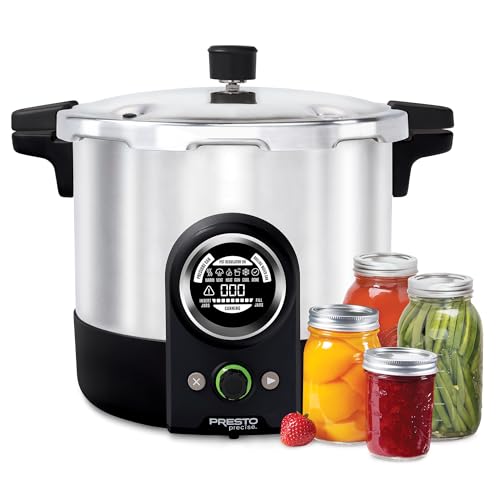
Presto Precise 16-Quart Digital Pressure Canner
Same 16-quart footprint, but a digital base runs the venting, timing, and pressure for you and shuts off on its own. It works on induction, which the aluminum 01755 cannot. The pick if the manual dance intimidates you or your cooktop is induction.

Presto 01781 23-Quart Aluminum Pressure Canner
The bigger sibling most owners end up wishing they had bought first. Same width so it fits the same burners, but the extra height lets you double-stack pint jars for nearly twice the load per batch. Get this if you grow a real garden.

T-fal Pressure Canner and Cooker, 22-Quart
A cheaper aluminum alternative that still clears seven quarts and the same jar counts. It uses a fixed weighted regulator, so there is no dial gauge to calibrate, though owner support and replacement parts are not as easy to find as Presto's.
You Might Also Need
Accessories worth grabbing alongside your purchase