Best Pressure Canner for a Glass-Top or Induction Stove (2026)
By Nora Calloway · Updated October 2026
Independent editorial guide. We never accept payment for coverage, though we may earn a commission if you purchase through our links.
Quick Take
If your stove is induction, buy the Presto 01784. It's the 23-quart Presto canner with a stainless steel-clad base, and that base is the entire point: an induction burner can only heat a pot that a magnet sticks to, so the plain aluminum canner everyone recommends will sit there cold no matter how high you turn the dial.
If your stove is a glass top that isn't induction, you have a different problem and a much smaller one. Radiant glass tops heat aluminum fine, so what you're managing is weight and handling: set the canner down gently, never slide it, and check your stove's manual for a load limit. Presto also notes its induction canner may not work on every portable induction range, so if you plan to run it on a countertop burner, pick one that has actually been tested with it.
Here's what we'd put on each of those two stoves, and why the famous one is the wrong buy for exactly one of them. See picks ↓

Search for a pressure canner for a glass-top stove and you'll get a hundred articles answering a question you didn't ask. Almost all of them treat "glass top" and "induction" as the same stove. They aren't, and the difference decides what you're allowed to buy.
The two look identical. Both are a flat sheet of black ceramic you wipe down with a sponge. Underneath, they work nothing alike. A radiant glass top has a heating element under the glass that glows and warms whatever is sitting on it: aluminum, stainless, cast iron, a tin can, it doesn't matter. An induction top has a coil that throws a magnetic field up through the glass and turns the pot itself into the heating element. If the pot isn't ferromagnetic, nothing happens. Not slowly. Nothing.
That one fact rules out most pressure canners on the market, including the 23-quart Presto that gets recommended in every canning thread ever written. It also explains why Presto sells a second, nearly identical canner that looks the same in photos and costs a few dollars more. Here's how to tell which problem you have, and what to do about each one.
Glass top and induction are two different problems
Both stoves have the same flat black surface, so the shopping advice gets mashed together into one mush. Split it apart and each side gets simple.
On a radiant glass top, the heat comes from an element under the glass. Your canner is a pot sitting on a hot plate, and the metal it's made of is irrelevant. What matters is weight, because you're setting 40 to 50 pounds of water, jars, and food on a sheet of ceramic, and flatness, because a warped or ridged base makes poor contact and your water takes forever to boil.
On an induction top, weight still matters, but it's the second problem. The first is whether the stove will turn on at all. Induction doesn't heat the glass, and it doesn't heat the pot by touching it. It induces currents inside ferromagnetic metal. Aluminum isn't ferromagnetic. An aluminum canner on an induction burner is a pot sitting on a cold piece of glass while the stove blinks an error code at you.
One r/Canning commenter compressed the whole guide into two sentences:
My glass top does fine. The real issue is that if it's aluminum, it won't work on induction.
That's it. That's the article. Everything below is just how to tell which stove you own and what to do once you know.
Why an aluminum canner won't heat on induction at all
This is the part that trips people up, because aluminum is a fantastic conductor of heat. It just isn't magnetic, and induction doesn't care how well a metal conducts. Someone in r/Canning laid it out more clearly than most manufacturer FAQs manage:
Aluminum is plenty conductive, it doesn't work with induction because it's not ferromagnetic. The coil in an induction stove induces magnetic currents to produce heat rather than electric currents. Essentially it's using magnetic pulses to try and get the atoms/molecules to move but they can't due to the high frequency of pulses from slightly different directions combined with the low energy of each pulse relative to the weight of the pan, so the friction on an atomic level turns into heat rather than motion. Materials that can't be moved by a magnet also can't be heated by one.
That's an owner on a hobby forum, so it's fair to ask whether he's actually right. He is. Iowa State University Extension's AnswerLine, which fields canning questions from the public, states the same fact in plainer language: "Since most brands of pressure canners are made of aluminum, they will not work on an induction burner." When a random commenter and a university extension service land on the same answer independently, you can stop wondering.
And most canners really are aluminum. It's the traditional material for the job: light for its size, affordable, and it spreads heat across a wide base without hot spots. Every one of those virtues is worth exactly nothing on induction.
The magnet test settles it in five seconds
You don't need to hunt down a spec sheet. Pull a magnet off your fridge and touch it to the bottom of the pot.
- If it grabs and holds, the base has enough ferromagnetic material to work on induction.
- If it slides off or won't stick, that canner will never heat on an induction burner. There's no adapter conversation and no turning it up higher. It just won't.
It's the check the r/Canning regulars reach for first:
Nice explanation. I would have added testing with magnet. For large batches we do them on the porch on two burner camp chief stove.
Run the same test on your stove if you're not sure what you own. Induction burners refuse to run without a compatible pot, and that refusal is itself the diagnostic:
My induction stovetop turns itself off if no induction-ready cookware is detected. Don’t they all do that?
So: set a stainless pan on the burner and then an aluminum one. If the stainless heats and the aluminum makes the burner shut itself off after a few seconds, you have induction. If both heat, you have radiant glass and you can forget about the metal entirely.
What the Presto 01784 actually changes
Presto's answer to all of this is the 01784, the induction-compatible version of the canner you have already seen recommended everywhere. Presto's product page describes a stainless steel-clad base, lists 23-quart liquid capacity (21.8 liters), and says flatly that it "Works on gas, electric, smooth-top, and induction ranges."
The clad base is the whole change. Same 23-quart body, same weighted-gauge routine canners have used for decades, same footprint on the stove. Bonded underneath the aluminum is a layer of stainless that gives the induction field something to grab. A magnet sticks to it. That is the difference between a canner that works on your stove and one that is a very expensive stockpot.
One caveat comes straight from Presto's own page, and it is worth reading before you buy a burner to go with it: "*May not work on all portable induction ranges." Full-size induction ranges are not the concern here. Countertop units vary in coil size and power, and a loaded 23-quart canner is a big, heavy pot with a wide base.
If your stove is glass top but not induction
Then relax. The metal question evaporates and you're left with weight and handling, and the r/Canning archives are full of people who have done this for years without incident. The recurring caution isn't physics, it's the cooktop itself:
I believe the issue with glass top is that it can’t bear the weight of the pot filled with water, jars, and filling. You could crack the glass which would ruin the entire stove. You can buy a camping stove and stand, that hooks up to a refillable bottle of propane, and do it outdoors. Or visit with a like-minded friend.
That's a fair worry and worth taking seriously, because a cracked cooktop costs more than the canner did. But the practical answer isn't "don't," it's "be deliberate." Check your stove's manual for a maximum burner load. Set the canner down instead of sliding it. Fill it after it's on the burner rather than carrying it full across the kitchen. Lift and place if you need to move it, and never drag.
If your stove passes that check, the regular 23-quart Presto is the canner to get, and it has been the hobby default for a generation for good reason. Just be certain before you click that your stove is radiant and not induction. That single mix-up is the reason this guide exists.
The countertop burner route solves both problems
There's a third path that sidesteps the whole argument: skip the range and can on a standalone burner. It takes the load off your cooktop, it keeps the heat out of your kitchen in August, and it's usually faster than the stove was anyway.
Highly recommend this. I have one I use for brewing and canning. Not only do I not have to worry about too much weight on the glass-top, it also brings that much water to a boil way faster than the stovetop.
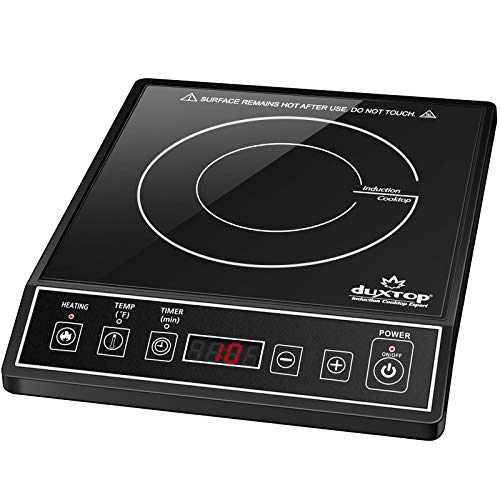
If you go this way with an induction canner, though, don't grab whatever burner is cheapest. This is exactly where Presto's "may not work on all portable induction ranges" bites. Iowa State Extension's AnswerLine names the specific unit that has been checked: "Presto has identified and tested a portable induction cooktop (Duxtop Portable Induction Cooktop, Model 9100MC) that is compatible with the Presto induction canner to assure the canner will operate properly during use."
That's a tested pairing named by an authority, not a guess from a spec comparison. If you want a countertop setup for the 01784, that's the burner to start with.
What works on a glass top
It comes down to one question you can answer in five seconds with a fridge magnet.
If your stove is induction, get the Presto 01784. This is the only part of the decision that isn't a judgement call: the base has to be magnetic or nothing happens.
If your stove is a radiant glass top, get the regular Presto 01781 and handle it carefully. You'll spend a little less, and you're buying the most-used canner in the hobby.
If you're not sure which stove you have, go find that magnet before you order anything. Five seconds now beats a canner you can't use and a return window you've already burned through.
Recommended
Products related to this guide.

What owners say
Real owner reports from the threads and editorial sources we drew on for this guide.
“My glass top does fine. The real issue is that if it's aluminum, it won't work on induction.”
— r/Canning / u/Alert-Potato
“Aluminum is plenty conductive, it doesn't work with induction because it's not ferromagnetic. The coil in an induction stove induces magnetic currents to produce heat rather than electric currents. Essentially it's using magnetic pulses to try and get the atoms/molecules to move but they can't due to the high frequency of pulses from slightly different directions combined with the low energy of each pulse relative to the weight of the pan, so the friction on an atomic level turns into heat rather than motion. Materials that can't be moved by a magnet also can't be heated by one.”
— r/Canning / u/Bradthony
“Nice explanation. I would have added testing with magnet. For large batches we do them on the porch on two burner camp chief stove.”
— r/Canning / u/Useful-Ad-385
“My induction stovetop turns itself off if no induction-ready cookware is detected. Don’t they all do that?”
— r/Canning / u/LaLechuzaVerde
“I believe the issue with glass top is that it can’t bear the weight of the pot filled with water, jars, and filling. You could crack the glass which would ruin the entire stove. You can buy a camping stove and stand, that hooks up to a refillable bottle of propane, and do it outdoors. Or visit with a like-minded friend.”
— r/Canning / u/cantcountnoaccount
“Highly recommend this. I have one I use for brewing and canning. Not only do I not have to worry about too much weight on the glass-top, it also brings that much water to a boil way faster than the stovetop.”
— r/Canning / u/oldjudge86
Sources
Presto 01784 official product page · Iowa State University Extension, AnswerLine: Exploring Portable Burners and Other Canner Options