Nesco
Nesco NPC-9 Electric Pressure Canner Review (2026)
By Theo Marchetti · Updated October 2026
Independent editorial review. We never accept payment for coverage, though we may earn a commission if you purchase through our links.
Verdict
Owners split cleanly by how they use it. People who run the Nesco for water-bath canning and everyday cooking tend to love it: it's cheap, small, easy on a glass-top stove, and foolproof to set and walk away from. The heat is all about the pressure side. No independent lab has verified any electric canner for low-acid processing, the USDA approves no canner at all, and canners who track the testing say the electric units an extension has bench-tested, Nesco and Carey included, didn't pass. Layer on real hardware quirks, a valve that can line up wrong, a display that skips a step, units that spew water, and the picture is consistent. We read it the same way the most careful owners do: a fine little water-bath canner and pressure cooker, and not a machine to trust for low-acid pressure canning.
Read full take ↓Similar pressure canners
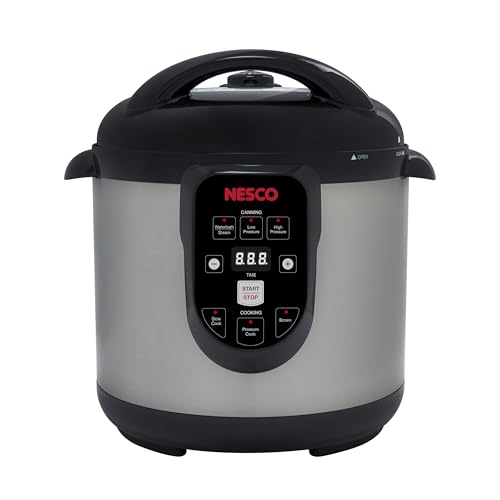
The Nesco NPC-9 Smart Electric Pressure Canner is the countertop canner people reach for when a real pressure canner feels like too much money or too much stove. It's a 9.5-quart electric pot with a digital panel: set a mode, walk away, listen for the beeps. At less than half the price of a digital Presto, and small enough to run on a porch or a glass-top kitchen, the pitch is obvious. It's the same machine sold for years as the Carey, so the two names come up interchangeably in canning threads.
And it lands in the single most contested corner of home canning. The appeal is real, but so is the asterisk: no independent lab has verified any electric unit reaches and holds the temperature that safe low-acid canning requires, and the big canning communities treat electric pressure canning as untested. That doesn't make the Nesco useless. It makes it a machine you have to buy for the right job. We read a few hundred owner comments to sort what it's genuinely good at from what it should never be trusted to do.
The short version
It's a handy little water-bath canner and pressure cooker wearing the word canner, and the word is doing more work than the machine can back up. Sort out which job you're buying it for and it makes sense. Buy it as your one true pressure canner and it doesn't.
What's good:
- Cheap and small: about a third the price of a digital Presto, and light enough for a countertop, a porch, or a glass-top stove.
- A real water-bath canner for high-acid foods, where you can watch the boil, plus a browning mode for heating jars.
- Hands-off operation: set a mode, walk away, listen for the beeps, with no dial to read and no jiggler to time.
- Doubles as a small-batch pressure cooker for everyday meals.
What's not:
- No independent authority has verified it for low-acid pressure canning, and the major canning communities flair electric pressure canning as untested.
- All-electronic, so there is no gauge to test and no way to confirm it held pressure the whole cycle.
- Owners report real hardware quirks: a valve that lines up wrong, a display that skips a step, and units that spew water.
- Small capacity makes it slow for putting up a real harvest.
Who it's for
Almost everyone who buys one is chasing the same thing: a cheaper, easier way in than a big stovetop canner. Price is usually the trigger.
Hoping for some guidance on what is considered a safe brand of electric pressure canners? I’m in Canada and the presto is nearly 600 bucks which feels way way too pricy. I’ve seen mixed reviews on Nesco - thoughts?
The other pull is nerves. A dial-gauge stovetop canner intimidates plenty of new canners, and a walk-away electric promises to take that anxiety away:
the dials and locking on the pressure canner always filled me with a bit of anxiety as to whether I'd done it right and correctly read the guage.
Both instincts point you at the right buyer and the wrong one. The Nesco is a smart buy for one and a mistake for the other.
Buy it for:
- Small-batch water-bath canning of high-acid foods (jams, jellies, pickles, properly acidified tomatoes) without heating up the whole kitchen.
- A cheap second machine that frees your stovetop canner for the big low-acid runs.
- Everyday pressure cooking, where none of the canning-safety questions apply.
Skip it if:
- You want one canner to safely put up meat, beans, and vegetables; a stovetop Presto or All American is the honest answer.
- You want processing you can verify; there is no gauge to test and no way to prove it held pressure.
- You put up volume; 9.5 quarts and one electronic cycle at a time is slow going.
What you are actually buying
Three facts about this machine decide almost everything else about owning it. Take them in before the price tag talks you into anything.
It is the Carey under a new label: Nesco sells the unit that was previously branded Carey, so owner reports, replacement gaskets, and safety discussions for both names describe the same 9.5-quart machine. We reviewed it under the other name in our Carey Smart Canner review, and everything here applies to that unit too.
It regulates by electronics, not by a gauge you can read: an internal sensor is supposed to bring it to pressure, hold it, and time the process. That is the entire selling point, and it is also the entire problem, because there is no dial to watch and nothing you can test for accuracy.
It is small: 9.5 quarts is a modest pot. It suits a batch of chili or a few jars, not a canning day. Owners who run one are clear that it is a small-batch tool, not a volume machine.
How well it preserves
A fair review has to split this machine in two, because it does one job well and cannot be trusted with the other.
The safe job is water-bath canning. For high-acid foods processed in boiling water, the process is verified by observation: you can see the rolling boil and time it, exactly as you would in an open pot. On that, the community and the machine agree.
An electric canner is ok for water bath canning as the process is able to be monitored by observation. It’s just not approved for pressure canning.
Owners who stay in that lane are happy, and the logic is simple: if the pot can boil water, hold it there, and cover the jars, it does the same thing an open canning pot does.
If it can boil water and hold it at boiling temps and cover the jars enough it should be fine.
The unsafe job is pressure canning low-acid foods, the meat, beans, and plain vegetables that can carry botulism if they are under-processed. Here the machine's whole design works against you: an electronic canner cannot prove it hit and held the temperature the process requires, and no independent lab has confirmed that any electric unit does.
No independent organization like the nchfp has been able to verify they are safe through testing and presto has not provided the information about their own testing for evaluation
It is worth being precise about the authority question, because marketing muddies it and one myth needs killing: the USDA does not approve any canner, electric or stovetop. It publishes tested recipes, and those recipes were written for stovetop canners of a specific size. The electric units carry neither that long testing history nor the capacity those recipes assume:
But not all products the same long history as far as USDA and the formal Agricultural Extensions are concerned. They also usually don't fit as many jars and might not work as well at high altitude.
The reason the canning world is strict about this is not gatekeeping. Under-processed low-acid food is the classic botulism risk, and an electronic canner gives you no way to catch a bad cycle in progress.
Electric canners lack consistent temperature and pressure regulation and cannot be relied on to correctly can food. Without proper heat and pressure for the proper amount of time you are at increased risk of botulism and other food-borne illness.
So the score here is not a knock on how the machine feels to use. It reflects one thing: a canner's defining job is safe low-acid processing, and this one cannot verify that it does it. Used as a water-bath canner it earns its keep. Trusted as a pressure canner, it shouldn't be, and that is why performance lands low.
Built to last
The durability worry is the same as the safety worry, wearing different clothes. Everything depends on a circuit board and a sensor, with no gauge to read mid-cycle and nothing to send off for calibration, so a drift or a failure can hide behind a confident-looking display.
If any part of the computer's chip in the canner should fail it could give a very false sense of security that the pressure and heat is accurate per the display when in fact, it could be very wrong.
That is not just theory, and the people who use one hardest come away trusting the pressure side least. One canner who reached for a Nesco to be extra careful walked away with the opposite lesson:
I used a Nesco electric canner. I thought I was being extra safe by doing this but again… I know now water bath and watching the temp is better.
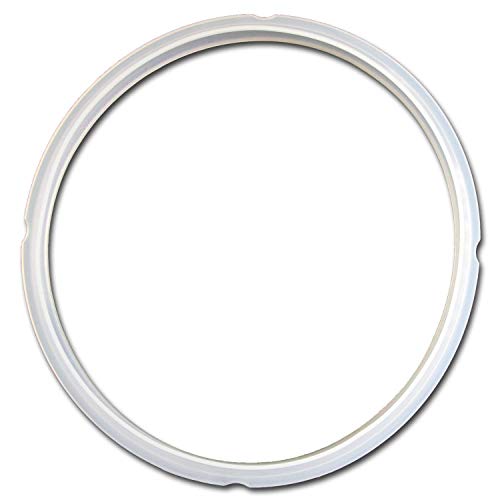
The gasket is a genuine wear item too, which is why replacement sealing rings for the NPC-9 are easy to find and worth keeping on hand. Add it up and this is a machine with a finite electronic lifespan and no gauge to prove it is still accurate along the way. Buy it knowing that, and the durability number below is why.
Living with it
Day to day, in the lane it belongs in, the Nesco is pleasant. There is no pressure to hold by hand and nothing to time by ear. For water bathing and light jobs, owners like the walk-away rhythm:
For me, if nothing else, I love mine for water bath canning, but I'm also happy to use it for pressure as well. So nice to be able to set it and walk away.
It also goes where a stovetop canner can't. Because it runs on a countertop instead of a burner, owners park it on a porch or in a garage to keep the heat and the smell of an all-day batch out of the kitchen:
I recently got an electric Nesco pressure canner and cooker combo. I have been using it outside on my porch because I am sick of the smell of bone broth cooking day in and day out in my house.
The real catch is that it is small and a little fussy for what it is. You still empty and refill it between jobs, the capacity is modest, and more than one canner has decided the trouble outweighs the convenience:
It would be an expensive water bath canner with limited capacity.
None of that sinks it for the job it suits. For high-acid water bathing and everyday cooking, where you are watching the process anyway, the walk-away convenience wins. It only becomes a real problem when you ask it to be the one canner you trust for low-acid food.
How it compares
Three machines come up whenever someone is deciding between the Nesco and something else. The lesson from people who went hunting for a fully trustworthy electric canner is worth hearing first:
I looked for this as well, and as far as I can tell it does not exist.
That is why every fair comparison ends up pointing at a stovetop canner. Here is a clear read on the three that come up most.
Versus a stovetop Presto 01781: the canner the hobby actually recommends. It costs a little more than the Nesco, holds far more, and has a dial gauge you can test for accuracy and tested USDA recipes written for it. The trade is that you run the pressure yourself on a stove that can take the weight. For anyone whose real goal is pressure canning, this is the machine, not the Nesco.
Versus the Presto Precise Digital: if the electric, hands-off format is the specific appeal, the Precise is the stronger version of the same idea. It carries the same not-independently-verified caveat, but it comes from a century-old canning company that developed it to meet USDA guidelines, and it holds a full seven quart jars. You pay roughly double the Nesco for it.
Versus the All American 921: the opposite philosophy entirely. No electronics, a metal-to-metal seal, a testable dial, and a body you can rebuild and hand down. It is heavy, pricey, and wrong for a glass-top stove, but nothing about it can silently drift or fail. If the Nesco's unverifiable electronics are what bother you, this is the cure.
Using it safely
If you own one or buy one, keep it on the right side of the line and it earns its place. Use it for water-bath canning of high-acid, properly acidified recipes, where you can watch the boil and time it. Run the valve deliberately: rotate the whole dial to the side that lines up correctly on exhaust and confirm steady steam before you trust the timer. Keep a spare gasket on hand, and run a water-only test cycle when the unit is new so a sealing problem shows up before there is food on the line. For low-acid foods, meat, beans, plain vegetables, and stock, process them in a tested stovetop canner instead, and treat the Nesco's pressure mode as a cooker, not a canner. The community's standing advice is blunt and worth repeating:
If you're asking this sub specifically, we don't recommend any brand of electric pressure canners for exactly the reason u/poweller65 said - lack of independent testing to ensure safety. We do recommend Presto stovetop pressure canners.
New to all of this and not sure which foods need pressure at all? Start with our water bath vs pressure canning guide, which sorts high-acid from low-acid and shows exactly where a machine like this can and cannot go.
The NPC-9 verdict
As a cheap, small water-bath canner and a countertop pressure cooker, the Nesco NPC-9 is a likeable little machine. It's inexpensive, it's easy on a glass-top stove, and for high-acid jars and everyday cooking the walk-away convenience is the whole point. Bought for that, owners are glad they have it.
But the label says canner, and the one job that word promises, safely pressure canning low-acid food, is the one job we can't tell you to trust it with. No independent testing backs it, there's no gauge to verify it, and the hardware quirks land on exactly the wrong machine. So our answer is split: yes as a second, small water-bath canner and pressure cooker if the price and footprint fit your kitchen, and no as the canner you rely on to put up meat and vegetables. For that, buy a stovetop Presto or an All American, and if you specifically want digital, step up to the Presto Precise.
Our Ratings
Overall score
Split the machine and the score makes sense. As a water-bath canner for high-acid foods it works, because the boil is verified by eye, and owners who stay in that lane are happy. As a pressure canner for low-acid foods, its defining job, it can't prove it hit and held the required temperature, no independent lab has verified any electric unit, and the USDA approves no canner of any kind. A canner that can't be trusted with low-acid processing can't score well on preservation, however pleasant it is to run.
Everything rides on a control board and a sensor, with no gauge to read mid-cycle or send off for calibration, so a drift or failure can hide behind a confident display. Owners report units that behave differently out of the box, valves that spew water, and firsthand distrust after hard use. The gasket is a real wear item. Plan on a finite electronic lifespan with no way to verify accuracy along the way.
The walk-away rhythm is the genuine draw: no pressure to hold, nothing to time by ear, and it's kind to a glass-top stove. What pulls the number down is that hands-off only helps if the controls are trustworthy, and they're fiddly where it matters, most notably an exhaust-versus-airtight valve that can look set correctly while it isn't. Fine for watching a water-bath boil, unnerving on anything you're trusting for safety.
Nesco NPC-9 Electric Pressure Canner on Amazon.
What People Are Saying
Owners split cleanly by how they use it. People who run the Nesco for water-bath canning and everyday cooking tend to love it: it's cheap, small, easy on a glass-top stove, and foolproof to set and walk away from. The heat is all about the pressure side.
No independent lab has verified any electric canner for low-acid processing, the USDA approves no canner at all, and canners who track the testing say the electric units an extension has bench-tested, Nesco and Carey included, didn't pass. Layer on real hardware quirks, a valve that can line up wrong, a display that skips a step, units that spew water, and the picture is consistent. We read it the same way the most careful owners do: a fine little water-bath canner and pressure cooker, and not a machine to trust for low-acid pressure canning.
We weight candid owner reports from Reddit and preservation forums above brand-influenced editorial coverage, then reach our own verdict from them. The quotes below are the evidence; the rating and the take are ours.
What Reddit Is Saying
“If it can boil water and hold it at boiling temps and cover the jars enough it should be fine.”View thread →
“For me, if nothing else, I love mine for water bath canning, but I'm also happy to use it for pressure as well. So nice to be able to set it and walk away.”View thread →
“Hoping for some guidance on what is considered a safe brand of electric pressure canners? I’m in Canada and the presto is nearly 600 bucks which feels way way too pricy. I’ve seen mixed reviews on Nesco - thoughts?”View thread →
“the dials and locking on the pressure canner always filled me with a bit of anxiety as to whether I'd done it right and correctly read the guage.”View thread →
“An electric canner is ok for water bath canning as the process is able to be monitored by observation. It’s just not approved for pressure canning.”View thread →
“But not all products the same long history as far as USDA and the formal Agricultural Extensions are concerned. They also usually don't fit as many jars and might not work as well at high altitude.”View thread →
“I recently got an electric Nesco pressure canner and cooker combo. I have been using it outside on my porch because I am sick of the smell of bone broth cooking day in and day out in my house.”View thread →
“I looked for this as well, and as far as I can tell it does not exist.”View thread →
“No independent organization like the nchfp has been able to verify they are safe through testing and presto has not provided the information about their own testing for evaluation”View thread →
“Electric canners lack consistent temperature and pressure regulation and cannot be relied on to correctly can food. Without proper heat and pressure for the proper amount of time you are at increased risk of botulism and other food-borne illness.”View thread →
“If any part of the computer's chip in the canner should fail it could give a very false sense of security that the pressure and heat is accurate per the display when in fact, it could be very wrong.”View thread →
“I used a Nesco electric canner. I thought I was being extra safe by doing this but again… I know now water bath and watching the temp is better.”View thread →
“If you're asking this sub specifically, we don't recommend any brand of electric pressure canners for exactly the reason u/poweller65 said - lack of independent testing to ensure safety. We do recommend Presto stovetop pressure canners.”View thread →
Frequently asked questions
Is the Nesco NPC-9 Electric Pressure Canner worth it?
The walk-away rhythm is the genuine draw: no pressure to hold, nothing to time by ear, and it's kind to a glass-top stove. What pulls the number down is that hands-off only helps if the controls are trustworthy, and they're fiddly where it matters, most notably an exhaust-versus-airtight valve that can look set correctly while it isn't. Fine for watching a water-bath boil, unnerving on anything you're trusting for safety.
How is the Nesco NPC-9 Electric Pressure Canner built?
Everything rides on a control board and a sensor, with no gauge to read mid-cycle or send off for calibration, so a drift or failure can hide behind a confident display. Owners report units that behave differently out of the box, valves that spew water, and firsthand distrust after hard use. The gasket is a real wear item.
What is the Nesco NPC-9 Electric Pressure Canner best suited for?
Split the machine and the score makes sense. As a water-bath canner for high-acid foods it works, because the boil is verified by eye, and owners who stay in that lane are happy. As a pressure canner for low-acid foods, its defining job, it can't prove it hit and held the required temperature, no independent lab has verified any electric unit, and the USDA approves no canner of any kind.
What do real owners say about the Nesco NPC-9 Electric Pressure Canner?
Owners split cleanly by how they use it. People who run the Nesco for water-bath canning and everyday cooking tend to love it: it's cheap, small, easy on a glass-top stove, and foolproof to set and walk away from. The heat is all about the pressure side.
Options Worth Checking Out

All American 921 21-Quart Pressure Canner
If your real goal is to safely pressure can meat and vegetables, this is the buy-it-for-life answer. It clamps metal to metal with no gasket to wear out, the dial can be tested, and there's no board to fail. Heavy, pricey, and close to indestructible.

Presto 01781 23-Quart Pressure Canner and Cooker
The stovetop canner the hobby recommends, for a little more than the Nesco but with real capacity and tested USDA recipes written for it. Its dial gauge can be checked for accuracy. You manage the pressure yourself on a stove that can take the weight.

Presto Precise 12-Quart Digital Pressure Canner
Want the electric, hands-off format specifically? This is the stronger version. Same not-verified caveat, but it's from a century-old canning company that built it to meet USDA guidelines, and it holds seven quart jars. Roughly double the Nesco.
You Might Also Need
Accessories worth grabbing alongside your purchase