KoMo
KoMo Classic Grain Mill Reviews (2026)
By Ruth Alvarez · Updated October 2026
Independent editorial review. We never accept payment for coverage, though we may earn a commission if you purchase through our links.

Verdict
Home millers separate their feelings about the mill from their feelings about the company, and cleanly. Owners who receive a KoMo are overwhelmingly happy with it: the stones grind fine, even flour across a wide range, it runs quietly enough to leave on the counter, and the beech or walnut cabinet counts as a feature in its own right, with many saying it easily beats the Nutrimill it replaced. The frustration is all in the acquisition. KoMo is not on Amazon, the US market runs through essentially one distributor, and buyers report waits from a couple of months to well over a year, dates that slip repeatedly, and price increases landing mid-preorder. A smaller but real thread covers arrival quality: dings, finish flaws, and seal unevenness that feel out of place on a mill this expensive. What the threads tell us is that the community loves the machine and has largely stopped defending the way it is sold, which is roughly where we ended up too.
Read full take ↓Similar grain mills
The KoMo Classic grain mill is the mill people in home-milling threads describe like a piece of furniture as much as an appliance. It is a solid beech box, handmade in Austria, with a pair of corundum-ceramic stones inside that grind wheat from exceedingly fine pastry flour down to coarse meal. Sold in the US as the Classic and known elsewhere as the Fidibus Classic, it is the flagship of a family that includes the Fidibus 21, the larger Fidibus XL, and the compact Mio, all sharing the same stones. Owners leave it out on the counter because it looks good there, and they tend to talk about it in lifetime terms.
Wanting one and getting one are two very different projects. KoMo is not on Amazon in any real way; in the US it runs almost entirely through a single distributor, and for the last couple of years buyers have faced waits measured in months, order dates that slip and slip again, and price increases that landed mid-preorder. A minority also open the box to cosmetic flaws nobody expects at this price. So the question we set out to answer was not whether the mill is good. It is whether the mill is good enough to justify the saga, or whether a NutriMill or Mockmill you can have this week does the job.
The short version
A beautiful, capable mill that most owners adore once it arrives. Nearly every complaint is about the ordering process, not the machine.
What's good:
- Corundum-ceramic stones grind from very fine flour to coarse meal, and the mill can run continuously so batch size is up to you.
- A solid beech cabinet built to be left on the counter, quiet enough that owners keep it out instead of hiding it in a cabinet.
- Self-sharpening stones and a 12-year warranty back the lifetime reputation, and it beats the old Nutrimill it replaced.
- Interchangeable stones and a shared design across the Classic, Fidibus, and Mio line mean parts and knowledge are easy to find.
What's not:
- It is not on Amazon; in the US it is effectively one distributor, and waits have run from a couple of months to well over a year.
- Order dates slip repeatedly and prices have risen mid-preorder, which several owners found harder to forgive than the wait itself.
- A real slice of buyers open the box to dings, finish flaws, or seal unevenness that feel unacceptable at a premium price.
- It is heavy, and a same-spec Mockmill grinds a touch faster for a touch less, so you are partly paying for the wood and the looks.
Who it's for
Patience is the qualifying trait. Work out where you stand on that before you join a waitlist.
Buy it for:
- Regular bakers who mill often and want a mill they will keep out and use daily, where the beech cabinet is a feature, not a splurge.
- Sourdough and artisan bakers who care about a wide fine-to-coarse range and a stone grind rather than an impact mill.
- People replacing a bulky, loud plastic mill who want something quieter, easier to clean, and far nicer to store on the counter.
Skip it if:
- You want to be milling this week; the NutriMill Harvest is the closest stone mill you can buy today.
- You mill purely for throughput and do not care about looks; a WonderMill makes fine flour fast for less, as our review lays out.
- You are on a tight budget or milling occasionally; an impact mill covers the basics for a fraction of the KoMo outlay.
If you are still deciding between a stone mill and something simpler, our guide to electric versus manual grain mills walks through where a mill like this is worth it and where it is overkill.
The specs that matter
Three lines on the Classic's spec sheet do all the work. Everything else is detail.
Corundum-ceramic stones, about 85 mm, from finer than 0.3 mm to coarse: this is the range that lets one mill make delicate pastry flour and cracked grain for porridge, and it is the reason stone-mill owners rarely go back to an impact machine. The stones are self-sharpening, so they hold their bite over years rather than needing service.
A 360-watt motor rated for continuous running: the Classic mills roughly 100 grams a minute at the fine setting and faster as you open it up, and because it can run non-stop you refill the hopper and keep going for whatever quantity you need. That makes batch size a matter of patience, not a hard ceiling.
A solid beech body that weighs about 18 pounds: the wood is the point here. It is sustainably sourced, finger-jointed, and finished with plant oils, and it is why owners leave the mill on the counter. The weight also keeps it planted while it works, though it is not something you will tuck away between bakes.
How well it preserves
Owners who make it through the wait say much the same thing about the flour. The corundum-ceramic stones take wheat to a fine, even grind and open up to coarse meal when you want it, and bakers coming from an impact mill or a bulky plastic unit call the switch a clear upgrade. One long-time miller measures it against the machine she retired:
I waited for my Komo because I wanted the walnut color. It took about 6 weeks. So glad I did. It is so much easier than my old Nutrimill Classic. I mill a lot and it never fails me. It is beautiful and sits out on my counter.
The same story turns up again and again. Owners who kept an old NutriMill for backup reach for the KoMo every time, to the point of doubting they will ever run the old one again:
This is about my exact same story!!! I still have my nutrimill classic but I doubt I will ever use it again. I love my walnut KOMO!!
Grind quality is not unique to the Classic, either, since the whole family shares stones. Useful to know if you are cross-shopping within the line. An owner who runs both the Classic and the Fidibus 21 settles the fineness question:
The Komo Fidibus 21 is a really nice mill. I have it and a Komo classic. Not much difference in speed of milling between the two and no difference in fineness capability. I’m sure the Mios are just as good I just prefer the all wood housing.
Speed is the limit, not quality. A same-size Mockmill grinds a little faster, and nobody should buy a KoMo to mill many pounds in one sitting. For the range and the flour it produces, and for the ability to run continuously until you have what you need, it matches anything in its class.
Built to last
On paper and in reputation the KoMo is a lifetime machine. Twelve-year warranty, self-sharpening stones, a solid beech cabinet, owners who talk about handing it down. Plenty of units arrive perfect and stay that way, and a Fidibus XL owner speaks for the well-built majority:
I have a Fidibus XL and it's flawless. I would check the burrs if they are completely clean or not. Maybe the unit isn't totally brand new? In any case, I would still contact them (KoMo) or the reseller from whom you bought it.
A premium price makes the arrival-quality complaints harder to swallow, and there is a real cluster of them. Dings, uneven finish, seal problems. The frustration runs hottest precisely because the mill is sold as an heirloom. One owner was underwhelmed enough to wish he had canceled:
I’m in the same boat as OP. I am very underwhelmed by the finish. Unboxed mine 2 days ago and I was expecting more from a premium product. Waited a year for something that would look as good as it worked. I bought a Mockmill 200 while I was waiting and with minimal difference in functionality I wish I had stuck to my gut and canceled my order.
A replacement does not always fix it either. One buyer documented a second unit arriving with glue residue and a scrape, then said out loud what a lot of people are thinking about the wood premium:
I received the ‘replacement’ today that was supposed to be “inspected”. The mill still came with the original concerns+this wooden cover came with glue residue with a scrape, still VERY UNDERWHELMING given the price. I have yet to decide on what to do. Just to give everyone context, I already have a Nutrimill steel grind mill, I ordered Komo Mill solely for its stone grind and aesthetic features. Otherwise for the price, Mockmill 200 is more of a better choice(grinds faster and a tad cheaper).
Keep it in proportion, though. Even owners reporting flaws agree they are cosmetic rather than mechanical, and one who received a clean unit puts the QC problem in its place: real, serious, and not the norm:
I got my Fibidus Classic last year from Pleasant Hill, and it arrived in excellent condition! The corner and seal issue you mentioned is definitely not standard. It’s a serious quality control problem. Sure, it’s just a tool and cosmetic, but considering the price, I consider those flaws unacceptable. Contact the store and ask for a replacement, if they have any.
So the picture splits. Excellent mechanism, long warranty, most units flawless. Finish quality control inconsistent enough at this price that you should unbox it carefully the day it lands and use the retailer's return path immediately if something is wrong. Take that inconsistency out and this axis would score with the other two.
Living with it
Owning one is a pleasure, and daily use is where the money and the wait pay off. It runs quietly enough to live on the counter and get used constantly, the self-sharpening stones ask for almost no maintenance, and the beech cabinet is something you want to look at rather than something you hide. People who came from a bulky plastic mill keep mentioning how much easier it is to keep out and clean.
Looks stop being vanity when a machine this size sits in the open, and owners weigh the cabinet heavily. The walnut version gets called the best-looking mill on the market, which is worth something when you see it every morning:
The main difference is appearance. The Komo Fidibus in walnut is inarguably the most attractive grain mill in the market. If you keep your mill on the counter, that's a real consideration.
Shared parts across the line matter too. The Classic, Fidibus, and Mio use compatible components, so stones and spares are easy to source. That is a large part of why the mill reads as a long-term buy rather than a gamble:
I went with a Komomio also as they have interchangeable parts to the Schneider Cearlo incase new stones are needed quickly ... prive value of Komo is great in my opinion
The one real friction is weight. Close to 18 pounds means it is not a mill you shuffle around the kitchen. Most owners call that a fair trade for something that stays put, stays quiet, and still looks good after years of daily use.
How it compares
Three mills come up every time somebody weighs the KoMo's price against its lead time.
Versus the Mockmill: this is the comparison that defines the category, because the two mills come from the same lineage and share stones, size, and operation. A same-size Mockmill grinds a touch faster and usually costs a little less, and owners who cross-shop them say the difference in the flour is essentially nil. What you pay the KoMo premium for is the solid-wood cabinet and the looks, which a KoMo owner who also weighed the Mockmill states plainly:
Baseline, Mockmill and KoMo are virtually the same. They basically have the same stones, size, and operation. Obviously which variant you get will make a difference. You're likely not going to be able mill enough for 60 loaves with anything other than than the MM200 Pro or the KoMo XL Pro. But it does depend how much flour that actually is and what your process is.
Versus the NutriMill Harvest: the Harvest is the KoMo's closest stone-mill rival that you can buy on short notice, and it is the mill many people settle on when the KoMo wait wears them down. It uses the same style of corundum-ceramic stones and covers a similar fine-to-coarse range in a bamboo body for less money. Our NutriMill Harvest review digs into where it matches the KoMo and where the German mill still feels like the nicer object.
Versus the WonderMill: if you care about throughput more than a stone grind or a pretty cabinet, an impact mill like the WonderMill makes very fine flour fast and costs less than the KoMo. It is loud and plain and cannot be washed, so it is a different philosophy of mill entirely. Our WonderMill review covers who is better served by raw speed than by stone-milled flour.
Using it well
Start on a middle setting and work finer once you know how your grain behaves, because very fine flour mills slower and warms the stones more. Feed it clean berries. Grit and small stones are what damage burrs, so buying grain from a reputable source is cheap insurance on an expensive machine. Milling several textures in one session? Run the coarse settings first. And let it work at its own pace across refills rather than pushing volume through it in a hurry.
Most people buy a mill like this to bake, and fresh stone-milled flour behaves differently from the bag. If sourdough is your goal, our guide to the best grain mill for sourdough covers grind fineness, hydration, and how a stone mill like the KoMo fits a real sourdough workflow, with the alternatives in context.
Is the Komo worth it
This mill earns real affection, which is rare for an appliance. It grinds beautiful flour across a wide range, runs quietly enough to live on the counter, and sits in a beech cabinet people display on purpose and expect to hand down. For a baker who mills often and wants the nicest version of the tool, the enthusiasm in the threads is loud and repeated. Performance and ease of use are why those two numbers sit high.
The problems are almost entirely about buying it rather than owning it. No Amazon listing, a single narrow US channel, and recent buyers who waited many months, watched dates slip, and were asked for more money than they signed up for, with the occasional cosmetic flaw waiting in the box. Our call: if you mill often and can wait without resenting it, order the KoMo and unbox it carefully the day it arrives. If you want fresh flour this month, or the cabinet means nothing to you, a NutriMill Harvest or a Mockmill gets you nearly all of the flour and none of the saga.
Our Ratings
Overall score
The KoMo's strongest axis. Corundum-ceramic stones take wheat from exceedingly fine pastry flour down to coarse meal, and the 360-watt motor is rated for continuous running, so batch size comes down to patience rather than a hard ceiling. Coming from an impact mill or a bulky plastic unit, the improvement in the flour is obvious, and since the whole Classic and Fidibus line shares stones, that quality holds right across the range. A same-size Mockmill grinds a touch faster. On range and flour quality, the KoMo matches anything in its class.
The mechanism is built to outlive you: self-sharpening stones, a solid beech cabinet, a 12-year warranty, and plenty of owners years in without trouble. Arrival quality control is what drags this score down. A real cluster of buyers open the box to dings, uneven finish, or seal problems, and at this price those flaws sting badly, particularly when the replacement shows up with damage of its own. Every fault owners report is cosmetic rather than mechanical. They are still common enough that you should unbox the mill the day it lands and use the retailer's return path if it is not right.
Where the money and the wait come back. It runs quietly enough to leave out and use daily, the self-sharpening stones need almost no upkeep, and the beech cabinet earns its counter space instead of being hidden in a cupboard. It is far easier to store and clean than the loud plastic mill it replaced, and the walnut version is about the best-looking mill you can buy. The only real friction is weight. Close to 18 pounds means it stays put, which for most owners is the point.
What People Are Saying
Home millers separate their feelings about the mill from their feelings about the company, and cleanly. Owners who receive a KoMo are overwhelmingly happy with it: the stones grind fine, even flour across a wide range, it runs quietly enough to leave on the counter, and the beech or walnut cabinet counts as a feature in its own right, with many saying it easily beats the Nutrimill it replaced. The frustration is all in the acquisition.
KoMo is not on Amazon, the US market runs through essentially one distributor, and buyers report waits from a couple of months to well over a year, dates that slip repeatedly, and price increases landing mid-preorder. A smaller but real thread covers arrival quality: dings, finish flaws, and seal unevenness that feel out of place on a mill this expensive. What the threads tell us is that the community loves the machine and has largely stopped defending the way it is sold, which is roughly where we ended up too.
We weight candid owner reports from Reddit and preservation forums above brand-influenced editorial coverage, then reach our own verdict from them. The quotes below are the evidence; the rating and the take are ours.
What Reddit Is Saying
“I waited for my Komo because I wanted the walnut color. It took about 6 weeks. So glad I did. It is so much easier than my old Nutrimill Classic. I mill a lot and it never fails me. It is beautiful and sits out on my counter.”View thread →
“This is about my exact same story!!! I still have my nutrimill classic but I doubt I will ever use it again. I love my walnut KOMO!!”View thread →
“I seem to remember Pleasant Hill Grain is the one-and-only(?) distributor for Komo. I ordered a Komo mill from them and it took 6-7 months and several communications back and forth (tgem notifying me of delays, options) to get here. It was worth the wait.”View thread →
“I also ordered my Komo Fidibus 21 back in Aug '25 and experienced the same repeated delays and then the price hike. While frustrating, I went ahead with the order and received the mill in May. Overall I'm really happy with the mill and don't regret going through with it. I got the standard wood, not the walnut option. I understand your frustration because I experienced it too.”View thread →
“The Komo Fidibus 21 is a really nice mill. I have it and a Komo classic. Not much difference in speed of milling between the two and no difference in fineness capability. I’m sure the Mios are just as good I just prefer the all wood housing.”View thread →
“I have a Fidibus XL and it's flawless. I would check the burrs if they are completely clean or not. Maybe the unit isn't totally brand new? In any case, I would still contact them (KoMo) or the reseller from whom you bought it.”View thread →
“The main difference is appearance. The Komo Fidibus in walnut is inarguably the most attractive grain mill in the market. If you keep your mill on the counter, that's a real consideration.”View thread →
“I went with a Komomio also as they have interchangeable parts to the Schneider Cearlo incase new stones are needed quickly ... prive value of Komo is great in my opinion”View thread →
“I got my Fibidus Classic last year from Pleasant Hill, and it arrived in excellent condition! The corner and seal issue you mentioned is definitely not standard. It’s a serious quality control problem. Sure, it’s just a tool and cosmetic, but considering the price, I consider those flaws unacceptable. Contact the store and ask for a replacement, if they have any.”View thread →
“Baseline, Mockmill and KoMo are virtually the same. They basically have the same stones, size, and operation. Obviously which variant you get will make a difference. You're likely not going to be able mill enough for 60 loaves with anything other than than the MM200 Pro or the KoMo XL Pro. But it does depend how much flour that actually is and what your process is.”View thread →
“I’m in the same boat as OP. I am very underwhelmed by the finish. Unboxed mine 2 days ago and I was expecting more from a premium product. Waited a year for something that would look as good as it worked. I bought a Mockmill 200 while I was waiting and with minimal difference in functionality I wish I had stuck to my gut and canceled my order.”View thread →
“I received the ‘replacement’ today that was supposed to be “inspected”. The mill still came with the original concerns+this wooden cover came with glue residue with a scrape, still VERY UNDERWHELMING given the price. I have yet to decide on what to do. Just to give everyone context, I already have a Nutrimill steel grind mill, I ordered Komo Mill solely for its stone grind and aesthetic features. Otherwise for the price, Mockmill 200 is more of a better choice(grinds faster and a tad cheaper).”View thread →
“I am pretty frustrated with the ordering process for the KoMo mill. I placed my pre-order last August (2025). It was originally supposed to arrive in December. November comes, and I get an update that the shipment has been pushed to March. February comes, and I get an order update that the order is now supposed to arrive in May. March comes, and I get an order update that it is now supposed to arrive in June. Today, I received an email that it is still supposed to arrive in June, but Pleasant Hill has cancelled my order because they now need to place a new order to charge me more since it took so long.”View thread →
“Dealing with this company has been a nightmare. I ordered one as a wedding gift in April of 2025. It has yet to be fulfilled (it’s been over a year and a half) and they are now requesting more money due to a price increase. I have tried contacting customer service many times and have not had any response. Such a poorly run company.”View thread →
Frequently asked questions
Is the KoMo Classic Grain Mill worth it?
Where the money and the wait come back. It runs quietly enough to leave out and use daily, the self-sharpening stones need almost no upkeep, and the beech cabinet earns its counter space instead of being hidden in a cupboard. It is far easier to store and clean than the loud plastic mill it replaced, and the walnut version is about the best-looking mill you can buy.
How is the KoMo Classic Grain Mill built?
The mechanism is built to outlive you: self-sharpening stones, a solid beech cabinet, a 12-year warranty, and plenty of owners years in without trouble. Arrival quality control is what drags this score down. A real cluster of buyers open the box to dings, uneven finish, or seal problems, and at this price those flaws sting badly, particularly when the replacement shows up with damage of its own.
What is the KoMo Classic Grain Mill best suited for?
The KoMo's strongest axis. Corundum-ceramic stones take wheat from exceedingly fine pastry flour down to coarse meal, and the 360-watt motor is rated for continuous running, so batch size comes down to patience rather than a hard ceiling. Coming from an impact mill or a bulky plastic unit, the improvement in the flour is obvious, and since the whole Classic and Fidibus line shares stones, that quality holds right across the range.
What do real owners say about the KoMo Classic Grain Mill?
Home millers separate their feelings about the mill from their feelings about the company, and cleanly. Owners who receive a KoMo are overwhelmingly happy with it: the stones grind fine, even flour across a wide range, it runs quietly enough to leave on the counter, and the beech or walnut cabinet counts as a feature in its own right, with many saying it easily beats the Nutrimill it replaced. The frustration is all in the acquisition.
Options Worth Checking Out
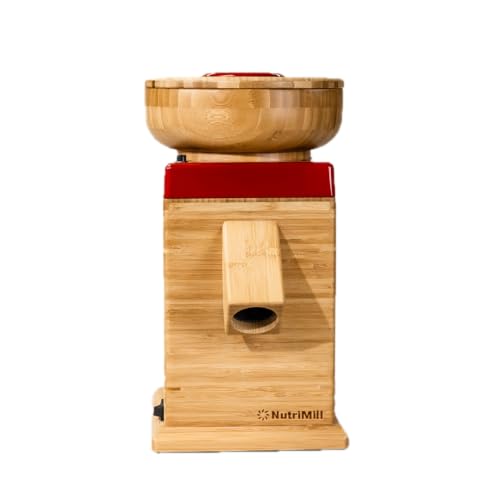
NutriMill Harvest Electric Stone Grain Mill, 450 Watt
The closest stone mill you can add to a cart today. Same corundum-ceramic burrs as the KoMo and the same fine-to-coarse range, for less money and none of the months-long wait. A bamboo body rather than beech, but real stone-milled flour now.

NutriMill Impact Compact High Speed Electric Grain Mill
The cheap, fast way into fresh flour. An impact mill with stainless heads that pulverizes wheat to fine flour in seconds. Not a stone grind, but a fraction of the KoMo price and far easier to find. Louder and plainer, yet it mills well and ships today.
You Might Also Need
Accessories worth grabbing alongside your purchase
