WonderMill
WonderMill Electric Grain Mill Reviews (2026)
By June Park · Updated October 2026
Independent editorial review. We never accept payment for coverage, though we may earn a commission if you purchase through our links.
Verdict
The WonderMill does three things well: it makes very fine flour, it makes it fast, and it needs no fiddling to get there. One owner who also runs a stone mill says he cannot feel the difference in fineness between the two, and another who mills for a small food business picked it for throughput and the lack of any run-time limit. Every complaint lands on ergonomics rather than results. It is bulky and plain, so owners keep asking the sub for a mill they can leave on the counter. It cannot be washed, which turns an ordinary contamination scare into a real problem. Noise splits the room: one buyer chose it because reviews called it quiet, while a cross-shopper ruled it out over noise and bought a stone mill instead. Availability frustrates people too, with buyers describing waitlists and months of watching for stock. None of those complaints are about the flour, which is the tell we pay attention to. Buy it for the output and store it where you cannot hear it.
Read full take ↓Similar grain mills
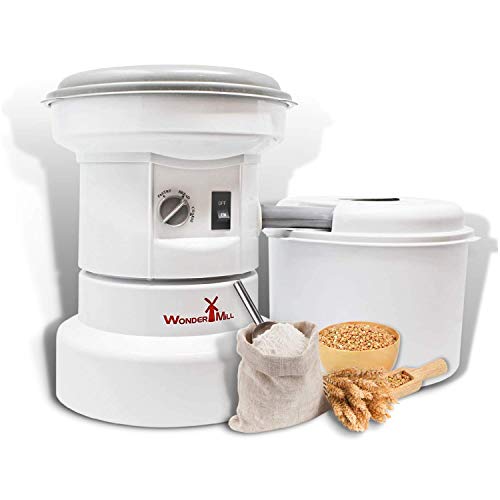
The WonderMill Electric Grain Mill is the white canister mill that turns up in home milling threads any time somebody wants flour in a hurry. It is a micronizer, an impact mill with no stones in it at all: a 1250 watt motor spins milling heads fast enough to shatter grain into powder, and WonderMill rates it at over 100 pounds of flour an hour. One power switch, one texture knob, and a sealed canister that catches the flour instead of dusting your kitchen with it. Check the brand before you order, because the Amazon listing title is generic and says almost nothing: this is the WonderMill, made by Grote Molen in Pocatello, Idaho, and it is not the NutriMill it gets cross-shopped against.
It makes bread flour fast, and for the bakers who buy it to do exactly that, it's an easy machine to like. One owner who runs a WonderMill and a stone mill side by side says he cannot feel the difference in fineness. Every catch is about what the machine will not do. Dry, non-oily grain only, per its own documentation. No washing. Big, plain, white plastic, and it lives in a pantry rather than on a counter. We think that is a fair trade for a lot of bakers and a bad one for a few, and below is how we got there.
The short version
The WonderMill does one job extremely well and flatly refuses a surprising number of others. Every complaint in this review traces back to that trade.
What's good:
- Very fine flour in a single pass, close enough to a stone mill that an owner of both cannot tell them apart by feel.
- Fast, and rated at over 100 pounds of flour an hour with no maximum run time to work around.
- Flour lands in a covered 12-cup canister through an air filter, so a milling session does not coat the kitchen.
- Milling heads are warranted for the lifetime of the original owner, with six years on every other part.
- Dead simple to operate. One switch, one knob, nothing to calibrate before a batch.
What's not:
- Dry, non-oily grain only. The manual bans nuts, sunflower and sesame seeds, flax, coffee, sugar, tapioca and dried fruit outright.
- You cannot wash it. Wipe the body, brush the lid, and flush the chamber with rice, because water must never get inside.
- Three knob positions, not a stone mill’s continuous adjustment, and no re-milling a batch to chase a finer grind.
- Big, white, plastic, and loud enough that cross-shoppers name noise as the reason they bought something else.
- No user serviceable parts, and WonderMill says any attempt to repair it voids the warranty.
- Hard to actually buy. Demand has outrun production, so Amazon does not list it and the grain specialists take preorders against a wait rather than shipping one today.
Who it's for
Wheat, rice, corn and dry beans, and you are in the right place. Flax, sesame or anything oily, and you are in the wrong aisle entirely.
Buy it for:
- Regular bread baking where you want a loaf’s worth of fine whole wheat flour in the time it takes to fill the mixer bowl.
- A prep pantry full of stored wheat, rice, corn and dry beans that you want to be able to turn into flour on demand.
- Gluten-free milling from dry grains such as rice, sorghum and millet, where fine texture matters more than adjustability.
- Anyone who wants a machine with no learning curve: no stones to set, no test batches, one switch.
Skip it if:
- You want to dial texture from cracked grain to fine flour. That is a stone mill’s job, and the NutriMill Harvest is the one to buy.
- You want to mill flax, sesame or nuts. No impact mill will do it, and WonderMill’s own grinding chart sends those items to a hand-crank burr mill.
- You are not sure milling is for you yet. The NutriMill Impact Compact is the cheaper way to find out before committing to a full-size machine.
- You want the mill to live on the counter and look good there. Owners of this one keep asking for something prettier to leave out.
If you are still deciding between mechanisms rather than between models, start with our electric versus manual grain mill guide and come back once you know which type you want.
The specs that matter
Most of the spec sheet is marketing. Three figures on it are not, and you can taste or hear all three.
A 1250 watt micronizing motor rated for over 100 pounds of flour an hour: WonderMill puts that at roughly 12 cups of fine flour in about three minutes, so a single loaf takes well under a minute of actual milling. One owner clocks it at 750 grams a minute, which is the same rating expressed the other way round.
Three texture positions on one knob: the manual calls for the bread setting for most milling, an 11 to 12 o’clock fine setting for pastry flour, and the far coarse position for beans and large grains. It also tells you to return the knob to the bread position afterward, which is a small chore a stone mill does not ask of you.
A 12-cup flour canister fed through an air filter: about eight cups of grain in the hopper fills the canister to its 12-cup limit, so batch size is set by the canister rather than by the motor. Overfill the canister and flour packs above the rim, then spills when you lift the lid.
How well it preserves
Owners back up both of the claims this mill is sold on. The most useful report comes from a baker who keeps a WonderMill and a stone mill in the same kitchen and mills on both:
I have both and they’re close enough that I can’t tell the difference in fineness by feel. One thing you cant do on the wonder mill is run the grain through multiple tjmes, which is possible in the mockmill. I’ve heard people say pre milling at a coarse setting then doing the final milling at the fine setting results in finer flour, I don’t feel the need to do that myself but ymmv. Oats btw tend to clog the mill, I typically mix my oats half with wheat and it runs thorough fine. The alternative is to feed pure oats slowly into the milling chamber and that seems to work too though it’s a giant pain imo.
The flour is fine enough that a working home baker cannot feel the gap. The catch is the workflow: what comes out on the first pass is what you get, with no second run to chase a finer grind. Another owner describes tuning the knob to get there, and his reference point is high praise for a mill in this class:
Our Wondermill makes really nice fine flour, typically crank the dial to as fine as possible and then ratchet back slowly until the grain starts feeding, feels a lot like Caputo 00.
Speed is the other half. WonderMill rates the mill at over 100 pounds of flour an hour, and one owner who moved up from a hand crank and then a blender chose it specifically because of the throughput and the fact that nothing forces you to stop and let it cool:
I got a Wondermill! I got it on eBay pre owned. It came perfectly new and whoever used it maybe used it once or twice. It can grind corn if it is dry corn. Neither the mockmill or Wondermill can grind wet ingredients aka nixtamalized corn (corn cooked and soaked). Nixtamalized corn is the traditional way of making corn dough for tortillas, tamales, etc. some large companies and products do make tortilla chips from grinding dry corn and not nixtamilize. I have only had my Wondermill for almost a month. I started with a marcato mulino in December. It’s a hand crank and it just took too long. Switched over to my vitamix dry blender which is great! As a household of two I would’ve stayed with just that but I’m starting a cottage food operation. The Wondermill grinds 750 grams/min and doesn’t have a max time running the machine so it’s best fit for what I want to do. While I was originally looking to at the mockmill in November/December because of its various settings of cracking to fine flour - I realized majority of what I do won’t use the settings. It’s a good machine just not what I need
That comment also names the limit that matters most, and the manufacturer is blunter about it than any owner. WonderMill’s manual says never to mill grains with a high oil or moisture content, never to attempt wet or damp products, and never to mill nuts, sunflower or sesame seeds, flax, coffee beans, sugar, tapioca or dried fruit. The approved list is dry grain and dry, non-oily legumes: wheat, oats, rice, rye, spelt, kamut, millet, sorghum, buckwheat, dried field corn, popcorn, split peas, chick peas and dry beans. Mill something off that list and the warranty stops covering you, whatever else it does to the machine.
Two smaller notes. Oats are on the approved list but sit right at the edge of what the chamber handles cleanly, and the owner above mixes them half and half with wheat to keep things moving. The mill is also a good deal cheaper than the stone machines it gets compared to, which is why some bakers land here at all:
I purchased the Kitchenaid attachment and I did not like it at all. I sent it back and purchased a Wondermill. It did not mill the flour very fine at all and it got very hot! Plus it took forever to grind small amounts. I really love the Wondermill! However, Mokmill and the rest have amazing reputations! This was what I could afford at the moment and I’m happy.
Read that one carefully. The hot, coarse, slow machine she is describing is the KitchenAid attachment she returned, not the WonderMill she replaced it with.
Built to last
The warranty is unusually strong for a kitchen appliance, and it tells you what WonderMill expects to fail. Grote Molen warrants the milling heads for the lifetime of the original owner and every other part for six years. The catches are worth reading before you buy: the cover applies only to the original, non-commercial owner, it does not apply if you buy from an unauthorized dealer, and it does not cover foreign object damage, which is why the manual pushes triple-cleaned grain from a reputable source.
Owner reports are thin on failures and long on quiet service, which is the pattern you want. The most direct summary of a long ownership run is also the shortest comment in the threads:
Wondermill - Yes! Had mine for years. Fast, efficient, inexpensive.
You cannot fix this mill yourself. WonderMill states that it contains no user serviceable parts and that any attempt to repair it voids the warranty. Nothing to dress, adjust or replace the way you would with stones, so a mill that stops working goes back to Idaho or becomes scrap. The clog procedure in the manual is the one repair you are allowed: unplug it, turn the knob to coarse, tip and tap the grain out, clear the flour outlet, and if the fuse on the bottom has popped, wait two minutes and press the reset button. Learn where that reset button is before you need it.
Supply is the other long-term risk, and it is a real one. Buyers spend months watching for stock, which is worth knowing if you are counting on this mill as a pantry backstop:
Since the wondermill is out of stock and looks like it's hard to get do I wait for it to come back in stock OR do I purchase a Mock Mill, and then the question is 100 or 200? I'm new to this however I also want to make sure I'm purchasing something that will last and I can do what I want. So basically it'll be alot of just wheat flour for the most part but I also want to do corn to make nacho's and torts and then whatever else I find when heading down this little rabbit hole of fun.
Thanks. I ended up getting on a waitlist for Wondermill because of reviews saying how quiet it is, otherwise i think it's fairly comparable to Nutrimill in how it preforms.
Living with it
Cleaning is the part nobody warns you about, and it is where this mill loses its points. The manual says to brush the separator lid, cup and filter after each use, wipe the hopper and body with a damp cloth, and never immerse the mill or let water run into the grinding chamber. There is no way to open the body and look inside. One owner found that out under the worst possible circumstances:
I have an unusual (I hope) issue. We had mice and either threw out food or put it in plastic containers. We hadn't seen activity for a while until I went to the pantry and moved some stuff. There were a bunch of droppings on the shelf next to my Wondermill opening where it attaches to the canister. The exterminator said the mice can get into an opening as small as a dime and the opening to the canister is definitely bigger than that. Is there a way to open the Wondermill and see if there are droppings in it? The instructions say not to get it wet inside. If the mice merely got in and urinated, is there a way to clean the inside? Should I abandon this $400+ machine? The ick factor is high here, but the money to replace it is not currently budgeted for. I did email the company and am waiting for a reply.
The standard answer in the sub is the same one the manual gives, and it works for factory dust, stale flour and a chamber you simply want to reset:
Well they say to run junk grain through the machines to get possible factory contaminates out… I think I would do that. Could do several cups of wheat or rice or something and it will clear junk out
WonderMill agrees. It tells you to mill 400 grams of hard grain and throw the flour away the first time you use the machine, and to run 100 grams of white rice through the chamber to clear a clog. Treat rice as your cleaning tool and the sealed body stops being a problem, as long as you never let anything damp near it.
Noise keeps buyers away, and we cannot settle it for you. Impact mills are loud by nature, and WonderMill markets this one as the quietest grain mill available, which is the sort of claim that starts an argument. Both sides show up in the same subreddit. One buyer chose it because the reviews he read called it quiet. Another cross-shopper ruled it out for the opposite reason:
New owner of a Mio. What kept me from the Wondermill or NM Classic was the noise level. Haven't had enough practice with it to say for certain, but no problems with getting flour fine enough (so far). Went with the Mio because of the 12 year warranty, looks, noise level, size, price and rated performance. Same stones, adjustment mechanism and motor as more expensive KoMo mills like the Classic, same rated output. Looks good enough sitting on the counter that it CAN sit on the counter.
Size and looks draw the other recurring gripe. A tall white plastic machine with a separate canister, and nobody in this harvest calls it attractive. Owners keep asking the sub for something they can leave out instead:
Is there something you did not like about KOMO? UI have wondermill, but I want one to leave out on the counter.
A friend who is an avid baker (bakes 5/7) days per week with her own sourdough, regrets not having a Mockmill or Komo. She says the Wondermill is fine, albeit takes up a lot of space, but she can't wait to get her hands on a Mockmill.
Then there is the grain itself. A mill this fast makes the flour question trivial and the sourcing question urgent, and shipping wheat berries is heavy and expensive:
Hey Everyone, Just got my mill yesterday and very excited to give this a try. Just wondering where are people buying their berries on the east coast? I looked at a few sites and with the shipping prices (Almost as much as the item itself) it's a littie daunting. I have a postal box in Calais, ME, and was thinking that might also be an option as I could have them ordered there and then bring them into Canada. But how long do you think the berries would last? Don't go down as often right now to pick up any parcels. Thanks
How it compares
Every WonderMill thread eventually turns into a cross-shop against these four.
Versus the NutriMill Harvest: the Harvest is the stone-burr answer to everything the WonderMill will not do. It adjusts continuously from cracked grain to fine flour, grinds cooler, and is the mill to buy if texture control is what you are paying for. It costs more, mills more slowly, and looks like something you would leave on a counter. Our NutriMill Harvest review goes through it in full.
Versus the NutriMill Impact Compact: same impact mechanism, much smaller machine, noticeably cheaper. It makes the same style of fine flour with less throughput and a footprint you can store in a cupboard, which makes it the sensible way to test whether home milling sticks before spending WonderMill money.
Versus the Kitchen Mill Model 95: the other American-assembled impact mill in this bracket, with a stainless milling chamber and maker claims of being quieter, faster and cooler. It is the obvious cross-shop when the WonderMill is out of stock, which happens often enough to matter.
Versus a manual mill like the Victoria: buy one as insurance, not as a substitute. It grinds slowly and it is real work, but it runs with no power and it handles the oily seeds and nuts the electric mill is forbidden to touch. Plenty of prep-minded owners keep both.
Using it well
Mill 400 grams of hard wheat and throw that first batch away to clear manufacturing dust, as WonderMill instructs. Leave the knob on the bread setting for almost everything. Drop to fine only when a recipe needs pastry flour, and move to coarse before beans or large grains go in the hopper. Fill the hopper and let it empty rather than topping it up mid-run, which is how you overfill the canister and wear a cloud of flour when you lift the lid. Let it run about five seconds after the last grain goes through to clear the chamber. Keep everything dry, keep oily seeds out entirely, and store berries in an airtight container. The manual is right that moisture is what ruins these.
Flour from any mill is at its best fresh, so mill what you plan to bake within a few days rather than filling a bin. If sourdough is the reason you are buying, our guide to the best grain mill for sourdough covers how grind texture and flour freshness change a loaf, and where an impact mill fits alongside the stone machines.
Who should own a WonderMill
A very good machine with a narrow brief. It makes fine flour fast, it makes a lot of it, it puts that flour in a sealed canister instead of on your cabinets, and the warranty behind it is the strongest in this category. Milling wheat, rice, corn and dry beans for everyday baking? It does that with almost no thought required, and owners years into ownership talk about it in exactly those terms.
Every reason to buy something else is knowable before you order. Fine flour only, one pass at a time. Nothing oily or damp, by manufacturer instruction rather than internet rumor. No washing, no repairs. A loud, plain, bulky appliance that will live in a pantry. If none of that bothers you, we would buy it at this price without hesitating. If any of it does, put the money into a stone mill and take the adjustability instead.
One practical note, since owners keep asking it out loud: you cannot simply add this to a cart today. Amazon has no listing, and the grain specialists sell it by preorder, so choosing the WonderMill means choosing to wait. If you need flour this month, buy one of the mills below instead.
Our Ratings
Overall score
Fineness and speed are what this mill sells, and it delivers both. An owner who mills on a WonderMill and a stone mill says he cannot tell the flour apart by feel, and WonderMill rates the machine at over 100 pounds of flour an hour with no maximum run time. The limits are firm rather than fatal: one pass only, no re-milling a batch, and dry non-oily grain exclusively, with the manual banning nuts, seeds, flax, coffee and anything wet.
The warranty is the best evidence here: lifetime coverage on the milling heads for the original owner and six years on everything else, with no owner in this harvest reporting a failed electric unit. What holds the score back is serviceability. WonderMill says the mill contains no user serviceable parts and that any repair attempt voids the warranty, so beyond clearing a clog and resetting the fuse on the bottom there is nothing you can fix yourself.
Running it is simple, one switch and one knob, but living with it takes adjustment. It cannot be washed, so cleaning means brushing the lid and flushing the chamber with rice. It is a bulky white plastic machine that owners store rather than display, and while WonderMill markets it as the quietest mill available, cross-shoppers in the same subreddit name noise as the reason they bought something else.
What People Are Saying
The WonderMill does three things well: it makes very fine flour, it makes it fast, and it needs no fiddling to get there. One owner who also runs a stone mill says he cannot feel the difference in fineness between the two, and another who mills for a small food business picked it for throughput and the lack of any run-time limit. Every complaint lands on ergonomics rather than results.
It is bulky and plain, so owners keep asking the sub for a mill they can leave on the counter. It cannot be washed, which turns an ordinary contamination scare into a real problem. Noise splits the room: one buyer chose it because reviews called it quiet, while a cross-shopper ruled it out over noise and bought a stone mill instead.
Availability frustrates people too, with buyers describing waitlists and months of watching for stock. None of those complaints are about the flour, which is the tell we pay attention to. Buy it for the output and store it where you cannot hear it.
We weight candid owner reports from Reddit and preservation forums above brand-influenced editorial coverage, then reach our own verdict from them. The quotes below are the evidence; the rating and the take are ours.
What Reddit Is Saying
“Wondermill - Yes! Had mine for years. Fast, efficient, inexpensive.”View thread →
“I got a Wondermill! I got it on eBay pre owned. It came perfectly new and whoever used it maybe used it once or twice. It can grind corn if it is dry corn. Neither the mockmill or Wondermill can grind wet ingredients aka nixtamalized corn (corn cooked and soaked). Nixtamalized corn is the traditional way of making corn dough for tortillas, tamales, etc. some large companies and products do make tortilla chips from grinding dry corn and not nixtamilize. I have only had my Wondermill for almost a month. I started with a marcato mulino in December. It’s a hand crank and it just took too long. Switched over to my vitamix dry blender which is great! As a household of two I would’ve stayed with just that but I’m starting a cottage food operation. The Wondermill grinds 750 grams/min and doesn’t have a max time running the machine so it’s best fit for what I want to do. While I was originally looking to at the mockmill in November/December because of its various settings of cracking to fine flour - I realized majority of what I do won’t use the settings. It’s a good machine just not what I need”View thread →
“Our Wondermill makes really nice fine flour, typically crank the dial to as fine as possible and then ratchet back slowly until the grain starts feeding, feels a lot like Caputo 00.”View thread →
“I purchased the Kitchenaid attachment and I did not like it at all. I sent it back and purchased a Wondermill. It did not mill the flour very fine at all and it got very hot! Plus it took forever to grind small amounts. I really love the Wondermill! However, Mokmill and the rest have amazing reputations! This was what I could afford at the moment and I’m happy.”View thread →
“Hey Everyone, Just got my mill yesterday and very excited to give this a try. Just wondering where are people buying their berries on the east coast? I looked at a few sites and with the shipping prices (Almost as much as the item itself) it's a littie daunting. I have a postal box in Calais, ME, and was thinking that might also be an option as I could have them ordered there and then bring them into Canada. But how long do you think the berries would last? Don't go down as often right now to pick up any parcels. Thanks”View thread →
“I have both and they’re close enough that I can’t tell the difference in fineness by feel. One thing you cant do on the wonder mill is run the grain through multiple tjmes, which is possible in the mockmill. I’ve heard people say pre milling at a coarse setting then doing the final milling at the fine setting results in finer flour, I don’t feel the need to do that myself but ymmv. Oats btw tend to clog the mill, I typically mix my oats half with wheat and it runs thorough fine. The alternative is to feed pure oats slowly into the milling chamber and that seems to work too though it’s a giant pain imo.”View thread →
“Thanks. I ended up getting on a waitlist for Wondermill because of reviews saying how quiet it is, otherwise i think it's fairly comparable to Nutrimill in how it preforms.”View thread →
“Is there something you did not like about KOMO? UI have wondermill, but I want one to leave out on the counter.”View thread →
“Well they say to run junk grain through the machines to get possible factory contaminates out… I think I would do that. Could do several cups of wheat or rice or something and it will clear junk out”View thread →
“Since the wondermill is out of stock and looks like it's hard to get do I wait for it to come back in stock OR do I purchase a Mock Mill, and then the question is 100 or 200? I'm new to this however I also want to make sure I'm purchasing something that will last and I can do what I want. So basically it'll be alot of just wheat flour for the most part but I also want to do corn to make nacho's and torts and then whatever else I find when heading down this little rabbit hole of fun.”View thread →
“I have an unusual (I hope) issue. We had mice and either threw out food or put it in plastic containers. We hadn't seen activity for a while until I went to the pantry and moved some stuff. There were a bunch of droppings on the shelf next to my Wondermill opening where it attaches to the canister. The exterminator said the mice can get into an opening as small as a dime and the opening to the canister is definitely bigger than that. Is there a way to open the Wondermill and see if there are droppings in it? The instructions say not to get it wet inside. If the mice merely got in and urinated, is there a way to clean the inside? Should I abandon this $400+ machine? The ick factor is high here, but the money to replace it is not currently budgeted for. I did email the company and am waiting for a reply.”View thread →
“A friend who is an avid baker (bakes 5/7) days per week with her own sourdough, regrets not having a Mockmill or Komo. She says the Wondermill is fine, albeit takes up a lot of space, but she can't wait to get her hands on a Mockmill.”View thread →
“New owner of a Mio. What kept me from the Wondermill or NM Classic was the noise level. Haven't had enough practice with it to say for certain, but no problems with getting flour fine enough (so far). Went with the Mio because of the 12 year warranty, looks, noise level, size, price and rated performance. Same stones, adjustment mechanism and motor as more expensive KoMo mills like the Classic, same rated output. Looks good enough sitting on the counter that it CAN sit on the counter.”View thread →
Frequently asked questions
Is the WonderMill Electric Grain Mill worth it?
Running it is simple, one switch and one knob, but living with it takes adjustment. It cannot be washed, so cleaning means brushing the lid and flushing the chamber with rice. It is a bulky white plastic machine that owners store rather than display, and while WonderMill markets it as the quietest mill available, cross-shoppers in the same subreddit name noise as the reason they bought something else.
How is the WonderMill Electric Grain Mill built?
The warranty is the best evidence here: lifetime coverage on the milling heads for the original owner and six years on everything else, with no owner in this harvest reporting a failed electric unit. What holds the score back is serviceability. WonderMill says the mill contains no user serviceable parts and that any repair attempt voids the warranty, so beyond clearing a clog and resetting the fuse on the bottom there is nothing you can fix yourself.
What is the WonderMill Electric Grain Mill best suited for?
Fineness and speed are what this mill sells, and it delivers both. An owner who mills on a WonderMill and a stone mill says he cannot tell the flour apart by feel, and WonderMill rates the machine at over 100 pounds of flour an hour with no maximum run time. The limits are firm rather than fatal: one pass only, no re-milling a batch, and dry non-oily grain exclusively, with the manual banning nuts, seeds, flax, coffee and anything wet.
What do real owners say about the WonderMill Electric Grain Mill?
The WonderMill does three things well: it makes very fine flour, it makes it fast, and it needs no fiddling to get there. One owner who also runs a stone mill says he cannot feel the difference in fineness between the two, and another who mills for a small food business picked it for throughput and the lack of any run-time limit. Every complaint lands on ergonomics rather than results.
Options Worth Checking Out

NutriMill Harvest Electric Stone Grain Mill, 450 Watt
The stone answer to everything the WonderMill refuses. Real burr stones adjust continuously from cracked grain to fine flour and grind cooler, so texture becomes a choice instead of a fixed setting. Costs more, mills slower, looks good on a counter.

Kitchen Mill Model 95 Electric Grain Mill, Stainless Milling Chamber
The obvious cross-shop when the WonderMill is between shipments. Same high-speed impact format and the same fine single-pass flour, assembled in the USA with a stainless milling chamber and maker claims of running quieter and cooler.

NutriMill Impact Compact High-Speed Electric Grain Mill
Test milling before you commit. Counter-sized, with stainless impact heads producing the same style of fine bread flour for a lot less money, in a body small enough to store in a cupboard. Less throughput, and it only does fine.

Victoria Manual Cast Iron Grain Mill with High Hopper
Insurance rather than a replacement. Cast-iron burr plates and a table clamp mill with no power at all, but they make coarse-to-medium meal, not the fine flour a dedicated mill gives. The maker says it will not grind wheat truly fine, so buy it for resilience, not texture.
You Might Also Need
Accessories worth grabbing alongside your purchase
