Best Dehydrator for Dog Treats (2026)
By Nora Calloway · Updated October 2026
Independent editorial guide. We never accept payment for coverage, though we may earn a commission if you purchase through our links.
Quick Take
For dog treats, buy a box-style dehydrator with metal trays, an adjustable thermostat, and enough capacity to make a real batch. The Cosori Premium Food Dehydrator is the safe default: six stainless trays that wipe clean after raw chicken or liver, a rear fan that dries every shelf evenly, and a low, steady heat that suits the long runs meat and sweet potato want. It is the machine dog owners keep naming.
The reason the tray material and format matter so much is that dog treats are mostly wet, greasy, single-ingredient foods: chicken breast, beef heart, liver, gizzards, sweet potato. Those take hours, not an afternoon, they stick to plastic and pool grease on solid sheets, and organ meat stinks while it dries. A cheap round stacker will still make treats, but you will rotate trays by hand, scrub harder, and wait longer.
Here is what dog treats ask of a dehydrator, and the four machines we would put on your counter for the job. See picks

Search "best dehydrator for dog treats" and almost everything you find is a listicle that never touches a piece of meat. The useful answers live in dog-owner threads, where people dry liver, chicken breast, gizzards, and sweet potato week after week and tell each other exactly what works and what stinks up the house.
Across enough of those threads, the same picture forms. Dog treats are not fruit. They are dense, wet, often greasy foods that need a low temperature held for a long time, trays you can clean after raw meat, room for a batch big enough to be worth the effort, and a plan for the smell. The treats mostly make themselves once a machine covers those four.
So this is not about which brand is trendy. It is about what making treats for a dog demands, why the famous cheap round dehydrators fall short of it, and which four machines handle the job well at four different budgets.
What making dog treats asks of a dehydrator
Start with what goes on the trays. The recurring dog-treat foods in these threads are lean meat and organ meat (chicken breast, beef heart, liver, kidney, gizzards) and a short list of vegetables led by sweet potato. Almost all of it is single-ingredient, both because it is cheaper than store treats and because so many dogs have allergies. One owner who dries treats constantly summed up the whole approach:
The best is the highest quality meat you can afford that is easy to get and prepare and within any diet restrictions. Because they will love it and you'll end up making it a lot! 99% of what I dehydrate is dog treats. My low budget treats I do a lot of lean 90%+ ground beef(Costco frozen) or bison with can pumpkin/freeze dried pumpkin or sweet potato/yams, ground elk antler powder +A dash of cinnamon and tumeric. I like using the dry powders in with the beef as it reduces initial moisture and it forms and dries better. They love thin sliced chicken breast as well. It would be best to use all fresh pumpkin and such but I don't have time for all that. For chicken it's best to get air chilled but that stuff is expensive. (Lower water content but more meat per lb) I guarantee they will love anything you make but it can get very expensive. I splurge on the good grass fed 98% lean stuff once in a while. As long as your dogs have good teeth you can just dry it to a crisp except chicken breast as it gets kinda sharp and spikey when it's too dry.
That tells you what the machine has to do. It needs to hold a low, even temperature for a long stretch, take raw meat without becoming impossible to clean, fit enough food to make a session worthwhile, and not drive you out of the kitchen with the smell. Fruit dehydrators are optimized for none of those. A dehydrator built for meat is, which is why so many owners describe trading up from a basic round unit:
Got this same model from my daughter as a birthday gift. It was an upgrade from the round stackable non fan no temp control cheap dehydrator. Best gift, made jerky but mostly been doing fruits, vegetables and dog treats.
That upgrade, from a fan-less round stacker with no temperature control to a box unit with a real thermostat, is the single most common story in these threads. The rest of this guide is the four reasons it matters.
Plan for long, low runs, not a quick afternoon
Meat and organ treats are a marathon. Owners routinely report drying chicken breast, liver, and gizzards for roughly six to twenty hours depending on thickness, and the goal is usually bone-dry and brittle so the treats keep at room temperature without spoiling. One liver-treat maker described a typical run:
All I did was cut them into fairly uniform pieces and dehydrated them until they were dry and crunchy. I didn’t add anything to them. I think it took around 12 hours at the highest setting on my dehydrator. I flipped them over once during the drying time. They dried nicely and the dogs loved them! Be warned though that the livers smell awful while they’re drying. I’ve since switched to chicken gizzards because they don’t smell nearly as bad while drying.
Another owner who makes gizzards and hearts is precise about the routine, and about why fully dry matters for shelf life:
Chicken gizzards and hearts are our dog's favorite treat. I buy them frozen, defrost just enough to break apart and cook them in my pressure cooker for 10-15 minutes. Then cool them just enough to handle, cut them to size and dehydrate at 140*F for 6-8 hours until hard and crunchy. I store them in a wire bail snap top container with the lid loose at room temperature. I found out the hard way that if I keep the lids closed air tight then mold will form within a few weeks. If I leave the lid loose then they will last for months with no mold forming.
Two things follow for buying. First, you want a thermostat you can set to a low, steady temperature and trust to hold it overnight, because a run this long is not something you babysit. Second, this is the same demand jerky places on a machine, so the mechanics carry straight over from our best dehydrator for jerky guide: a rear fan and metal trays beat a weak round stacker for meat every time. Note too that owners run these times at their own temperatures, and drying heat alone is not a food-safety guarantee, so treat any specific temperature as an owner routine and confirm what is right for your dog with your vet.
Raw meat, small pieces, and easy cleanup
The difference between drying apples and drying liver is grease and mess. Raw meat and wet organ leave a residue that bakes onto trays, and small pieces fall through or weld to the mesh. Tray material and a good non-stick mat matter most for this job. One sweet-potato maker will not go without mats:
I make dehydrated sweet potatoes for my dog. A silicone mat makes it easy to dehydrate and clean up afterwards. I can’t imagine not having the mats. Makes it so much easier and my dog is always needing me to make more dehydrated treats. He loves them. The vet says he has the cleanest teeth he’s seen for a dog his age. Those sweet potatoes are ROCK HARD.
Mats matter even more for wet organ meat, which is the hardest thing to clean off bare trays:
They are very very helpful if you’re dehydrating liver or any other “wet” organ. If you have a dehydrator with metal wiring I highly recommend them, every time I dehydrated liver I nearly always made such a mess and a bunch of powder cause it won’t come off the friggin trays. Edit: I bought the mats with holes, so that there still is airflow and I do not see a change in time it takes for my meat to dehydrate.
There is a real tradeoff to know, though. A solid mat slows meat down because grease pools instead of dripping away, so you end up flipping. The fix owners land on is a mat with holes, or parchment on the tray floor for drips, rather than a solid sheet under the meat itself:
Silicone mats are better for liquids or small items like fruit leather or herbs. Dehydrating beef on a mat will take longer as the liquid will pool up on the mat itself and you will need to flip the beef.
Small pieces are the other cleanup headache, and the good news is you can cut bigger than you think. Meat shrinks a lot as it dries:
I like to buy chicken livers in bulk, which are very cheap. I boil them, chop them and throw em in the dehydrator and the dogs love them. Gizzards as well. And just plain boiled chicken breast. Just remember that they will shrink a lot, so you don’t need to chop them super small or you will end up with little bitty morsels lol.
For buying, the lesson is simple: prefer stainless or metal trays you can scrub and, ideally, put in the dishwasher, and budget a few dollars for perforated silicone mats. Solid plastic trays that stain and hold odor are the thing to avoid for a meat-heavy treat routine.
Capacity comes down to batch economics
The whole reason to make treats instead of buying them is cost, and that math only works if you can make a real batch at once. Owners are blunt about how fast homemade pays for the machine:
I bought this multi function appliance thing with a dehydrate setting, it’s paid for itself over and over in dehydrated sweet potatoes. The bags of dehydrated sweet potato dog treats would cost like 15$ and it barely amounted to 2 potatoes. Since getting my little dehydrator, I’ve dehydrated at least a dozen or two sweet potatoes for my dogs. They get so crunchy. My older husky girl loves them. It’s such a cheap and healthy treat! I’d love to dehydrate liver but oh my god, the smell when I did it in the past.
That is the case for more trays and a bigger footprint. If you have one small dog and make sweet potato chips now and then, six trays is plenty. If you have multiple dogs, or you are drying meat that shrinks to a fraction of its raw weight, capacity is what keeps you from running the machine every other day. One owner buying a big unit put the two use cases together:
No. My old one is round. American Harvest I believe. It’s ooooooold. I just purchased an Excalibur. Hope it’s good. Will be mainly for jerky. Dog and human.
That doubling up, human jerky and dog treats from the same machine, is common, and it is the strongest argument for stepping up to a large flat-tray unit like the Excalibur. More trays cost more up front, but for a busy multi-dog household the per-treat cost drops and you refill the jar far less often.
Yes, it will stink, and that decides where it lives
This is the part the listicles never mention and every dog owner learns fast. Drying organ meat, especially liver and kidney, smells strong, and it lingers. The same sweet-potato owner quoted above, thrilled with how cheap the treats are, still added that she would love to dry liver if not for the smell she remembered from last time. It is not a reason to avoid these treats, which dogs love more than almost anything, but it absolutely shapes where you run the machine.
The practical takeaways from the threads are consistent. Liver and kidney are the worst offenders; chicken gizzards and heart are noticeably milder, which is why several owners switch to them, as the liver-treat maker earlier in this guide did. Many run the dehydrator in a basement, garage, porch, or spare room with a window rather than the kitchen. And because the smell can cling, a machine with dishwasher-safe stainless trays is easier to reset between a batch of liver and a batch of fruit than one with porous plastic. None of this is a dealbreaker, but plan for it: a dehydrator you can move somewhere ventilated is worth more here than in any other use.
A word on what is safe to dry (ask your vet)
This guide is about gear, not veterinary advice, and dog nutrition is deeply individual, so treat everything here as a starting point and let your vet have the final word, especially for a dog with allergies or a health condition. A few points come up so often they are worth stating plainly:
- Onions, garlic, and xylitol are commonly cited as toxic to dogs, so keep them out of anything you dry. When in doubt about an ingredient, ask your vet before it goes on a tray.
- Single-ingredient treats are what owners overwhelmingly stick to, both for cost and because it makes allergies easy to manage. Plain meat or plain vegetable, nothing added, is the common default.
- Raw poultry can carry bacteria, and owners split on whether to cook it first: some pressure-cook or bake meat before or after drying, others dry it raw and report no problems. Drying temperature by itself is not a food-safety guarantee, so this is a good question for your vet.
- Bones matter. Some owners feed dehydrated chicken necks and feet and consider the small bones fine when never cooked; others avoid all bones. This is exactly the kind of call to make with your vet, not a stranger online.
On temperatures and times: the numbers owners share (very roughly, meat somewhere around 140-165F for several hours until brittle, vegetables lower) are their own routines, offered here as context for what these machines are set to do, not as vet-approved safety instructions. Your vet, and your dehydrator's own manual, are the right sources for the settings you actually use.
How the four dehydrators we review compare for dog treats
All four of our picks are box or expandable units with adjustable thermostats, which already puts them ahead of the fan-less round stackers many owners start on. They differ mainly in capacity, tray material, and price.
The Cosori is the all-rounder and our default. Six stainless trays wipe clean after raw meat, the box format and rear fan dry evenly, and it is the brand dog owners name most often for exactly this job. It is the right answer for most dogs and most treats.
The Excalibur is the step up for volume. Ten flat stainless trays and horizontal airflow dry a large batch of jerky or liver in one run, so a multi-dog household refills the jar far less often. It costs more, and recent-production units are worth checking on arrival, but nothing here matches its batch capacity.
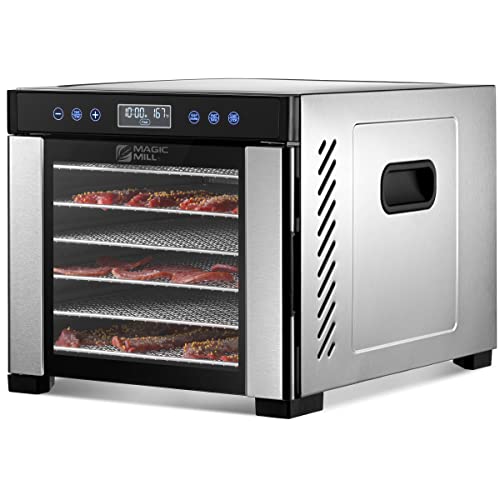
The Magic Mill Pro is the close alternative at a similar price to the Cosori, with seven XL stainless trays and a rear fan. It handles the same meat and organ treats, and at least one owner uses theirs mostly for that:
We got a Magic Mill MFD-7070 and we really like it. It came with 7 stainless steel trays. We are mostly using it to make dog treats from top round beef and boneless, skinless chick breasts. We have plans to branch out to other projects.
The Nesco Snackmaster is the budget entry. The round FD-75A starts small and expands with add-on trays as your batches grow, and its thermostat reaches meat range. You will rotate trays by hand and clean around the center hole, but it makes treats cheaply and has done so for years in plenty of kitchens.
Which one for treats
For most people, get the Cosori. Stainless trays that clean up after raw meat, even drying, and enough capacity for a real batch cover the great majority of dog-treat making without overthinking it.
If you have several dogs or you also make jerky for yourself, step up to the Excalibur for the flat-tray capacity. If the Cosori is out of stock or you want the same job at a similar price, the Magic Mill Pro is the easy swap. And if money is tight, the Nesco Snackmaster will make cheap single-ingredient treats for years as long as you do not mind rotating trays.
Whichever you pick, remember the parts the machine cannot do for you: plan for long runs, keep a few perforated mats on hand, run the smelly stuff somewhere ventilated, and check with your vet about what belongs on the tray in the first place.
Recommended
Products related to this guide.


What owners say
Real owner reports from the threads and editorial sources we drew on for this guide.
“The best is the highest quality meat you can afford that is easy to get and prepare and within any diet restrictions. Because they will love it and you'll end up making it a lot! 99% of what I dehydrate is dog treats. My low budget treats I do a lot of lean 90%+ ground beef(Costco frozen) or bison with can pumpkin/freeze dried pumpkin or sweet potato/yams, ground elk antler powder +A dash of cinnamon and tumeric. I like using the dry powders in with the beef as it reduces initial moisture and it forms and dries better. They love thin sliced chicken breast as well. It would be best to use all fresh pumpkin and such but I don't have time for all that. For chicken it's best to get air chilled but that stuff is expensive. (Lower water content but more meat per lb) I guarantee they will love anything you make but it can get very expensive. I splurge on the good grass fed 98% lean stuff once in a while. As long as your dogs have good teeth you can just dry it to a crisp except chicken breast as it gets kinda sharp and spikey when it's too dry.”
— r/dehydrating / u/KLAM3R0N
“Got this same model from my daughter as a birthday gift. It was an upgrade from the round stackable non fan no temp control cheap dehydrator. Best gift, made jerky but mostly been doing fruits, vegetables and dog treats.”
— r/dehydrating / u/Electronic_Umpire445
“All I did was cut them into fairly uniform pieces and dehydrated them until they were dry and crunchy. I didn’t add anything to them. I think it took around 12 hours at the highest setting on my dehydrator. I flipped them over once during the drying time. They dried nicely and the dogs loved them! Be warned though that the livers smell awful while they’re drying. I’ve since switched to chicken gizzards because they don’t smell nearly as bad while drying.”
— r/dehydrating / u/MickLittle
“Chicken gizzards and hearts are our dog's favorite treat. I buy them frozen, defrost just enough to break apart and cook them in my pressure cooker for 10-15 minutes. Then cool them just enough to handle, cut them to size and dehydrate at 140*F for 6-8 hours until hard and crunchy. I store them in a wire bail snap top container with the lid loose at room temperature. I found out the hard way that if I keep the lids closed air tight then mold will form within a few weeks. If I leave the lid loose then they will last for months with no mold forming.”
— r/dehydrating / u/KBMcF
“I make dehydrated sweet potatoes for my dog. A silicone mat makes it easy to dehydrate and clean up afterwards. I can’t imagine not having the mats. Makes it so much easier and my dog is always needing me to make more dehydrated treats. He loves them. The vet says he has the cleanest teeth he’s seen for a dog his age. Those sweet potatoes are ROCK HARD.”
— r/dehydrating / u/Own-Ad-9098
“They are very very helpful if you’re dehydrating liver or any other “wet” organ. If you have a dehydrator with metal wiring I highly recommend them, every time I dehydrated liver I nearly always made such a mess and a bunch of powder cause it won’t come off the friggin trays. Edit: I bought the mats with holes, so that there still is airflow and I do not see a change in time it takes for my meat to dehydrate.”
— r/dehydrating / u/Zaphod__beatbox
“Silicone mats are better for liquids or small items like fruit leather or herbs. Dehydrating beef on a mat will take longer as the liquid will pool up on the mat itself and you will need to flip the beef.”
— r/dehydrating / u/spazz9461
“I like to buy chicken livers in bulk, which are very cheap. I boil them, chop them and throw em in the dehydrator and the dogs love them. Gizzards as well. And just plain boiled chicken breast. Just remember that they will shrink a lot, so you don’t need to chop them super small or you will end up with little bitty morsels lol.”
— r/dehydrating / u/BravesMaedchen
“I bought this multi function appliance thing with a dehydrate setting, it’s paid for itself over and over in dehydrated sweet potatoes. The bags of dehydrated sweet potato dog treats would cost like 15$ and it barely amounted to 2 potatoes. Since getting my little dehydrator, I’ve dehydrated at least a dozen or two sweet potatoes for my dogs. They get so crunchy. My older husky girl loves them. It’s such a cheap and healthy treat! I’d love to dehydrate liver but oh my god, the smell when I did it in the past.”
— r/dehydrating / u/RavishingRedRN
“No. My old one is round. American Harvest I believe. It’s ooooooold. I just purchased an Excalibur. Hope it’s good. Will be mainly for jerky. Dog and human.”
— r/dehydrating / u/ItchyCartographer116
“We got a Magic Mill MFD-7070 and we really like it. It came with 7 stainless steel trays. We are mostly using it to make dog treats from top round beef and boneless, skinless chick breasts. We have plans to branch out to other projects.”
— r/dehydrating / u/CountyRt17
“Take a look at the Corosi brand. We have their air fryer and dehydrator, and both are fantastic. I have made bananas, peanut butter banana (powdered PB, healthier, no sugar), and sweet potatoes for my dogs. I've also made rabbit, if you have a local butcher shop that carries. It's a shame they're allergic to chicken. Chicken hearts are super cheap and my dogs are snagging them up!”
— r/dehydrating / u/Working5daysaWeek