Are Your Oxygen Absorbers Still Good? How to Tell (2026)
By Theo Marchetti · Updated November 2026
Independent editorial guide. We never accept payment for coverage, though we may earn a commission if you purchase through our links.
Quick Take
Squeeze one. A good oxygen absorber feels soft, like a sachet of fine powder. A spent one feels solid and crunchy, because the iron inside has rusted and caked. That is PackFreshUSA's own published test, and it is the only hands-on check with a manufacturer behind it.
Do not use warmth to judge them. Working absorbers do get warm, but the same instructions say it is normal to feel it and equally normal not to, so a cold packet tells you nothing. And if the factory pack is still sealed, pinch one end and lift: if the sachets slide around inside, the vacuum is gone and the manufacturer says do not use them.
Buying fresh ones, or somewhere airtight to keep the leftovers? See picks.

You open a hundred-pack, use eleven, and then stand there holding eighty-nine absorbers and a question nobody answers well: how long do these last, and how would I even know if they had gone off?
It is a reasonable worry, because the whole product is invisible. Nothing changes color, nothing beeps, and the consequence of a dud is a bucket of rice that looks perfect for two years and is not.
"I'm debating ordering a bunch of oxygen absorbers, so I don't need to think about it for a while, but I don't know if that's a good idea. The entire reason we use mylar bags and oxygen absorbers is because the plastic isn't airtight, so the plastic of the absorbers would probably go bad after a bit, right?" - u/Sufficient_Rest_9722
There are good answers to this, and most of them come from the people who manufacture the things rather than from anyone repackaging them. A few of the rules you have probably absorbed from the internet turn out to be wrong, including one we expected to confirm and could not.
Soft or crunchy, and why warmth tells you nothing
The useful check is tactile. PackFreshUSA's instructions say an absorber should feel soft, like it contains powder, and that one which has been fully exposed feels solid and crunchy. The physics is straightforward: iron oxide takes up more room than the iron it came from, and as it forms it cakes the powder into something closer to a wafer.
Their suggestion for calibrating yourself is a good one. Sacrifice a single packet, leave it out on the counter overnight, and feel the difference. After that you know what you are feeling for permanently. One preserver in these threads arrived at exactly the same test independently, which is reassuring in a way that a manufacturer saying it on its own is not:
"I squeeze as much air out as possible after dropping the o2 absorber in. It should look nearly vacuum sealed after a day or two. If the oxygen absorber was hard and crunchy, then it was bad. It should be soft and feel like fine powder inside. I always vacuum seal my leftover o2 absorbers like 5 at a time. If I only need one or two, I vacuum seal the remaining or they'll go bad. Or you used one that was too small." - u/I-Make-Things-Cold
One honest limit on that. This is PackFreshUSA's published test, not an industry specification. Mitsubishi Gas Chemical, who make the absorbers a good deal of the market repackages, publish a sixty-page technical manual that never mentions it. So treat the crunch test as a strong signal from one serious manufacturer rather than a law of nature.
The other check everyone repeats is heat: a live absorber feels warm, a dead one feels cold. The first half is true and the conclusion does not follow, and the clearest refutation comes from the same instruction sheet as the crunch test, which says it is normal for absorbers to feel warm while they work and also normal not to notice this.
Mitsubishi describes the heat as small, insufficient to cause burns, and lasting only a few minutes. So a perfectly good packet will feel cold if it is small, if your kitchen is cool, if it is the slower-reacting type, or simply if you got to it a few minutes late.
Worse, the test fails in the other direction too. A nearly-spent absorber can still feel warm, because warmth tells you it is reacting right now, not how much capacity it has left. Our advice: never throw away a cold absorber on that evidence alone. Squeeze it instead.
One more thing on heat, buried in the manufacturer's manual and absent from every consumer article we read: do not work from a heap. Mitsubishi says to keep sachets spread out rather than lying one on top of another, because stacked absorbers generate heat and their performance drops quickly. If you tip a hundred-pack into a bowl while you fill bags, you are degrading them faster than the clock is.
The test to do before you open the pack
This is the best thing we found, because it is the only check that happens while the answer is still actionable.
Absorbers ship vacuum-packed inside a master bag. Mitsubishi's instruction is to pinch one end of that unopened bag and lift it: if the contents slide down, the vacuum has been lost and air has been getting in. If the whole thing lifts as a solid block, you are fine. Their verdict on a pack that fails is blunt, that absorbers in a master bag under a less degassed condition are defective and should not be used.
Do that in the shop or the moment the parcel arrives, not after you have cut the bag open, because afterwards there is nothing to learn. The worry comes up in the threads in a more sophisticated form than usual:
"They came in a vacuum-sealed plastic pouch, not Mylar. Now I’m confused: 1) Do they slowly react through the plastic? Does oxygen diffuse through that packaging so they’re already partly used up when they arrive? 2) How fast does that happen? Days, weeks, months? 3) What’s the best way to store unused absorbers once I open the pack? Mason jar, Mylar, vacuum again, something else? 4) How can I tell if an absorber is already spent? (Indicator dot? Paket feels hard/soft?) Thanks for any tips." - u/User1856
The answer is that the master bag is deliberately oxygen-permeable in places, which is exactly why the vacuum state is a meaningful test: pinholes and shipping damage show up as a pack that has gone soft. On unopened shelf life, Mitsubishi guarantees twelve months from shipment stored below 30C and out of sunlight, and notes some products are rated for less. That is a guarantee period rather than an expiry, but it is the only published number we could find, and it is a good deal shorter than the forever most people assume.
You have hours, not fifteen minutes
Every article on this subject tells you that once the pack is open you have about fifteen minutes before the absorbers are spent. We went looking for the source of that number and could not find it in a single manufacturer document.
What the manufacturers actually publish is considerably more relaxed. PackFreshUSA puts full exposure in open air at about two hours, and asks you to finish sealing within ten minutes only so that each packet keeps its rated capacity in reserve, with twenty minutes as the outer limit. Mitsubishi publishes a defined handling time for its water-dependent type of within eight hours below 70 percent humidity, or four hours above it, and halves those figures again in the 25 to 35C band. Some of its other formats are tighter, under an hour.
So the published range across types is roughly one hour to a day, not a quarter of an hour. Heat and humidity do shorten the window, in the direction folklore assumes, but by halvings of hours.
Keep working quickly and open one pack at a time, because capacity in reserve is worth having. But if the phone rang and you were twenty-five minutes, you have not ruined anything, and you certainly should not throw the batch away.
The indicator pill is a leak detector, not an absorber tester
Some packs ship with a small color tablet, and it causes more confusion than it resolves, mostly because people expect it to grade the absorbers.
Pink means oxygen-free. Blue means oxygen is present. Mitsubishi specifies pink at roughly 0.1 percent oxygen or less and blue at about 0.5 percent or more, and Dry Pak reduces it on their own sheet to pink for safe and blue for inspect your packaging. If you have seen it stated the other way round, there is a reason, and it is not your memory: Mitsubishi's own English marketing page gets it backwards in one sentence and right in the next.
Three things the pill will not tell you, all from the manufacturer's manual:
- It lags, and asymmetrically. The color goes blue within minutes of meeting oxygen, but takes two to three hours to return to pink after a bag reaches an oxygen-free state. A bag you sealed twenty minutes ago can look like a failure when it is working perfectly.
- It lies in predictable conditions. It can read blue under high humidity, or below 5C, with no oxygen problem at all. After prolonged heat it turns orange and stops responding altogether. Mitsubishi also asks you to read it against a white background.
- Purple is not a malfunction. The intermediate colors are a reading of intermediate oxygen levels, not a fault.
Most importantly, the pill reads the atmosphere in the package. It is not a test of whether your absorbers were any good, and nothing we found ties its color to remaining capacity. A missing pill means you have no leak check, and that is all it means.
Storing what is left of a hundred-pack
This is the actual problem, and the two manufacturers we could read disagree about the answer, which is worth knowing rather than smoothing over.
Mitsubishi recommends a smaller bag. Asked directly whether a master bag can be opened and closed repeatedly, they say that is undesirable, and that you should repackage the sachets into smaller gas-barrier bags to reduce how often they meet the air. Their own procedure is to squeeze the air out before resealing. If you own a heat sealer, this is the best answer: it minimizes both trapped air and the number of openings.
PackFreshUSA endorses a jar. They suggest another mason jar, closed very tightly, and note that glass and metal are the only permanent barriers to oxygen. Several preservers here do the same thing with a vacuum sealer, including the one quoted above, who reseals leftovers five at a time on the reasoning that otherwise they will go bad.
The jar works, with a catch that is about the headspace rather than the glass. Every bit of air you trap in there is capacity your absorbers will spend on the jar instead of on your food, and a quart of trapped air holds roughly 200cc of oxygen, which is an entire 200cc packet gone. Use the smallest jar that fits them. PackFreshUSA's own fix for a jar that is too big is to fill the dead space with marbles, which is an admission of the same problem.
One detail worth knowing before you reach for the vacuum sealer, and it connects to a different part of this kitchen: running a canning jar under vacuum counts as using that flat lid. The sealing compound takes its impression the first time, and NCHFP is clear that a used lid should not be expected to seal again. Our guide to reusing canning lids goes through why. It works, it just quietly costs you a lid each time you open the jar.
And a small instruction from the manual that we have seen nowhere else: when you come back to a batch you stored, throw the first packet away.
The bag did not go hard. That is not a failure.
More anxiety is generated by this than by anything else in long-term storage, and one number settles it. Oxygen is about 21 percent of air. Absorb every molecule of it and the volume inside can only drop by about a fifth. That is the entire budget, and the community has this right:
"Not every single package 'sucks in to look vacuum sealed' like a lot of people say. Oxygen is only 20% of the air, so they may not shrink around the rice and beans. If you used a big enough absorber you are all set." - u/captaincrunch00
"Not even remotely. 80% of the air will remain. I have no idea where this myth even started. Oxygen (and moisture) absorbers are meant to be used in vacuum sealed bags, they don't make a vacuum." - u/Davisaurus_
So a bricked bag is a good sign, and PackFreshUSA notes that in a rigid mason jar with a domed lid you will see it every time because the lid gets pulled in. In a mylar bag they are equally direct that the 21 percent loss is not always noticeable. If you sealed in a little extra air, or the contents are bulky and loosely packed, nothing visible will happen. Expect the oxygen to be gone within six to twelve hours either way.
"Just a note that using an oxygen absorber in your Mylar bags gives a superior package to vacuum sealing. Your bag might still feel puffy since the oxygen is removed, but it leaves behind the nitrogen which is good. So many reasons, including a complete kill of any possible organism left behind" - u/lr99999
Being honest about the limit in the other direction as well: bricking mostly proves your seal is holding, which is not the same as proving the absorber was fresh, and a bag will pull tight from a vacuum sealer with no absorber in it at all. What absorbers do need is a container that actually holds:
Which raises the question people ask next, and it has its own answer: if a vacuum sealer pulls the bag tight on its own, do you need the absorber at all? You do, for long-term storage, and vacuum sealing versus mylar bags works through why a vacuum is not the same as an oxygen-free package.
"They shouldn't be. Sealed inside mylar bags makes it air-tight- therefore they lower the O2 content in the bag. Using O2 absorbers in a non-airtight container generally renders them useless (They'll just absorb ambient O2 while more floods in.)" - u/TheRealBunkerJohn
"just dump rice, wheat, beans, whatever right into the 5 gallon bucket without Mylar Sure, you could do that. Wouldn't be an issue. Though, there's no reason to use an oxygen absorber if you do do it that way, since buckets are not airtight." - u/TacticalCrackers
Both are right, and it is the single most common way absorbers get wasted. A bucket is not an airtight container. The bag inside it is.
No, you cannot recharge them
Mitsubishi states it in one line in their caution table: oxygen absorbers cannot be reused. The reason is worth understanding, because it also tells you why the workaround people suggest cannot work.
The iron in a spent packet is already iron oxide. Turning rust back into metallic iron needs roughly 700C and a reducing atmosphere such as hydrogen. A kitchen oven reaches somewhere near 260C and is full of air, which is the opposite of what that reaction requires. You are not recharging anything, you are baking rust.
The myth has an honest origin, and knowing it lets you stop the advice when you see it passed along. The other little packet in a lot of packaging, silica gel desiccant, can be dried in an oven and reused. Poison Control says exactly that on the same page where it notes oxygen absorbers are single use only. Two packets, two different materials, one piece of advice that fits only one of them.
The microwave is the part to take seriously. Mitsubishi warns that a package containing an absorber may spark, scorch the package, and on rare occasions ignite. Metal powder in a microwave arcs. That is not a reason to be nervous about sachets sitting in a cupboard, and the manufacturer describes the contents as non-combustible, but it is a specific documented reason never to microwave one.
While we are retiring folk remedies, one more from these threads:
"Hand warmers work for O2 absorbers, if you find then on sale. A hair straightener also works instead of an iron, if you have one in your home already." - u/trombonist2
The chemistry is broadly the same, and the application is not. Hand warmers are built to breathe air continuously rather than to strip a sealed headspace, they carry no rated absorption capacity so you cannot size them to a container, and they are not sold as food grade. Use them on your hands.
Dry food only, and where that rule really comes from
This is the one place we are going to be more careful than the number deserves, because the rule is right even though its provenance is shakier than everyone pretends.
The rule: only bone-dry, low-oil staples belong in a sealed bag with an absorber. Rice, beans, pasta, flour, oats, sugar, dried corn. Clostridium botulinum is an anaerobe, so removing the oxygen removes the thing holding it back, and a moist low-acid food in a sealed low-oxygen package is precisely the environment you never want to build.
Now the part most articles get wrong. The familiar figure is 10 percent moisture or less, and it is routinely credited to the USDA or the FDA. Neither publishes it. It is published by Utah State University Extension, who warn that botulism poisoning may result if moist products are stored in packaging that reduces oxygen, and ask that products be dry at about 10 percent or less moisture content. The FDA's actual published limits are expressed as water activity, with the floor for botulinum toxin formation at 0.935 and the Food Code drawing its regulatory line at 0.91. Those thresholds describe properly wet food, closer to fresh meat than to under-dried apple slices, and the two kinds of number cannot be converted into one another anyway.
So why keep a rule whose headline number has no federal source? Because the thing that actually catches people is moisture you cannot see: case-hardened jerky with a damp center, dried fruit that was never equalized, or a bag that reabsorbed moisture in storage, which NCHFP warns about directly. A generous margin is the right tool when you cannot measure the real variable at home, and you cannot.
Oil is a separate axis with nothing to do with botulism. Brown rice, whole wheat flour, nuts and granola go rancid on their own fats whatever the oxygen is doing. And sugar behaves oddly in a way worth planning for:
"The only problem I see with this list is that when sugar is stored using an oxygen absorber or vacuum seal, it turns into a really hard brick. It is still good but can be a challenge to use. It can be loose in the mylar bag and sealed though." - u/KountryKrone
That is correct and it is not spoilage. Our guide to what not to store in mylar works through the full list.
One last thing absorbers are quietly good at, with a caveat nobody mentions. Low oxygen does kill grain insects at every life stage, which is why sealed wheat stays clean for years. Kansas State's stored-product reference puts the requirement at below 1 percent oxygen held for about twenty days at room temperature. The failure mode is a leaky seal: USDA research found nothing emerged at 1 percent after fourteen days, while at 3 to 5 percent the grain looked fine at fourteen days and adults were still emerging at forty-five. And strangely, lower is not better, since rice weevils survive longer at 0.1 percent than at 1.0 percent by shutting their spiracles and waiting.
How we would buy and check them
Buy absorbers in small sealed sub-packs rather than one enormous bag, because the leftover problem is the whole problem and a ten-per-pouch box solves it at the point of purchase. Pinch-test the pack before you open it. Squeeze a packet if you are unsure, and ignore whether it feels warm.
Size generously. No manufacturer documentation we found describes any harm from using more capacity than you need, while Mitsubishi is specific that undersizing leaves oxygen behind and under-performs, and recommends going larger than calculated when conditions are against you. The arithmetic is just air's composition: multiply the air volume in millilitres by 0.21 and round up. Our oxygen absorber calculator does it per container, and how many a 5-gallon bucket needs covers the bucket case.
And know when you do not need them at all, which is more often than this hobby admits:
"I'll often store things like rice and flour that I'm planning on using up within a year in canning jars. It's air tight and then I'll reuse the jar when it's empty. this is the best way for rotational short-term use stuff for sure. you don't even need to bother with vacuum sealing or o2 absorbers or anything at the 1-year and less with just simple canning jars." - u/TheAspiringFarmer
That is sound. Absorbers buy you decades, not months. For anything you will eat within a year, a jar with a tight lid is already doing the job, and the packet you did not use is one you still have.
Recommended
Products related to this guide.

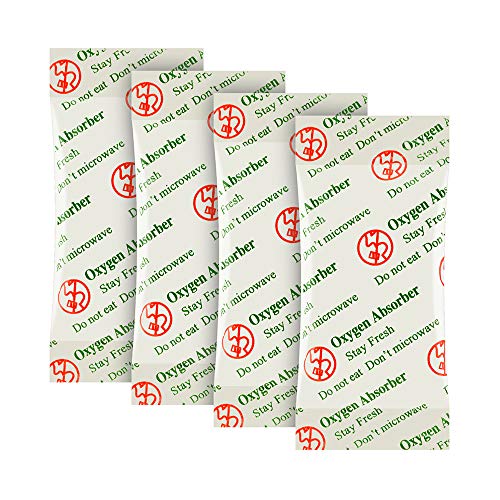

What owners say
Real owner reports from the threads and editorial sources we drew on for this guide.
“I'm debating ordering a bunch of oxygen absorbers, so I don't need to think about it for a while, but I don't know if that's a good idea. The entire reason we use mylar bags and oxygen absorbers is because the plastic isn't airtight, so the plastic of the absorbers would probably go bad after a bit, right?”
— r/preppers / u/Sufficient_Rest_9722
“I squeeze as much air out as possible after dropping the o2 absorber in. It should look nearly vacuum sealed after a day or two. If the oxygen absorber was hard and crunchy, then it was bad. It should be soft and feel like fine powder inside. I always vacuum seal my leftover o2 absorbers like 5 at a time. If I only need one or two, I vacuum seal the remaining or they'll go bad. Or you used one that was too small.”
— r/preppers / u/I-Make-Things-Cold
“Not every single package 'sucks in to look vacuum sealed' like a lot of people say. Oxygen is only 20% of the air, so they may not shrink around the rice and beans. If you used a big enough absorber you are all set.”
— r/preppers / u/captaincrunch00
“Not even remotely. 80% of the air will remain. I have no idea where this myth even started. Oxygen (and moisture) absorbers are meant to be used in vacuum sealed bags, they don't make a vacuum.”
— r/preppers / u/Davisaurus_
“Just a note that using an oxygen absorber in your Mylar bags gives a superior package to vacuum sealing. Your bag might still feel puffy since the oxygen is removed, but it leaves behind the nitrogen which is good. So many reasons, including a complete kill of any possible organism left behind”
— r/preppers / u/lr99999
“They shouldn't be. Sealed inside mylar bags makes it air-tight- therefore they lower the O2 content in the bag. Using O2 absorbers in a non-airtight container generally renders them useless (They'll just absorb ambient O2 while more floods in.)”
— r/preppers / u/TheRealBunkerJohn
“just dump rice, wheat, beans, whatever right into the 5 gallon bucket without Mylar Sure, you could do that. Wouldn't be an issue. Though, there's no reason to use an oxygen absorber if you do do it that way, since buckets are not airtight.”
— r/preppers / u/TacticalCrackers
“Hand warmers work for O2 absorbers, if you find then on sale. A hair straightener also works instead of an iron, if you have one in your home already.”
— r/preppers / u/trombonist2
“The only problem I see with this list is that when sugar is stored using an oxygen absorber or vacuum seal, it turns into a really hard brick. It is still good but can be a challenge to use. It can be loose in the mylar bag and sealed though.”
— r/preppers / u/KountryKrone
“I'll often store things like rice and flour that I'm planning on using up within a year in canning jars. It's air tight and then I'll reuse the jar when it's empty. this is the best way for rotational short-term use stuff for sure. you don't even need to bother with vacuum sealing or o2 absorbers or anything at the 1-year and less with just simple canning jars.”
— r/preppers / u/TheAspiringFarmer
“They came in a vacuum-sealed plastic pouch, not Mylar. Now I’m confused: 1) Do they slowly react through the plastic? Does oxygen diffuse through that packaging so they’re already partly used up when they arrive? 2) How fast does that happen? Days, weeks, months? 3) What’s the best way to store unused absorbers once I open the pack? Mason jar, Mylar, vacuum again, something else? 4) How can I tell if an absorber is already spent? (Indicator dot? Paket feels hard/soft?) Thanks for any tips.”
— r/preppers / u/User1856