All American
All American 921 Pressure Canner Reviews (2026)
By Ruth Alvarez · Updated October 2026
Independent editorial review. We never accept payment for coverage, though we may earn a commission if you purchase through our links.

Verdict
Owners talk about the 921 the way people talk about heirlooms. The praise keeps landing on the same three things: the metal-to-metal seal means no gasket to fail or replace, the cast aluminum body runs for decades, and the weighted jiggler holds pressure without fuss. Units running since the 1990s, and some past forty years and twenty thousand quarts, show up as ordinary ownership rather than exceptions. The recurring gripes are all about living with it: it is heavy enough to worry glass-top stove owners, the wing nuts and vent-and-jiggle routine take a few runs to learn, and the overpressure plug is a consumable that can blow if the heat runs high. The other real-world catch is availability. The 921 sells out constantly and carries a premium price, so buying one often means waiting for stock rather than grabbing it off a shelf. Nobody in those threads regrets the purchase, and neither would we.
Read full take ↓Similar pressure canners
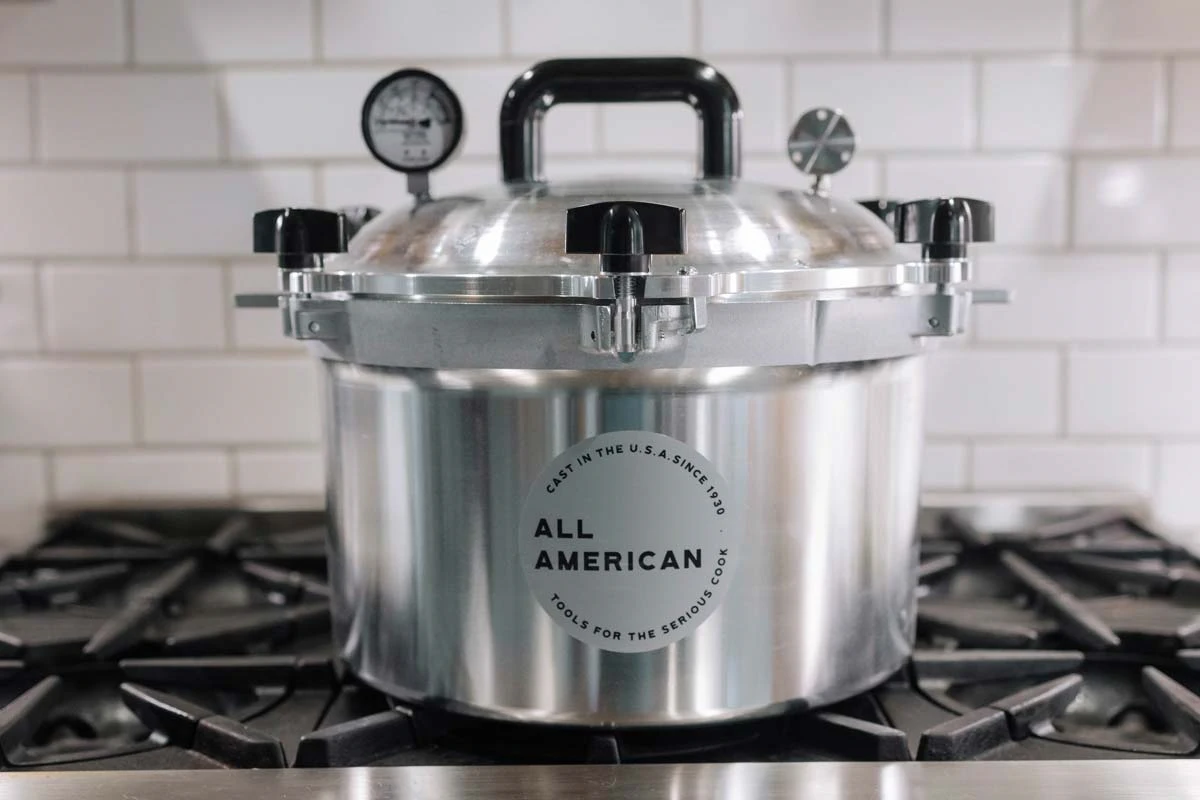
The All American 921 Pressure Canner is the canner people mean when they say buy once, cry once. It is 21.5 quarts of heavy cast aluminum with a machined metal-to-metal seal instead of a rubber gasket, so there is nothing to dry out, crack, or hunt down a replacement for every few seasons. You bolt the lid down with wing nuts, set a weighted jiggler on the vent, and let physics hold the pressure. It is the premium end of the shelf, and owners treat it like an heirloom rather than an appliance.
The reputation is earned and the bill is real. The 921 is expensive, heavy, and sells out constantly, so buying one often means waiting for stock rather than picking it off a shelf. The wing nuts and the jiggle-and-vent routine take a few runs to learn, and the weight rules it out for a lot of glass-top stoves. What follows covers why owners keep theirs for decades, where the 921 asks more of you than a modern canner, and who is better off with something lighter or cheaper.
The short version
This is the most durable canner most people will ever touch. A couple hundred owner comments agree on that and split on everything about handling it.
What's good:
- The metal-to-metal seal means no gasket to replace, dry out, or fail, which is the single biggest reason owners run these for decades.
- Cast aluminum body that shrugs off hard use; plenty of owners are years or decades in with the same pot.
- The weighted jiggler holds pressure by physics, so once the heat is set it stays locked on 10 or 15 psi at a low flame.
- The maker will test, and sometimes refinish, a tired canner rather than call it scrap.
What's not:
- It is heavy, close to fifty pounds loaded, which is rough on glass-top stoves and hard to move once it is full.
- The wing nuts and the vent-then-jiggle routine take a few runs to get comfortable with.
- It is expensive and chronically low on stock, so buying one often means waiting rather than grabbing it today.
- The overpressure plug is a consumable; run the heat too high and it can blow and need replacing.
Who it's for
Your stove decides most of this before your budget gets a say.
Buy it for:
- Canning in real volume for years, where a gasket-free seal you never have to source again pays for itself.
- A gas, propane, or coil stove that can carry the weight, or an outdoor burner and the counter space to store a heavy pot.
- Anyone who wants one canner their grandkids will still be using and does not mind paying up front for it.
Skip it if:
- You have a glass-top or induction range; the weight and the aluminum body make the Presto 01784 the safer match.
- You want the lowest price to start canning; the T-fal 22-quart gets you pressure-canning for a fraction of the outlay.
- You want to set it and walk away; the Presto Precise digital canner automates the venting and pressure the 921 asks you to manage by hand.
The specs that matter
The seal, the capacity, and the weight system explain both the price and the reputation.
Metal-to-metal seal, no gasket: the lid seats against the pot on a machined, lightly oiled rim rather than a rubber ring. Longevity comes down to that one design choice. There is no gasket to perish, no part number to chase down in five years, and no seasonal replacement to remember. You oil the lip, and that is the maintenance.
21.5 quarts of cast aluminum: a full load is seven quart jars or up to nineteen pints stacked in two layers, enough to make a canning session worth the setup. The heft that comes with it is the tradeoff, and it is why owners talk about weight limits and burner ratings as much as capacity.
Weighted jiggler plus a dial gauge: the weight sets the pressure mechanically, so 10 pounds on the weight is 10 pounds regardless of what the dial reads. The gauge becomes a reference for when the canner is safe to open, not the thing you trust for pressure, which sidesteps the annual gauge-testing that dial-only canners need.
How well it preserves
The weighted jiggler locks the canner onto its target pressure and keeps it there. Because the weight sets pressure by physics, you are not babysitting a dial for ninety minutes. Owners are consistent about this. One breaking in a brand-new unit put the result plainly:
New one came in on Friday, 10OCT25. Been busy in the garden space, until yesterdays rainy event here in MD so tested it making some homegrown black raspberry jam. Held pressure as expected at a very low flame. Impressive unit.
The jiggler is also what makes the 921 hard to run wrong once it is going. It cannot really climb over its set pressure on a normal burner, because excess steam just pushes the weight harder and vents off. An owner who has converted more than one All American to the weighted vent laid out why that beats a gauge-only canner:
The other advantage is that with a jiggler it is virtually impossible to go over the processing pressure unless you are using a wok burner or something crazy powerful. It will just jiggle harder and let the excess steam out. I've converted both a 921 and a 915 and they are both way simpler to use than the gauge-only style that require you to sit in front of the stove making micro-adjustments to the burner to maintain the correct pressure for the entire processing time.
The weight system also frees you from depending on a calibrated dial. In a lot of places you cannot even get a gauge tested anymore, and the weighted vent makes that a non-issue.
I did this with 921, like notanotherjennifer above. The jiggler is easier to manage as you have an audible cue that the thing is running right. And another thing: I don't know about where you live, but around here it is virtually impossible to get a pressure canner's gauge tested. In years past it was always recommended to get your pressure gauge tested once a year, just before canning season. Installation of a jiggler vent using the weight means you do not need to worry about exact pounds of pressure, so you do not need to get the gauge tested. 10 lb on the weight is 10 lb. 15 lb on the weight is 15 lb. I almost forgot to add: you got a REAL deal on your 921, congrats!
The limits sit with the operator. New owners lose more water than they expect on a first run, and settling the jiggle rate takes practice. That is a learning curve, not a performance problem. For actually holding pressure through a long process, the 921 does the core job as reliably as anything on the shelf.
Built to last
The price is here, in the metal. A metal-to-metal seal removes the one part that ages out on rival canners, and the cast aluminum body does not wear out on any normal timeline. Owners routinely talk in decades, not years:
Sad to see it go, those All American 921s are tanks. Mines been running since the 90s and still kicks. Hope you get a good replacement, that pots earned its retirement for sure.
WOOHOO!!! LUCKY YOU!! My older one is probably as old as me or close to it (I am 58, have had it forty years, canned over 20k quarts and still near perfect. I got it from my aunt). My second one is coming up on a year, over 200 quarts, 48 pints... That is the absolute gold standard of generational kitchen appliances right there.
Those are not outliers. Twelve years, a decade, forty years and twenty thousand quarts keep showing up as ordinary ownership. Two more owners describe theirs the same way, as a pot they expect to hand down:
Congratulations! I’ve been using my 921 for the past 12 years and my 930 about 10 years!
Grease the lid and rim. Take to county extension office they can test the dial I have new 921 (10 years) it’s a work horse. Jealous of your version tho!!! :-) Congrats!!
People keep circling back to the gasket-free design. No rubber ring to perish, no replacement to source, just a rim you oil before each run:
If you don't have the manual for it, you can find it online. The big difference is oiling the lip to seal it instead of using gaskets. What a fantastic inheritance!
Failures do happen, but they are slow and rare. The usual end for a 921 is metal fatigue after decades of hard use, a divot or thinning in the base, at which point the maker will actually test and sometimes refinish the pot rather than write it off. The one durability note worth flagging is the overpressure plug, which is a small consumable that can blow if the heat runs too high, and needs replacing when it does. That is a several-dollar part, not a dead canner, and it is why the number below is high but not a perfect ten. For a preserving tool you buy once, the 921 is about as close to permanent as this category gets.
Living with it
Weight is the first thing you notice and the last thing you get used to. A loaded 921 runs close to fifty pounds. That is a lot to lift, and it is why glass-top and induction owners keep running into trouble:
You could check with the stove manufacturer to find out the weight limit for the glass top. I have a 921 as well and it weighs 18 pounds empty with 7 quarts and 3 inches of water, It’s probably close to 50 pounds. Even if you did buy a propane outdoor burner from Cabella’s and what you paid for that all American you’re probably in for less than a brand new all American 921.
That weight is why the 921 is a poor fit for glass-top ranges, and why owners on those stoves are steered toward a lighter Presto or an outdoor burner. On a gas, propane, or heavy coil setup it is a non-issue, but it is the first thing to check before you buy.
Then the learning curve. The wing nuts and the vent-then-jiggle routine are simple once they click, and fiddly before that. New owners spend their trial runs asking the same questions about water level, jiggle rate, and lid leaks:
I took the 921 for a trial run with about 2.5 inches of water (and nothing else inside). I had a couple of intermittent lid leaks, but the All American video on this said that was ok and normal for a new canner so long as the canner held pressure. The jiggler was jiggling 1 -3 times per minute and I ran it for 50 minutes at 15psi. When it did jiggle it was usually not a gentle jiggle. I had a little over one inch of water left and that seems kind of low for a 50 minute run. Should I start with more water - maybe 3.5 inches? The trial run was on a ceramic flat stove.
Hi folks, I hope I can get your wisdom re my trial run on this All American model 921 pressure canner. I live about 1,000ft and 15 lbs is recommneded for this altitude and recipe. I am using it on my glass top electric range. (I checked with the manufacturer and they say that is fine). As the temperature gets close to range the pressure regulator starts to jiggle and make rhythmic hissing noises. The instruction manual says to only let it jiggle 1 to 4 times a minute, versus continually.
The overpressure plug can blow if the heat is too high. That sends a new owner scrambling before they learn it is a cheap, replaceable part and usually a sign to turn the burner down:
I have an issue with my 921, which is less than a year old and has been used about 8 times. At 15 pounds on the gauge (150 feet above sea level), the overpressure plug blows. It did it during cooking stock yesterday (less than half full) and happened today when I tried to pressure can the stock. The overpressure plug appears to be in good condition and the vent pipe is not blocked. A solid column of steam comes out before putting the weight on @ 15 lbs. The pressure doesn't get high enough for the weight to start jiggling (it hisses). I have not had any problems with it. Any thoughts as to why it is failing?
And the wing-nut design is not for everyone. Plenty of owners find it fussy compared with a lever-lock lid, and at least one longtime canner would rather keep a gasketed Presto for exactly that reason:
I have an older 22 quart presto canner. It’s very heavy duty metal unlike newer canners. As long as I keep the dial gauge accurate and replace the gasket periodically, it will be good forever I think. I personally think All-Americans are a hassle with all the screwing.
Past the first few runs, none of this makes the 921 hard to live with. Most owners settle into the routine quickly and never think about it again. Still, between the weight, the wing nuts, the learning curve, and the price and stock problem, ease of use is clearly where the 921 gives ground.
How it compares
Most people weighing a 921 are weighing three cheaper canners alongside it, and all three win on price or convenience.
Versus the Presto 01784 Induction-Compatible 23-Quart: this is the practical alternative for most kitchens. It is far lighter, works on induction and glass-top ranges where the 921 does not, and costs a fraction as much. It uses a gasket you will replace over time, and it will not last generations the way the All American does, but it is easy to find and it fits stoves the 921 cannot.
Versus the Presto Precise 23-Quart Digital: this is the hands-off route. It automates the venting, pressure, and timing that the 921 asks you to manage by hand, which is the draw if the manual routine is what is scaring you off. You trade the 921's decades-long, gasket-free durability for electronics and convenience.
Versus the T-fal 22-Quart: the T-fal is the budget floor. It is aluminum, lighter than the 921, and the cheapest way to start pressure canning at a similar capacity. You give up the metal-to-metal seal and the decades of service, but if the 921's price or stock is the wall you keep hitting, it gets you canning now.
Versus the All American 915 (15.5-Quart): the same canner in a smaller body. The 915 has the identical metal-to-metal seal and cast build, it just holds less per load, which suits a smaller kitchen or smaller batches. If the 921's capacity is more than you need, our All American 915 review covers where the step down makes sense.
Using it well
Oil the lid rim and the pot lip before each run so the metal-to-metal seal seats cleanly, and tighten the wing nuts in an opposing, crisscross pattern so the lid pulls down evenly. Start with about three inches of water. Vent a full stream of steam for ten minutes before you set the weight, then adjust the burner so the jiggler moves one to four times a minute rather than racing. Keep a spare overpressure plug on hand, since it is a consumable. Store the lid inverted on a folded towel so nothing dings the sealing surface.
If your stove is the sticking point, it is worth reading how weight and stove type interact before you buy. Our guide to pressure canning on a glass-top or induction stove walks through why a heavy aluminum canner like the 921 is a poor match for glass and what to run instead.
The case for buying one
Buy it if you can in volume and want to buy a canner once. The metal-to-metal seal removes the one part that ages out on every rival, the cast aluminum body outlives its owners, and the weighted jiggler holds pressure with a reliability that keeps people loyal for decades. On durability, nothing else in this category is close.
Everything around that seal is where the 921 costs you. The 921 is heavy enough to rule out a lot of glass-top stoves, the wing nuts and jiggle routine take a few runs to learn, and it is pricey and often out of stock. Expect to wait for one, to lift a heavy pot, and to spend your first couple of sessions learning its rhythm. For most owners that is the whole cost of admission, and the 921 is the last canner they buy. If any one of those tradeoffs is a dealbreaker, a lighter Presto or the budget T-fal serves you better for less.
Our Ratings
Overall score
The weighted jiggler sets pressure by physics, not a dial, so once the heat is set it locks onto 10 or 15 psi and stays there, even at a low flame, and it is nearly impossible to overshoot on a normal burner. Owners run these hard for decades without a wobble. The only friction is a learning curve around venting time and jiggle rate, and that sits with the operator, not the canner.
Our highest score, and the one that justifies the price. Heavy cast aluminum and a machined metal-to-metal seal mean there is no gasket to dry out, crack, or hunt down every few years, and owners report units running since the 1990s, some past forty years and twenty thousand quarts. Failures are rare and slow, usually metal fatigue after decades, and the maker will test and refinish a tired pot rather than scrap it. This is a canner you buy once and hand down.
The 921 asks more of you than a modern canner. It is very heavy, close to fifty pounds loaded, so it is rough on glass-top stoves and hard to move. The wing nuts and metal-to-metal seal take practice, and getting the jiggle rate and venting right trips up new owners. Add chronic low stock and a steep price and this is clearly its weakest score, even though the routine gets simple once it clicks.
All American 921 Pressure Canner Reviews (2026) on Amazon.
What People Are Saying
Owners talk about the 921 the way people talk about heirlooms. The praise keeps landing on the same three things: the metal-to-metal seal means no gasket to fail or replace, the cast aluminum body runs for decades, and the weighted jiggler holds pressure without fuss. Units running since the 1990s, and some past forty years and twenty thousand quarts, show up as ordinary ownership rather than exceptions.
The recurring gripes are all about living with it: it is heavy enough to worry glass-top stove owners, the wing nuts and vent-and-jiggle routine take a few runs to learn, and the overpressure plug is a consumable that can blow if the heat runs high. The other real-world catch is availability. The 921 sells out constantly and carries a premium price, so buying one often means waiting for stock rather than grabbing it off a shelf.
Nobody in those threads regrets the purchase, and neither would we.
We weight candid owner reports from Reddit and preservation forums above brand-influenced editorial coverage, then reach our own verdict from them. The quotes below are the evidence; the rating and the take are ours.
What Reddit Is Saying
“Sad to see it go, those All American 921s are tanks. Mines been running since the 90s and still kicks. Hope you get a good replacement, that pots earned its retirement for sure.”View thread →
“WOOHOO!!! LUCKY YOU!! My older one is probably as old as me or close to it (I am 58, have had it forty years, canned over 20k quarts and still near perfect. I got it from my aunt). My second one is coming up on a year, over 200 quarts, 48 pints... That is the absolute gold standard of generational kitchen appliances right there.”View thread →
“Congratulations! I’ve been using my 921 for the past 12 years and my 930 about 10 years!”View thread →
“Grease the lid and rim. Take to county extension office they can test the dial I have new 921 (10 years) it’s a work horse. Jealous of your version tho!!! :-) Congrats!!”View thread →
“If you don't have the manual for it, you can find it online. The big difference is oiling the lip to seal it instead of using gaskets. What a fantastic inheritance!”View thread →
“New one came in on Friday, 10OCT25. Been busy in the garden space, until yesterdays rainy event here in MD so tested it making some homegrown black raspberry jam. Held pressure as expected at a very low flame. Impressive unit.”View thread →
“I did this with 921, like notanotherjennifer above. The jiggler is easier to manage as you have an audible cue that the thing is running right. And another thing: I don't know about where you live, but around here it is virtually impossible to get a pressure canner's gauge tested. In years past it was always recommended to get your pressure gauge tested once a year, just before canning season. Installation of a jiggler vent using the weight means you do not need to worry about exact pounds of pressure, so you do not need to get the gauge tested. 10 lb on the weight is 10 lb. 15 lb on the weight is 15 lb. I almost forgot to add: you got a REAL deal on your 921, congrats!”View thread →
“The other advantage is that with a jiggler it is virtually impossible to go over the processing pressure unless you are using a wok burner or something crazy powerful. It will just jiggle harder and let the excess steam out. I've converted both a 921 and a 915 and they are both way simpler to use than the gauge-only style that require you to sit in front of the stove making micro-adjustments to the burner to maintain the correct pressure for the entire processing time.”View thread →
“I took the 921 for a trial run with about 2.5 inches of water (and nothing else inside). I had a couple of intermittent lid leaks, but the All American video on this said that was ok and normal for a new canner so long as the canner held pressure. The jiggler was jiggling 1 -3 times per minute and I ran it for 50 minutes at 15psi. When it did jiggle it was usually not a gentle jiggle. I had a little over one inch of water left and that seems kind of low for a 50 minute run. Should I start with more water - maybe 3.5 inches? The trial run was on a ceramic flat stove.”View thread →
“Hi folks, I hope I can get your wisdom re my trial run on this All American model 921 pressure canner. I live about 1,000ft and 15 lbs is recommneded for this altitude and recipe. I am using it on my glass top electric range. (I checked with the manufacturer and they say that is fine). As the temperature gets close to range the pressure regulator starts to jiggle and make rhythmic hissing noises. The instruction manual says to only let it jiggle 1 to 4 times a minute, versus continually.”View thread →
“You could check with the stove manufacturer to find out the weight limit for the glass top. I have a 921 as well and it weighs 18 pounds empty with 7 quarts and 3 inches of water, It’s probably close to 50 pounds. Even if you did buy a propane outdoor burner from Cabella’s and what you paid for that all American you’re probably in for less than a brand new all American 921.”View thread →
“I have an issue with my 921, which is less than a year old and has been used about 8 times. At 15 pounds on the gauge (150 feet above sea level), the overpressure plug blows. It did it during cooking stock yesterday (less than half full) and happened today when I tried to pressure can the stock. The overpressure plug appears to be in good condition and the vent pipe is not blocked. A solid column of steam comes out before putting the weight on @ 15 lbs. The pressure doesn't get high enough for the weight to start jiggling (it hisses). I have not had any problems with it. Any thoughts as to why it is failing?”View thread →
“I have an older 22 quart presto canner. It’s very heavy duty metal unlike newer canners. As long as I keep the dial gauge accurate and replace the gasket periodically, it will be good forever I think. I personally think All-Americans are a hassle with all the screwing.”View thread →
Frequently asked questions
Is the All American 921 Pressure Canner worth it?
The 921 asks more of you than a modern canner. It is very heavy, close to fifty pounds loaded, so it is rough on glass-top stoves and hard to move. The wing nuts and metal-to-metal seal take practice, and getting the jiggle rate and venting right trips up new owners.
How is the All American 921 Pressure Canner built?
Our highest score, and the one that justifies the price. Heavy cast aluminum and a machined metal-to-metal seal mean there is no gasket to dry out, crack, or hunt down every few years, and owners report units running since the 1990s, some past forty years and twenty thousand quarts. Failures are rare and slow, usually metal fatigue after decades, and the maker will test and refinish a tired pot rather than scrap it.
What is the All American 921 Pressure Canner best suited for?
The weighted jiggler sets pressure by physics, not a dial, so once the heat is set it locks onto 10 or 15 psi and stays there, even at a low flame, and it is nearly impossible to overshoot on a normal burner. Owners run these hard for decades without a wobble. The only friction is a learning curve around venting time and jiggle rate, and that sits with the operator, not the canner.
What do real owners say about the All American 921 Pressure Canner?
Owners talk about the 921 the way people talk about heirlooms. The praise keeps landing on the same three things: the metal-to-metal seal means no gasket to fail or replace, the cast aluminum body runs for decades, and the weighted jiggler holds pressure without fuss. Units running since the 1990s, and some past forty years and twenty thousand quarts, show up as ordinary ownership rather than exceptions.
Options Worth Checking Out

Presto Precise 23-Quart Digital Pressure Canner
The hands-off route. It automates the venting, pressure, and timing the 921 makes you manage by wing nut and jiggler, and it is waterbath capable. You trade the All American's decades-long, gasket-free durability for convenience.

Presto 01784 23-Quart Induction-Compatible Pressure Canner
The practical alternative for most kitchens. Far lighter than the 921 and works on induction and glass-top ranges where the heavy All American cannot. It uses a gasket you replace over time, but it is easier to find and fits more stoves.

T-fal 22-Quart Aluminum Pressure Canner
The budget floor. Aluminum, lighter than the 921, and the cheapest way to start pressure canning at a similar capacity, with three PSI settings and a canning rack. You give up the metal-to-metal seal and the lifetime durability here.
You Might Also Need
Accessories worth grabbing alongside your purchase