All American
All American 915 Pressure Canner Reviews (2026)
By Ruth Alvarez · Updated October 2026
Independent editorial review. We never accept payment for coverage, though we may earn a commission if you purchase through our links.
Verdict
Owners of the All American 915 are about as close to unanimous as any product in this niche gets, and the praise circles the same thing: a metal-to-metal seal with no gasket to fail means the canner just keeps working, often for decades, and people plan to hand theirs down. The weighted regulator earns steady trust for holding pressure without babysitting a dial. The friction is all around fit and feel: the aluminum body will not heat on induction and is heavy on a glass-top, the wingnuts and the 10 psi weight take a batch or two to learn, and it is expensive and hard to buy on Amazon. That combination is why owners so often steer beginners and induction cooks to a Presto first, even while calling the All American the one they would never give up. We land in the same place: on a gas or coil stove, in a house that cans a few times a season, this is the pot to buy once, and the Presto is the smarter starting point only until you can get one.
Read full take ↓Similar pressure canners
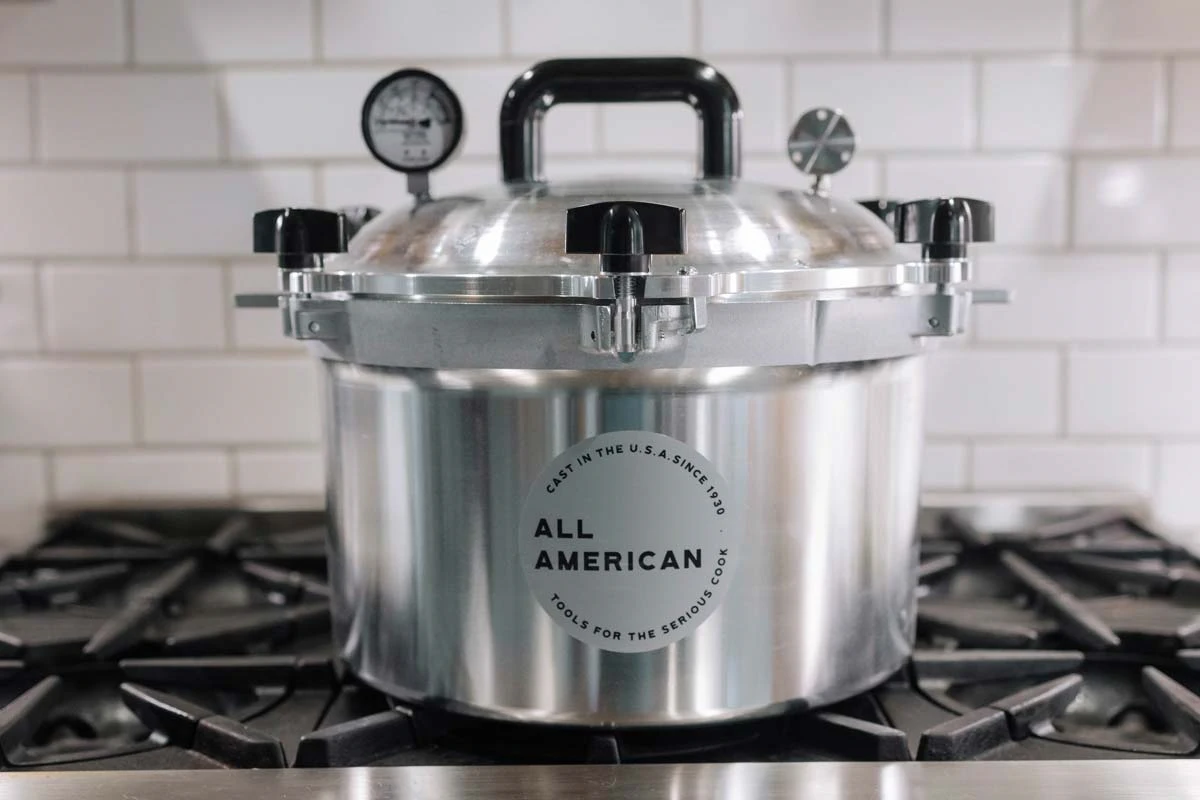
The All American 915 Pressure Canner is the smaller sibling in the line that canners talk about like an heirloom. It's a 15.5-quart cast-aluminum pot that seals metal-to-metal, with a machined lid clamped down by wingnuts and no rubber gasket anywhere to dry out, crack, or hunt down a replacement for. Where most canners age into a parts search, this one is built to simply keep working, and owners with decades on theirs are the rule here, not the exception.
The catch is that legend comes in a heavy, expensive, hard-to-get package, and the 915 is chronically tricky to buy on Amazon since All American sells mostly direct and through specialty stockists like Pleasant Hill Grain. That shapes this review. The 915 earns its score on the merits, but the one-click alternatives worth naming are the Presto canners you can actually add to a cart today, which is exactly what a lot of owners here end up recommending to anyone just starting out or cooking on induction.
The short version
This is about as close to a buy-it-once canner as the category gets. The costs that come with it are short enough to list, and none of them are about how it cans.
What's good:
- Metal-to-metal seal with no gasket, so there is nothing rubber to replace, dry-rot, or track down years later.
- Holds pressure rock-solid off a weighted regulator, so you set it and listen instead of babysitting a dial.
- Decades of documented life, with owners running units from the 1940s and passing them to their kids.
- A smaller, lighter step down from the big 921, easier to lift and friendlier on a glass-top stove.
What's not:
- Cast aluminum will not work on an induction cooktop, and heavy on glass-top, so magnetic-stove cooks need a Presto or a separate burner.
- Sold mostly direct and through specialty stores, so it is often out of stock on Amazon and rarely discounted.
- Still a heavy pot, and the ring of wingnuts and the weighted valve take a batch or two to learn.
- Fewer jars per load than the larger All Americans, so bulk canners will fill it faster.
Who it's for
Your stove decides more of this than your budget does. Start there, then read the lists.
Buy it for:
- A once-and-done canner on a gas or coil stove who wants a seal that never needs a replacement part.
- A household putting up meats, beans, soups, and broth a few times a season and planning to hand it down.
- Anyone who hates calibrating and prefers a weighted regulator you can hear from the next room.
Skip it if:
- You cook on an induction stove; the aluminum body will not heat on it, and the Presto 01784 induction canner is built for exactly that.
- You are brand new and want to spend as little as possible; the Presto 01781 does the same job for far less while you learn.
- You want a fully hands-off cycle; the Presto Precise digital canner builds, holds, and vents pressure for you.
The specs that matter
The 915's whole reputation comes out of how it is built. Body, seal, regulator:
15.5-quart cast-aluminum body: a mid-size load that handles a household batch of quarts or pints without being the two-tier monster the bigger All Americans are. It is lighter and shorter than the 921, which is why it is the size people reach for on a glass-top stove, though aluminum still rules out an induction burner.
Metal-to-metal seal, no gasket: the lid and pot are machined to seat against each other and clamp shut with wingnuts, so there is no rubber ring to soften, crack, or discontinue. This one design choice is the reason these canners routinely outlive the stoves they sit on.
Weighted regulator plus a dial gauge: you set pressure with a jiggler weight at 5, 10, or 15 psi and use the gauge only as a visual double-check. The weight never needs the annual calibration a dial-only canner does, which owners treat as the whole reason to buy in.
How well it preserves
On the core job, holding a steady, trustworthy pressure for a full process, the 915 is as solid as this category gets, and owners barely think about it once it is running. The weighted regulator does the regulating: you bring it up to the weight, back the heat off until it rocks a few times a minute, and it simply holds. People who came from a dial-only canner describe the difference as finally being able to walk away.
I live in a country where canning is not the norm, so I have no way of getting a gauge tested. That’s why I bought the all American, because it has the jiggly weight. I completely ignore my gauge and just go off that. If I were you, I’d order a new weight, give it a clean and go nuts.
That confidence traces straight back to how little there is to fail. With no gasket and a machined seal, the failure modes that plague other canners just are not present, and the safety plug is the one wear item to think about. One owner lays out the whole maintenance story in a sentence:
Clean them, replace the emergency pressure release plug, then put a little water in them and do a test run to see if they seal. That's all you need to do. The whole point of the All-American canners is that there's almost nothing to go wrong with them through aging. The failsafe plug is basically it unless you drop it and bend something.
It also plays nicer with a glass-top stove than the full-size All Americans, thanks to the smaller footprint and lighter load, and owners report clean, uneventful processing on flat cooktops as long as the stove can carry the weight:
I have an all American we have used on the glass top stove for a couple years. No problems. Personally I would take the all American. And if a 925 pops up used later pick that up too. Being able to do 19 pint jars instead of 10 is great when you have a lot of stuff to process. The inside of ours is black too, totally normal.
The limit is your stove. The aluminum body cannot heat on induction at all, and a heavy full canner is a lot to ask of a glass top, which is why a real slice of owners run theirs on a propane or portable burner instead. Match it to the right heat source and the preservation performance is close to flawless.
Built to last
Nothing else in this category comes close on durability. The metal-to-metal seal removes the single most common thing that ages a canner out of service, and the owner reports pile up the same way: units bought new years ago that still perform like the day they arrived.
FWIW, I bought a 15 1/2 quart in 2011 for $180. According to the inflation calculator, that smaller version would cost $264 today. Aside from cleaning the unit, I haven't had to do anything with it and it still works as perfectly as the day I bought it.
The longevity is baked into the buying decision. People choose the All American specifically because it will outlast a gasketed canner, and the maker backs it with a warranty owners describe as generational:
I bought an All American, new, several years ago. The company has an amazing extensive warranty so when I pass it to my child it'll still be covered, and so on if she has kids.
I had my other grandmothers presto canner. The rubber seal under the lid had been discontinued. That all American canner is the very best.
That reputation is why used 915s are worth grabbing when they surface, and owners routinely vouch for old ones after a clean-up and a water-only test run. Two long-time owners put the point plainly:
Those are by far the best ones made. I've had two different sizes for many years
Awesome! I got mine on CL for around $80. Still a great deal, but not as sick as yours! I suggest double checking everything and doing a test run with just water in the pot to verify it’s in good condition.
None of this means it is maintenance-free forever. The dial gauge can drift and the weighted regulator or safety plug can eventually need replacing, but those are cheap, available parts, not a dead machine. When people say these canners are built to last, the owner reports back them up harder than almost any product we have reviewed, which is exactly why the durability number below sits where it does.
Living with it
The 915 asks more of you than any other canner we would recommend, and that is where an otherwise glowing picture gives ground. It is a heavy pot, and the ring of wingnuts around the lid means you tighten opposite corners in sequence every time you seal it, then loosen them the same way. A first-timer's most common surprise is finding a nut or two backed off after a run:
I officially used my 915 for the first time yesterday to can my green beans. Both times that I used it, I noticed when I went to unlock everything that a couple of the lock nuts were already loose. I know that I tightened everything before I started the process, so does anyone have any ideas on what's going on?
The weighted regulator is the other thing to learn. Simple once it clicks. But the 10 psi setting in particular can hiss rather than rock until you settle the heat, and new owners often need a batch or two of water-only practice before they trust it:
Brand new All American 915, unboxed yesterday. First time using a jiggler weight and watched a bunch of videos to see what it's supposed to do. I get a great jiggle using the 5 lb and 15 lb settings. For the 10 lb setting, which is actually what I want to use, it mostly just hisses steam, sometime violently, but never really gets a "jiggle" going. I've tried cranking up the heat when it really starts to hiss and it just hisses more. I turn it down and the hissing will slow down. Occasionally I'll get a single jiggle but nothing like the 5 and 15 lb settings.
Altitude adds its own wrinkle, since higher elevations mean the 15 psi weight and a burner hot enough to hold it, and beginners understandably want reassurance the first few times:
Hello! I am new to pressure canning and I have an All American 915. I have had a hard time finding YouTubers or other people to learn from because I live at 8,500 feet so I have to can at 15psi.
There is also a small maintenance learning curve if you buy used and retrofit the older petcock to a modern weighted valve, which can be fiddly to seal:
I bought a second hand All American 915 last year, and it had the old style petcock so I replaced it with the the newer style valve that uses the weights (with some teflon tape on the threads). It worked for a while, but now the valve has started leaking a tiny bit from the threaded part. I've stopped using (obviously).
None of these are dealbreakers, and every one of them fades after the first season. But they are real, and they are the reason someone who wants a canner that is easy from the very first jar is often happier starting on a Presto.
How it compares
Nobody cross-shops the 915 against other premium canners. They cross-shop it against the Prestos you can actually add to a cart, and against its own bigger sibling.
Versus the Presto 01781 23-Quart: the Presto is the sensible starter and the one to reach for when the 915 is out of stock. It is far cheaper, lighter, and holds more jars, and the tradeoff is a rubber gasket that ages and a dial gauge that wants annual calibration. Owners routinely tell beginners to learn on a Presto first.
All American is a high-end and worth it canner, but since you're just getting into it, go with a Presto. They're great canners (I'm still using mine) and you can use it until you're sure that you'll get the value of an All American canner.
Versus the Presto induction and digital models: if your stove is induction, the comparison ends before it starts, because the aluminum 915 will not heat on it. The Presto 01784 is built for induction and glass-top, and the Presto Precise runs the cycle digitally. Owners who want the All American but cook on induction reluctantly land on a Presto instead.
I wanted an All-American, but I think it’s not induction-compatible, so I will get a Presto when I finally get one. I’m pretty sure Presto is the highest rated for induction and has a long history of reliability.
Versus the larger All American 921: the 921 is the same metal-to-metal legend in a bigger body that swallows more jars per load. The 915 trades that capacity for a lighter, shorter pot that is easier to lift, easier to store, and kinder to a glass-top stove. If you can in real volume, size up; if you value the smaller footprint, the 915 is the friendlier daily canner.
Using it well
Oil the sealing edge of the lid lightly before you clamp it, and tighten the wingnuts in opposite pairs a little at a time so the lid seats evenly. Vent a full ten minutes of steady steam before you set the weight, then back the heat down until the regulator rocks just a few times a minute so you are not blasting water out of the jars. Rely on the weight for pressure and treat the dial gauge as a backstop, and do a water-only test run before your first real batch so the rhythm is familiar.
Because the aluminum body is picky about heat source, it is worth reading how stove type changes the math before you commit. Our guide to the best pressure canner for a glass-top or induction stove walks through why induction and glass-top are two different problems, where the All American fits, and which Presto to buy if your cooktop rules it out.
Is it worth the money
On the merits, this is one of the easiest recommendations we have made. The metal-to-metal seal removes the part that usually kills a canner. It holds pressure without fuss off the weighted regulator. And the durability claim is backed by a wall of owners running decades-old units and planning to hand them down. For a gas or coil stove, in a household that cans a few times a season and wants to buy once, it is as close to a forever purchase as the category offers.
In some circles the All-American is the upgrade. I personally would rather replace a stove than surrender my AAs. A less drastic option is the standalone burner suggested above (or a separate canning kitchen. I like that idea!)
The brakes are price, weight, the wingnut-and-weight learning curve, and availability, since it is sold mostly direct and is hard to grab on Amazon. If your stove is induction, or you are brand new and want to spend as little as possible while you learn, one of the Presto canners below is the smarter first buy, and you can always graduate to an All American later. Meet it on the right stove, be patient with the wingnuts for a season, and this is the canner you buy so you never have to buy another. As one owner put it about spotting a used one, jump on it.
If you're finding an All American for $100, I'd jump on that immediately and figure out how you're going to use it later.
Our Ratings
Overall score
The 915 holds a steady, trustworthy pressure off its weighted regulator: bring it up, back the heat down until it rocks a few times a minute, and it simply stays there while you walk away. With no gasket and a machined seal, the failure modes that plague other canners are absent, so performance is near-flawless when it is matched to the right stove. The only real limit is heat source, since the aluminum body cannot heat on induction and is heavy on glass-top.
Nothing else in the category is built like this. The metal-to-metal seal means there is no rubber gasket to dry out, crack, or discontinue, which removes the single most common thing that ages a canner out of service. Owners run units bought decades ago that still work like new, choose it specifically to outlive a gasketed canner, and describe a warranty they expect to pass to their kids. Cheap wear parts like the gauge and safety plug are the only upkeep.
Everyday handling is the soft spot. It is a heavy pot, the ring of wingnuts has to be tightened and loosened in sequence every time, and the weighted regulator takes a batch or two of practice before you trust it, especially the 10 psi setting. Add the aluminum body's refusal to work on induction and the fact that it is sold mostly direct and hard to find on Amazon, and a first-time canner is often happier starting on a Presto.
What People Are Saying
Owners of the All American 915 are about as close to unanimous as any product in this niche gets, and the praise circles the same thing: a metal-to-metal seal with no gasket to fail means the canner just keeps working, often for decades, and people plan to hand theirs down. The weighted regulator earns steady trust for holding pressure without babysitting a dial. The friction is all around fit and feel: the aluminum body will not heat on induction and is heavy on a glass-top, the wingnuts and the 10 psi weight take a batch or two to learn, and it is expensive and hard to buy on Amazon.
That combination is why owners so often steer beginners and induction cooks to a Presto first, even while calling the All American the one they would never give up. We land in the same place: on a gas or coil stove, in a house that cans a few times a season, this is the pot to buy once, and the Presto is the smarter starting point only until you can get one.
We weight candid owner reports from Reddit and preservation forums above brand-influenced editorial coverage, then reach our own verdict from them. The quotes below are the evidence; the rating and the take are ours.
What Reddit Is Saying
“FWIW, I bought a 15 1/2 quart in 2011 for $180. According to the inflation calculator, that smaller version would cost $264 today. Aside from cleaning the unit, I haven't had to do anything with it and it still works as perfectly as the day I bought it.”View thread →
“I bought an All American, new, several years ago. The company has an amazing extensive warranty so when I pass it to my child it'll still be covered, and so on if she has kids.”View thread →
“Those are by far the best ones made. I've had two different sizes for many years”View thread →
“I had my other grandmothers presto canner. The rubber seal under the lid had been discontinued. That all American canner is the very best.”View thread →
“Awesome! I got mine on CL for around $80. Still a great deal, but not as sick as yours! I suggest double checking everything and doing a test run with just water in the pot to verify it’s in good condition.”View thread →
“Clean them, replace the emergency pressure release plug, then put a little water in them and do a test run to see if they seal. That's all you need to do. The whole point of the All-American canners is that there's almost nothing to go wrong with them through aging. The failsafe plug is basically it unless you drop it and bend something.”View thread →
“I live in a country where canning is not the norm, so I have no way of getting a gauge tested. That’s why I bought the all American, because it has the jiggly weight. I completely ignore my gauge and just go off that. If I were you, I’d order a new weight, give it a clean and go nuts.”View thread →
“I have an all American we have used on the glass top stove for a couple years. No problems. Personally I would take the all American. And if a 925 pops up used later pick that up too. Being able to do 19 pint jars instead of 10 is great when you have a lot of stuff to process. The inside of ours is black too, totally normal.”View thread →
“In some circles the All-American is the upgrade. I personally would rather replace a stove than surrender my AAs. A less drastic option is the standalone burner suggested above (or a separate canning kitchen. I like that idea!)”View thread →
“If you're finding an All American for $100, I'd jump on that immediately and figure out how you're going to use it later.”View thread →
“I wanted an All-American, but I think it’s not induction-compatible, so I will get a Presto when I finally get one. I’m pretty sure Presto is the highest rated for induction and has a long history of reliability.”View thread →
“All American is a high-end and worth it canner, but since you're just getting into it, go with a Presto. They're great canners (I'm still using mine) and you can use it until you're sure that you'll get the value of an All American canner.”View thread →
“Brand new All American 915, unboxed yesterday. First time using a jiggler weight and watched a bunch of videos to see what it's supposed to do. I get a great jiggle using the 5 lb and 15 lb settings. For the 10 lb setting, which is actually what I want to use, it mostly just hisses steam, sometime violently, but never really gets a "jiggle" going. I've tried cranking up the heat when it really starts to hiss and it just hisses more. I turn it down and the hissing will slow down. Occasionally I'll get a single jiggle but nothing like the 5 and 15 lb settings.”View thread →
“Hello! I am new to pressure canning and I have an All American 915. I have had a hard time finding YouTubers or other people to learn from because I live at 8,500 feet so I have to can at 15psi.”View thread →
“I officially used my 915 for the first time yesterday to can my green beans. Both times that I used it, I noticed when I went to unlock everything that a couple of the lock nuts were already loose. I know that I tightened everything before I started the process, so does anyone have any ideas on what's going on?”View thread →
“I bought a second hand All American 915 last year, and it had the old style petcock so I replaced it with the the newer style valve that uses the weights (with some teflon tape on the threads). It worked for a while, but now the valve has started leaking a tiny bit from the threaded part. I've stopped using (obviously).”View thread →
Frequently asked questions
Is the All American 915 Pressure Canner worth it?
Everyday handling is the soft spot. It is a heavy pot, the ring of wingnuts has to be tightened and loosened in sequence every time, and the weighted regulator takes a batch or two of practice before you trust it, especially the 10 psi setting. Add the aluminum body's refusal to work on induction and the fact that it is sold mostly direct and hard to find on Amazon, and a first-time canner is often happier starting on a Presto.
How is the All American 915 Pressure Canner built?
Nothing else in the category is built like this. The metal-to-metal seal means there is no rubber gasket to dry out, crack, or discontinue, which removes the single most common thing that ages a canner out of service. Owners run units bought decades ago that still work like new, choose it specifically to outlive a gasketed canner, and describe a warranty they expect to pass to their kids.
What is the All American 915 Pressure Canner best suited for?
The 915 holds a steady, trustworthy pressure off its weighted regulator: bring it up, back the heat down until it rocks a few times a minute, and it simply stays there while you walk away. With no gasket and a machined seal, the failure modes that plague other canners are absent, so performance is near-flawless when it is matched to the right stove. The only real limit is heat source, since the aluminum body cannot heat on induction and is heavy on glass-top.
What do real owners say about the All American 915 Pressure Canner?
Owners of the All American 915 are about as close to unanimous as any product in this niche gets, and the praise circles the same thing: a metal-to-metal seal with no gasket to fail means the canner just keeps working, often for decades, and people plan to hand theirs down. The weighted regulator earns steady trust for holding pressure without babysitting a dial. The friction is all around fit and feel: the aluminum body will not heat on induction and is heavy on a glass-top, the wingnuts and the 10 psi weight take a batch or two to learn, and it is expensive and hard to buy on Amazon.
Options Worth Checking Out

Presto 01781 23-Quart Pressure Canner
The cheap canner the whole hobby points beginners toward, and one click away when the All American is sold out. Aluminum body, dial gauge, and a 23-quart load that double-stacks pints. It needs an annual gauge check, but cans what the 915 does for less.

Presto 01784 23-Quart Induction-Compatible Pressure Canner
The same 23-quart Presto built with a stainless-clad base, so it works on the induction and glass-top stoves the aluminum 915 cannot heat. If a magnet sticks to your cooktop, this is the cheapest way to can indoors without a separate burner.

Presto Precise 23-Quart Digital Pressure Canner
Presto's digital 23-quart canner runs the whole cycle for you: it builds pressure, holds it, times the process, and vents down itself. Induction-ready, and the hands-off pick if the 915 wingnut-and-weight routine sounds like more fuss than you want.
You Might Also Need
Accessories worth grabbing alongside your purchase