Granite Ware
Granite Ware Water Bath Canner Reviews (2026)
By Nora Calloway · Updated October 2026
Independent editorial review. We never accept payment for coverage, though we may earn a commission if you purchase through our links.
Verdict
Owners are broadly warm on the Granite Ware, and they praise the same four things: cheap, deep enough to cover pint jars, rack included, and for high-acid water-bath canning it simply works, with plenty of people decades deep on the same pot. The worries repeat just as reliably. Enamel chips and the steel, rack, and rim rust if the pot is not dried after use; the thin body and rack feel flimsy; the burner-style bottom boils slowly and sits poorly on glass and induction; and a few longtime canners have retired theirs for a steam canner on speed and weight. Nobody in the threads expects a premium pot at this price. Neither do we, and that is roughly the right way to buy it: a capable starter you handle carefully, not a lifetime purchase.
Read full take ↓Similar water-bath canners
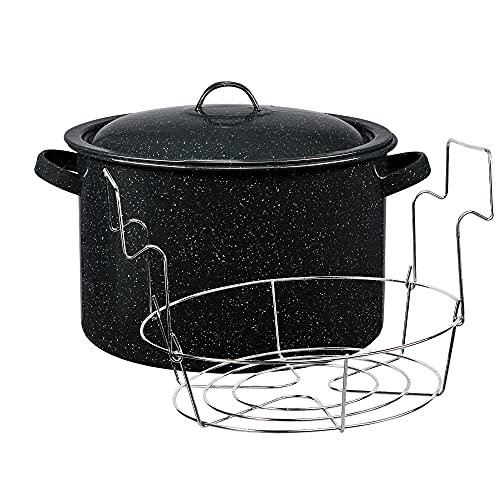
The Granite Ware Enamel-on-Steel Water Bath Canner is the black speckled pot that has been the front door to home canning for generations. Twelve quarts of enamel-coated steel, a wire rack that drops seven pint jars in and lifts them back out, and a price low enough that nobody agonizes over it. For jams, pickles, salsa, tomatoes, and anything else high-acid, it does the one job a water-bath canner has to do: hold a tall, rolling boil over your jars long enough to seal them.
Simplicity is the whole appeal, and the caveats sit right next to it. Owners who have run one for decades swear by theirs, and beginners love that it costs about as little as a canner can. The same thread that praises it will also mention chipped enamel, rust creeping around the rim and rack, steel thin enough to flex, and a bottom that boils slowly and sits badly on a glass or induction top. Most of that is just the price of a cheap pot. One of them is a real reason to buy something else.
The short version
A lot of canner for very little money, with one weakness you should know about before you buy rather than after.
What's good:
- Cheap enough that a first-year canner can start water-bath canning without a real investment.
- A true pint-jar canner: it covers half-pint and pint jars with the two inches of water processing needs, and holds about seven pints a batch. For quart jars you need the taller 21.5-quart Granite Ware.
- Comes with a jar rack that lowers a full load in and lifts it out, so you are not jury-rigging a trivet.
- Dead simple and light when empty, which makes it easy to store and easy to learn on.
What's not:
- The porcelain enamel chips, and bare spots plus the rack and rim can rust over time.
- The steel is thin and the rack and lid feel flimsy on some units.
- The wavy or ridged bottom boils slowly and sits unevenly on glass and induction cooktops.
- It is water-bath only. It is not a pressure canner, so it cannot safely do low-acid foods like plain vegetables, meat, or beans.
Who it's for
Your stove decides this one more than your budget does.
Buy it for:
- Getting into water-bath canning for the first time on a small budget, with jams, jellies, pickles, salsa, and tomatoes.
- A gas or propane burner, or an outdoor turkey-fryer ring, where the pot can sit flat and boil hard.
- Anyone who wants a dedicated canner with a rack rather than hunting for a pot deep enough and a trivet that fits.
Skip it if:
- You cook on a glass or induction top and want a flat base that heats fast and sits evenly; the CLMSTE canner with rack is a cheap flat-bottom alternative.
- You want a canner that boils fast and stays light on a full load; a Concord steam canner uses a fraction of the water and comes to temperature quicker.
- You want to plug it in and walk away rather than babysit a stovetop; the Ball EasyCanner heats electrically and holds its own temperature.
- You need to can low-acid foods like green beans, corn, or meat; none of these is a substitute for a pressure canner.
The specs that matter
Three numbers, and one of them will decide whether this pot works for you at all:
Twelve quarts of depth over a wire rack: enough height to cover half-pint and pint jars with the couple of inches of water processing requires, and room for about seven pints a batch. Here is the limitation to understand before you order: at roughly seven and a half inches deep, the 12-quart is a pint-jar canner, and it is not tall enough to hold quart jars and still cover them with the required inch or two of water. Canning in quarts means buying the taller 21.5-quart Granite Ware instead. Depth is the spec beginners get wrong when they try to make a regular stockpot work, and it is the main reason people give up and buy a real canner:
The height is the most important thing! My tallest stock pot wouldn't cover pint jars with enough water, so I got the GraniteWare canning pot.
Enamel-on-steel body, roughly a pound or two empty: light and easy to store, which is a real plus on a pot this bulky. Full of water and jars it weighs what any canner weighs, so the light body helps you shelve it, not lift it off the burner.
A wavy or ridged bottom built for a burner flame: the base is shaped to sit over a gas or propane ring. On a flat electric or glass top it rocks and heats unevenly. If you do not cook on gas, this spec outweighs every other one on the list:
What’s your heat source? The granite ware usually has a wavy bottom designed for gas or propane burners.
How well it preserves
On high-acid water-bath canning, the Granite Ware performs. It brings a tall pot of water to a rolling boil and holds the jars under it, which is the entire job description, and owners turn out jams, pickles, salsa, and tomatoes with it season after season. The rack does more work than it looks like it does. It keeps jars off the bottom and spaced apart so water circulates, then lifts the whole load out when the timer goes.
Speed is the knock. That burner-style bottom and thin steel bring a big volume of water up slowly, especially on electric or glass, and plenty of owners keep a kettle going on the side to hurry it along. One who runs both a stockpot and the canner lays out the tradeoff:
I have both. The stock pot works really well, but only holds three jars at a time. The water bath canner takes forever to boil. I speed that up by adding kettles of boiling water as I am working. It holds many more jars, so ends the overall task quicker
Volume causes its own small headaches. Overfill it and a hard boil pushes water over the rim; jars rattle against each other in a roiling pot. Both fixes are trivial once somebody tells you: less water, a little space between jars, ease off the heat. Veterans pass them along to beginners constantly:
1) you only need 2 inches of water over your jars for water bath 2) if you have any voids in the pot for example doing a smaller load you can place empty jars in there with no lid to prevent rattling 3) the lack of a "pop" does not mean the seal failed. Not every jar makes a sound and you might not hear it from the other room 4) your pints should be safe to eat however like you noticed it does mean that the contents turn mushy.
An overflowing canner is almost always just too much water in the pot:
Too much water. All you need is an inch/2.5cm about the top of the jar.
One line to underline: this is a water-bath canner, not a pressure canner. It is right for high-acid foods like jams, pickles, and tomatoes, and it is not safe for low-acid foods like plain vegetables, meat, or beans, which need the higher temperature only a pressure canner reaches. Judged on the high-acid job it was built for, it does that job well.
Built to last
The lowest score on this review, and the reason is the enamel. Treat one gently and it can last a very long time. Plenty of owners are decades deep with theirs:
My granite ware canner has served me well for decades. Well worth it. I like having a dedicated canner with a rack that fits and can easily be lowered into the pot, rather than just using a random pot and jury-rigging a rack.
The porcelain coating chips, though, and once the steel underneath is exposed it rusts. Rack and rim go first, usually. Owners who otherwise like the pot name both failure modes without being asked:
It depends on the size of your stock pot mine's 22.5 quarts AKA 5 1/2 gallons. The recipes assume a 5 gallon pot, the granite ware ones are fine, they do however chip and rust.
The steel is thin, the rack and lid feel flimsy on some units, and the coating does not survive rough handling or being put away damp. Care buys years here. Drying it thoroughly after every use is the one habit long-term owners repeat, and it decides whether the pot rusts out in three seasons or outlives the stove it sits on:
The granite ware is a great starter. Be sure to dry it throughly after each use. I used mine to hold the 'canning kit', everything (everything!) I need to make a batch, the spatula, the clean dish towel,, the thermometer, the waterproof pen etc. because I hate digging around for a tool. That kit is sacrosant and lives in the back of a closet.
So this is a trade you make knowingly rather than a gamble you take. Cheap pot, chips and rust if neglected, no low-acid foods ever regardless of how well you treat it. Buy it on those terms and keep it dry and it earns its keep. Expect it to feel like a premium pot and you will be disappointed the first time you knock it against the sink.
Living with it
There is nothing to learn. Fill it, load the rack, boil, process, lift the rack out. It stores easily, and it costs little enough that you will not be precious with it. Owners on the right stove report no drama at all:
I use mine on my glass stove frequently and haven't had a problem.
Flat cooktops are where the friction lives. The burner-style bottom rocks on glass or induction, heats slowly, and puts a lot of weight on the glass once the pot is full, which owners worry about before they have even boiled water. One new buyer on an induction range hit that wall immediately:
Hey all! I just recently bought a Granite Ware 21.5qt high gauge pot. It DOES work on my induction flat top but its huge and I have concerns about it busting my stovetop. I read my stove manual and it mentions canning like its fine but has no guidelines on how big of a pot is ok or not other than "make sure it is at least as big as the burner surface" Has anybody used this specific pot on their glass top? Or any type of stove and what is your opinion of it?
A loaded canner is heavy, so moving it on and off the burner takes care, and the slow boil commits you to standing there a while. On gas or an outdoor ring, none of that is a dealbreaker. On a glass top it is enough that some owners go shopping for a different pot before their first season is out, which is why the picks below exist.
How it compares
Owners who hit the Granite Ware's limits reach for one of three replacements.
Versus the Ball EasyCanner Electric Water Bath Canner: the EasyCanner is the plug-in upgrade. It heats electrically and holds its own temperature, so you skip the slow stovetop boil and the glass-top weight worry entirely. You pay more and give up the huge open pot, but for a small kitchen or a fussy cooktop it removes the two biggest Granite Ware headaches at once.
Versus a Concord Stainless Steel Steam Canner: steam canning is the answer several veteran owners give when they finally retire the Granite Ware. It uses a small pool of water instead of a full pot, so it is lighter and comes to temperature far faster, and it handles the same high-acid foods for processing times under about 45 minutes. Stainless also sidesteps the chip-and-rust problem. Our Concord steam canner review covers whether it is the upgrade worth making.
Versus the CLMSTE Water Bath Canner with Rack: the nearest thing to a direct swap on price. Same idea, a big pot with a jar rack, but with a flat base aimed at glass and electric tops where the Granite Ware's wavy bottom struggles. It is the cheap swap for someone who wants the Granite Ware's simplicity without the cooktop mismatch.
Using it well
Fill it only enough to cover the jars by an inch or two, never to the brim, or a hard boil will slop over the rim. Leave a little space between jars on the rack so they do not rattle, and drop lidless empty jars into the gaps on a small load. Bring it up on your largest, hottest burner with a kettle boiling alongside to top it up and cut the wait. Then the habit that matters most for the pot itself: dry it completely after every use, rack included, so exposed steel never gets the chance to rust.
Still deciding whether this is the right first canner at all? Our guide to the best water bath canner for beginners goes deeper on pot depth, rack design, cooktop fit, and steam canning, and shows where the Granite Ware sits among them.
Who the Granite Ware suits
On a gas burner, for a first season of jams, pickles, salsa, and tomatoes, yes. It boils a tall pot of water over seven pint jars, the rack does the lifting, and it costs almost nothing. Decades of happy owners back that up. Know going in that it is a pint-jar canner: putting up quarts means the taller 21.5-quart Granite Ware.
The score is held down by wear and fit rather than price. Enamel chips, exposed steel rusts if you put it away damp, the thin body and flimsy rack feel exactly like what they cost, and the burner-style bottom fights a glass or induction top. It will never do low-acid foods either, so it is not the last canner you buy if canning sticks. We would still buy it for a beginner on gas. On a glass top, or if you want speed, one of the picks below is the better spend.
Our Ratings
Overall score
On high-acid water-bath canning it does what it needs to: a tall rolling boil over about seven pint jars, with a rack that keeps them spaced and lifts the load out. Owners turn out jams, pickles, salsa, and tomatoes with it for years on end. Speed is the knock, since the burner-style bottom and thin steel come to a boil slowly on electric and glass. It is also water-bath only, so it cannot safely do low-acid foods like meat or plain vegetables.
The weak spot, and we scored it accordingly. Treated gently and dried after every use, a Granite Ware lasts decades, and plenty of owners are years deep with theirs. The porcelain enamel chips though, and exposed steel, rack, and rim all rust. Thin body, flimsy rack and lid. Care buys longevity here more than build quality does, so keep it dry and judge it as a cheap pot that wears rather than a premium one that survives neglect.
Where the Granite Ware earns its fans. Cheap, deep enough to cover pint and half-pint jars, rack included, light and simple to store and learn on: exactly what a first-year canner wants. The cooktop is the friction. That wavy bottom rocks and heats slowly on glass and induction and puts real weight on the glass when full, and a hard boil overflows if you fill it too high. On a gas or outdoor burner, most of those gripes never come up.
Granite Ware Water Bath Canner Reviews (2026) on Amazon.
What People Are Saying
Owners are broadly warm on the Granite Ware, and they praise the same four things: cheap, deep enough to cover pint jars, rack included, and for high-acid water-bath canning it simply works, with plenty of people decades deep on the same pot. The worries repeat just as reliably. Enamel chips and the steel, rack, and rim rust if the pot is not dried after use; the thin body and rack feel flimsy; the burner-style bottom boils slowly and sits poorly on glass and induction; and a few longtime canners have retired theirs for a steam canner on speed and weight.
Nobody in the threads expects a premium pot at this price. Neither do we, and that is roughly the right way to buy it: a capable starter you handle carefully, not a lifetime purchase.
We weight candid owner reports from Reddit and preservation forums above brand-influenced editorial coverage, then reach our own verdict from them. The quotes below are the evidence; the rating and the take are ours.
What Reddit Is Saying
“My granite ware canner has served me well for decades. Well worth it. I like having a dedicated canner with a rack that fits and can easily be lowered into the pot, rather than just using a random pot and jury-rigging a rack.”View thread →
“The granite ware is a great starter. Be sure to dry it throughly after each use. I used mine to hold the 'canning kit', everything (everything!) I need to make a batch, the spatula, the clean dish towel,, the thermometer, the waterproof pen etc. because I hate digging around for a tool. That kit is sacrosant and lives in the back of a closet.”View thread →
“The height is the most important thing! My tallest stock pot wouldn't cover pint jars with enough water, so I got the GraniteWare canning pot.”View thread →
“I use mine on my glass stove frequently and haven't had a problem.”View thread →
“It depends on the size of your stock pot mine's 22.5 quarts AKA 5 1/2 gallons. The recipes assume a 5 gallon pot, the granite ware ones are fine, they do however chip and rust.”View thread →
“I have both. The stock pot works really well, but only holds three jars at a time. The water bath canner takes forever to boil. I speed that up by adding kettles of boiling water as I am working. It holds many more jars, so ends the overall task quicker”View thread →
“What’s your heat source? The granite ware usually has a wavy bottom designed for gas or propane burners.”View thread →
“1) you only need 2 inches of water over your jars for water bath 2) if you have any voids in the pot for example doing a smaller load you can place empty jars in there with no lid to prevent rattling 3) the lack of a "pop" does not mean the seal failed. Not every jar makes a sound and you might not hear it from the other room 4) your pints should be safe to eat however like you noticed it does mean that the contents turn mushy.”View thread →
“Too much water. All you need is an inch/2.5cm about the top of the jar.”View thread →
“Hey all! I just recently bought a Granite Ware 21.5qt high gauge pot. It DOES work on my induction flat top but its huge and I have concerns about it busting my stovetop. I read my stove manual and it mentions canning like its fine but has no guidelines on how big of a pot is ok or not other than "make sure it is at least as big as the burner surface" Has anybody used this specific pot on their glass top? Or any type of stove and what is your opinion of it?”View thread →
“Hi everyone! This is my first year that I’m going to try canning. I’m starting with just water bath canning. I’m running in circles here trying to find a pot that will work. I bought the 15.5 quart Granite Ware enamel pot, but after some research, it seems like it’s not a good idea to use on my glass top stove due to it not sitting evenly on the eye (there’s a slight ridge along the edge of the pot, leaving the middle part sitting just above the eye on the stove). Anybody have a recommendation for a pot that’s glass stove top friendly?? And approximately around 16 quarts? I’m going to be canning in quart and pint sized jars. Thanks!”View thread →
“I’ve been canning 40+ years and I love my steam canner. I always hated that old granite water bath canner. Get a steam canner with a gauge on it so you know when it’s up to temperature to start timing. It’s faster and lighter weight than a water bath canner. I have a Victorio.”View thread →
“Enamelware is esthetic but not very efficient. I have a big stockpot from Walmart for water bath canning. As long as your chosen pot has a good thick bottom and a lid it'll be fine. The issue of how much weight a glass cook top can bear will not be solved by alternate pots. Check the stove specs in your owner's manual”View thread →
Frequently asked questions
Is the Granite Ware Water Bath Canner worth it?
Where the Granite Ware earns its fans. Cheap, deep enough to cover pint and half-pint jars, rack included, light and simple to store and learn on: exactly what a first-year canner wants. The cooktop is the friction.
How is the Granite Ware Water Bath Canner built?
The weak spot, and we scored it accordingly. Treated gently and dried after every use, a Granite Ware lasts decades, and plenty of owners are years deep with theirs. The porcelain enamel chips though, and exposed steel, rack, and rim all rust.
What is the Granite Ware Water Bath Canner best suited for?
On high-acid water-bath canning it does what it needs to: a tall rolling boil over about seven pint jars, with a rack that keeps them spaced and lifts the load out. Owners turn out jams, pickles, salsa, and tomatoes with it for years on end. Speed is the knock, since the burner-style bottom and thin steel come to a boil slowly on electric and glass.
What do real owners say about the Granite Ware Water Bath Canner?
Owners are broadly warm on the Granite Ware, and they praise the same four things: cheap, deep enough to cover pint jars, rack included, and for high-acid water-bath canning it simply works, with plenty of people decades deep on the same pot. The worries repeat just as reliably. Enamel chips and the steel, rack, and rim rust if the pot is not dried after use; the thin body and rack feel flimsy; the burner-style bottom boils slowly and sits poorly on glass and induction; and a few longtime canners have retired theirs for a steam canner on speed and weight.
Options Worth Checking Out

Ball EasyCanner Electric Water Bath Canner
Step up here if the slow boil or the weight on a glass top is your dealbreaker. It heats electrically and holds its own water-bath temperature, so you plug it in on the counter and skip the burner. Smaller batch, more money, far less fuss.

Concord Stainless Steel Steam Canner
The upgrade veteran canners name when they retire the Granite Ware. It steam-processes high-acid foods with a small pool of water, so it heats far faster and weighs less, and stainless sidesteps the chip-and-rust problem. Good for shorter cook times.

CLMSTE Water Bath Canner with Rack
The cheap like-for-like swap. Same idea, a big pot with a jar rack, but with a flat base built for glass and electric tops where the wavy enamel bottom rocks and heats slowly. Pick it for the Granite Ware format without the cooktop mismatch.
You Might Also Need
Accessories worth grabbing alongside your purchase
