What Thickness Mylar Bag Do You Need for Food Storage? (2026)
By Theo Marchetti · Updated October 2026
Independent editorial guide. We never accept payment for coverage, though we may earn a commission if you purchase through our links.
Quick Take
For almost all long-term food storage, 5 mil per side is the thickness you want. It shrugs off punctures from rice and beans, seals cleanly with a household iron, and protects staples for 25-plus years. It's the practical standard, and most people never need more.
Step up to 7 mil per side only when conditions are punishing: heavy rodent pressure, sharp or heavy contents, or decades of rough handling. And skip anything thinner than about 4 mil for the deep pantry. One label trick trips everyone up first, though, so read the next section before you shop.
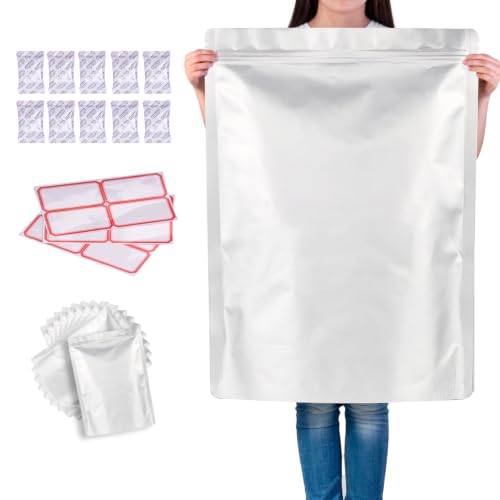
Below are a solid 5-mil bag, a true 7-mil for hard use, a budget option, and the sealer that handles thick Mylar. See picks ↓

Search "how thick should my Mylar bags be" and you get a wall of packaging companies, each one nudging you toward the bag they happen to sell. It's an easy question to overcomplicate and an easy one to get quietly wrong, because the number printed on the bag doesn't always mean what you think it means.
Mil is a measure of thickness: one mil is a thousandth of an inch. More mils means a stiffer, tougher, more puncture-resistant bag that also costs more and takes more heat to seal. So far, simple. The catch is that two brands can both print a big number on the label while meaning completely different things by it, which is why a "10 mil" bag and a "7 mil" bag can sit next to each other and the 7 mil one is actually thicker.
Here's the honest, non-salesy version: what thickness actually matters for, where the marketing numbers mislead, and the one thickness that covers the vast majority of home food storage. Owners who've been down this road fill in the rest.
The short answer: 5 mil per side
If you take nothing else from this, take this: 5 mil per side is the standard for home food storage, and it is what we'd put on the shelf for rice, beans, wheat, oats, sugar, and flour meant to last decades. It is thick enough to resist the punctures that dry grains cause, sturdy enough to survive normal handling, and still thin enough to seal with a clothes iron. The question that kicks off most thickness threads is really a question about the floor, not the ceiling:
Is 3.5 millimeters thick enough for long term food storage? Or should I wait for the 5 mil to restock?
The community answer to that one is consistent: wait for the 5 mil. Thin "economy" bags in the 3.5 to 4 mil range are fine for short-term or a bag-in-a-bucket setup, but for a 25-year staple you want the extra margin. Here's the whole range at a glance.
| Thickness (per side) | Good for | Watch out |
|---|---|---|
| 3.5 to 4 mil | Short-term storage, or a liner inside a sealed bucket | Too thin for a decades-long deep pantry on its own |
| 5 mil (often sold as "10 mil total") | The standard: rice, beans, wheat, oats, flour for 25+ years | Very sharp contents or heavy rodent pressure |
| 7 mil per side | Rodent-prone spots, sharp or heavy foods, roughest handling | Harder to heat-seal, and it costs noticeably more |
The label trap: "per side" versus "total" mil
This is the part the vendor blogs skate past, and it's the single most useful thing to understand before you spend a dime. A Mylar bag has two walls. Some brands rate the mil of one wall ("per side"), and some rate both walls added together ("total"). So a bag advertised as "10 mil" is very often a 5-mil-per-side bag with the two sides doubled up in the marketing, while a bag advertised as "7 mil" may mean 7 mil on each side, which is genuinely thicker.
That is not a hypothetical. A well-regarded 5-mil bag from Wallaby is sold as "10 Mil Total," and a heavy-duty PackFreshUSA bag is sold as "7 Mil Thick (Per Side)." Same shelf, and the smaller-sounding number is the thicker bag. Once you know to ask "per side or total?" the numbers stop lying to you. And on the cheap end, the ratings get looser still:
Was looking on amazon for 1gal, at least 7mil thick mylar bags for storing food long term. Founds lots claiming to be 7mil or more, but pretty consistently the reviews stated that theyre nowhere near what the stated thickness is
That's the practical takeaway on no-name bags: treat a bargain "7 mil" listing with suspicion, buy from a brand that states its rating clearly, and judge a bag by its stiffness in hand more than the number on the box.
When 5 mil is plenty (which is most of the time)
For the everyday deep-pantry staples, 5 mil per side does everything you need. Dry beans, wheat berries, oats, sugar, and flour sit quietly in it for decades without working a hole through the wall. It heat-seals with an ordinary iron or a cheap impulse sealer, and dropped into a food-grade bucket for physical protection, it is the setup the whole long-term-storage world runs on. If your storage is indoors, reasonably climate-stable, and packed with ordinary staples, you are done at 5 mil.
If you're still working out the rest of the system, the thickness is only one piece. Our companion guide on how many oxygen absorbers you need for a bucket or bag covers the absorber side, and the shelf-life chart for dry staples shows what actually lasts once it's sealed.
When to go 7 mil
There are real reasons to spend up, and they come down to what's going in the bag and what's living near it. Sharp or heavy contents are the first: a thicker wall resists the grains that poke through a thinner one. As one owner lays out, the food itself decides how much puncture resistance you need:
Depends on the item you're storing. Smooth beans like black beans or kidney, navy or red beans or products like barley ordry milk or flour don't generally puncture. Garbanzo beans, many macaroni products, will puncture. Rice may puncture, depending on how sharp the grain is.
The other reasons are rodents, decades-long storage in a rougher environment like a garage or barn, and any situation where the bags get stacked, shifted, and handled a lot. In those cases the extra dollars for 7 mil per side buy real insurance. For a climate-controlled closet full of smooth beans and rice, they mostly buy peace of mind you didn't need.
Thicker bags are harder to seal
Thickness has a cost beyond price, and it catches people off guard: the thicker the bag, the more heat and dwell time it takes to fuse the seal. A household iron handles 5 mil comfortably. Push into true 7-mil-per-side territory and a weak sealer can leave you with a seam that looks closed but isn't, which is the worst of both worlds. Owners run into exactly this math:
most impulse sealers for mylar say they only do 10mil, but i have 7.5 mil bags, and if you include both layers its 15mil which probably wont work? I assume it should work if it gets hot enough, a thicker bag should at most need a longer heat cycle
The read is simple. At 5 mil, an iron or a basic impulse sealer is fine. If you're buying at the thick end, buy a sealer that can keep up, and always run a finger-tug test on a cooled seam before you trust a bag with a year of food.
What thickness can't fix
Two honest limits, because no mil rating buys its way out of either. First, Mylar is not rodent-proof at any thickness a home storage bag comes in. A determined mouse chews through 7 mil as happily as 5, which is why the bag belongs inside a hard container, not on an open shelf:
I can attest, from personal experience, that mylar is not rodent proof. When I want to store foodstuffs in original packaging and/or mylar, it eventually winds up either in a bucket ($4-$5 with lid) or some other mouse proof container of similar thickness plastic.
Second, thickness has nothing to do with a vacuum. Mylar bags are heat-sealed, not vacuum-sealed, and an oxygen absorber does the air-removal chemically rather than sucking the bag tight. People new to it try to run Mylar through a vacuum sealer and get nowhere:
Do you have any tricks to getting your vacuum sealer to vacuum the 7 mil Mylar bags? I have a cheapo one and a large Weston and neither one will vacuum out the air with the Mylar.
So a correctly sealed bag will not look shrink-wrapped, and that's fine. The bag's job is to be an airtight, light-blocking, puncture-resistant wall; the absorber handles the oxygen and the bucket handles the mice.
Which thickness to order
For the overwhelming majority of home storage, buy a quality 5-mil-per-side bag, seal it with an iron or a basic impulse sealer, and drop it in a food-grade bucket. That combination stores your staples for decades and costs the least to get right. Only reach for true 7-mil-per-side bags if you're storing sharp or heavy foods, fighting rodents, or stashing food somewhere rough for the very long haul, and pair those with a sealer strong enough to close them.
Whichever you choose, read the label for "per side" versus "total," trust the feel of a stiff bag over a big printed number, and remember the thickness is only the wall. For which specific kits hold up, see our roundup of the best Mylar bags and oxygen absorbers.
Recommended
Products related to this guide.


What owners say
Real owner reports from the threads and editorial sources we drew on for this guide.
“Is 3.5 millimeters thick enough for long term food storage? Or should I wait for the 5 mil to restock?”
— r/preppers / u/professordurian
“Was looking on amazon for 1gal, at least 7mil thick mylar bags for storing food long term. Founds lots claiming to be 7mil or more, but pretty consistently the reviews stated that theyre nowhere near what the stated thickness is”
— r/preppers / u/ColdasJones
“Depends on the item you're storing. Smooth beans like black beans or kidney, navy or red beans or products like barley ordry milk or flour don't generally puncture. Garbanzo beans, many macaroni products, will puncture. Rice may puncture, depending on how sharp the grain is.”
— r/preppers / u/tofu2u2
“most impulse sealers for mylar say they only do 10mil, but i have 7.5 mil bags, and if you include both layers its 15mil which probably wont work? I assume it should work if it gets hot enough, a thicker bag should at most need a longer heat cycle”
— r/preppers / u/ab123w
“I can attest, from personal experience, that mylar is not rodent proof. When I want to store foodstuffs in original packaging and/or mylar, it eventually winds up either in a bucket ($4-$5 with lid) or some other mouse proof container of similar thickness plastic.”
— r/preppers / u/DeafHeretic
“Do you have any tricks to getting your vacuum sealer to vacuum the 7 mil Mylar bags? I have a cheapo one and a large Weston and neither one will vacuum out the air with the Mylar.”
— r/preppers / u/Firm-Subject5487