Best Home Freeze Dryer: A Buying Guide (2026)
By Theo Marchetti · Updated October 2026
Independent editorial guide. We never accept payment for coverage, though we may earn a commission if you purchase through our links.
Quick Take
If you buy a home freeze dryer, you are almost certainly buying a Harvest Right, and for most households the Medium is the one to get. It comes in Small, Medium, and Large, sells direct from harvestright.com rather than Amazon, and for the household that keeps it fed it's the single most capable preservation appliance you can put in a house: milk, eggs, raw meat, and whole cooked meals, shelf stable for decades.
The caveats are real, and worth naming up front. This is a four-figure machine that runs a day or two per batch, wants a vacuum pump maintained, adds noise and heat to the room it lives in, and carries a reliability and support record you should read about before ordering. Budget for the consumables too: mylar bags, oxygen absorbers, and pump oil are what turn a finished batch into food that actually keeps.
The machines ship direct from Harvest Right, so the picks below pair that link with the mylar, absorbers, pump oil, and sealer every batch ends up needing. See picks ↓
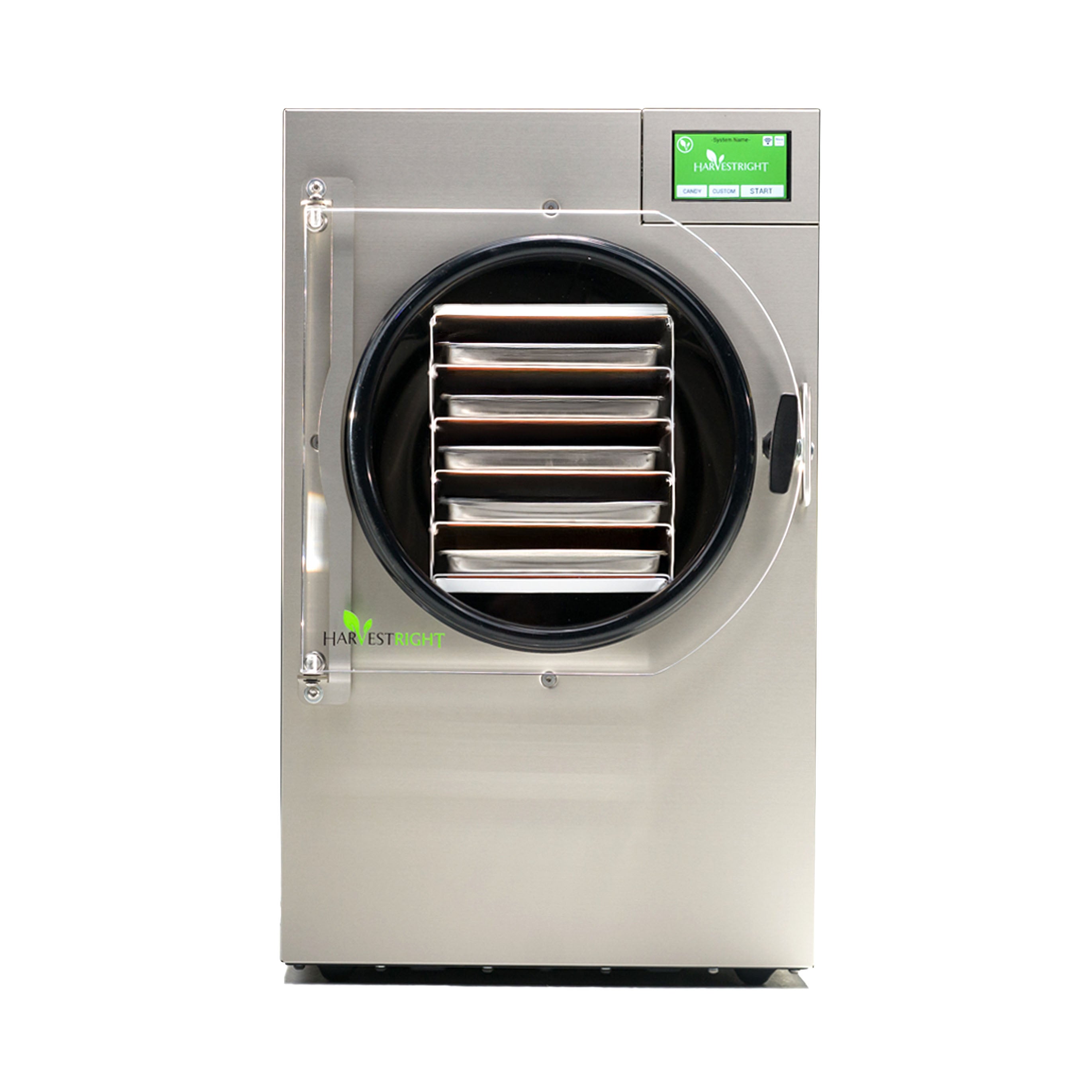
Shopping for "the best home freeze dryer" is not like shopping for the best dehydrator or the best canner. In those categories a dozen brands fight for the top slot and the job is sorting them. Here, one company built the consumer category and still towers over it, so the real questions are different: which size, which pump, what it actually costs to run, and whether you should buy one at all.
That last question matters more than it does for any other appliance on this site. A freeze dryer is not a countertop convenience. It is a four-figure workflow that rewards a household with a garden, a farm, bulk meat deals, or a serious storage plan, and it quietly punishes a buyer who wanted a set-and-forget gadget. The owners who love theirs run it constantly. The owners who regret theirs let it sit.
This guide walks the whole decision: the Harvest Right lineup and how to size it, the electricity and consumables math owners actually report, the pump choice, the reliability record, the new challengers worth watching, the unbranded imports worth avoiding, and the storage supplies that make the food keep for decades instead of months.
One company owns this category, and you should know that going in
Every buying guide on this site starts by comparing brands. This one cannot. Harvest Right created the home freeze dryer as a consumer product, and for most of the past decade it was, as owners in r/preppers put it, "Harvest Right or the highway." The machines sell direct from harvestright.com, and owners also report finding them at Costco, Lowes, Home Depot, Tractor Supply, and local farm stores. They are not sold on Amazon, which is why the Amazon links in this guide point at the consumables rather than the machine.
That dominance is not an accident. Nothing else in a home kitchen does what freeze drying does: pull the moisture out of food at low temperature under deep vacuum so that nutrition, color, and flavor survive, with shelf life measured in decades instead of seasons. The most-upvoted answer in the threads is also the shortest:
If you can afford it and foresee you’ll want to freeze dry food enough food to justify buying it, you’ll love it. There’s nothing like it on the consumer market.
It also does what a dehydrator chemically cannot. Dairy and eggs are unsafe to dehydrate, and heat-dried food gives up more of its nutrition along the way:
Dehydrating causes much more of a loss of nutrients. I have one with an oil free pump. Highly recommended.
For the full scored verdict on the machine itself, including the durability record in detail, read the Harvest Right freeze dryer review. This guide is the buying decision around it: size, pump, running cost, alternatives, and supplies.
Small, Medium, or Large: buy more machine than you think
Harvest Right's home line comes in Small, Medium, and Large, plus an XL tier above that. The Medium is the default for a reason: owners report roughly 10-15 pounds of fresh food per batch across five trays, enough to fill a run of jars or mylar bags every cycle, and one long-time owner counts about 70 eggs per load. The Small suits a single person or a tight room. The Large wants a dedicated circuit and more floor space, and some owner reports mention special electrical requirements, so plan the outlet before the machine arrives.
Here is the pattern in the threads, though: the regret almost always runs in one direction. Nobody wishes they had bought smaller.
I know two people that have them. The one piece of advice I've heard them both say is: "if you buy one spend the extra money and buy the BIG one, because even the big one is too small."
The reason is throughput. A batch takes a day or two no matter what, so tray area is the only lever you have on how much food actually gets put up per month. And the output is denser than it sounds:
I did about 5 gallons of whole milk about a week ago and after drying and then running thru blender to get uniform powder, I ended up with 22 1/2 cups of whole milk powder. I definitely want to do enough to have at least 50lbs on hand.
The practical rule: buy the biggest machine your space, budget, and wiring can support, and if that is a coin flip between two sizes, take the larger one.
What it really costs to run
The sticker is only the entry fee, so here is the running-cost picture assembled from owner reports rather than marketing pages. Electricity first: owners consistently land in the range of a couple of dollars per load, with figures from about $1.50 to $4 depending on local rates, and one owner measured the draw at roughly 9-11 amps on a 115-volt line while running. The worst case is real but narrow:
40 hours (longest time for hardest to freeze dry things) on the largest machine (XL) that can draw up to 17A with higher electric rates does get up into the $10-15 range, some places have seen electric rates raise more than 30% in the last year, variable rates/peak rates that make it more expensive. The extra power draw can push people into higher rates. Their website says $4/day on average.
Then the consumables. Mylar bags and oxygen absorbers are per-batch costs, with owners putting quart-size bag kits at under a dollar a bag. The standard oil pump drinks vacuum-pump oil, which owners stretch by draining, filtering, and reusing between loads. Time is the cost nobody prices in: batches run roughly 24-50 hours depending on the food, and the machine only pays for itself if it keeps running week after week.
Put together, the math still works for the right buyer, and the counter-argument from owners is specific:
😂 Biggest machine on the longest setting at the highest electric rates in the country, then maybe. The XL does 30+lbs of food in a run and lists between 20-40hrs, 40 hrs would be like, watermelon or something? You can do 30lbs of ground beef in 24hrs for $4 in electricity at your numbers, $2 at my home rate. That means you're out the door for under $6 a lb once you're packaged and done, vs $25+ a lb for freeze dried ground beef purchased from mountain house, etc.... (Ground beef is an easy example).
One comment carries the running-cost math: per-pound, home freeze-dried food comes out far cheaper than commercial pouches, but only for the household that actually feeds the machine.
The pump decision: oil or oil-free
Every Harvest Right runs on a vacuum pump you choose at checkout, and the choice shapes the ownership experience more than the machine size does. The standard oil pump (owners mostly call it the Premier) is cheaper and quieter, but wants its oil drained, filtered, and topped up on a rhythm; owner routines range from every batch to roughly every 25 loads. The oil-free pump deletes that chore for a much higher price, and owner reports describe periodic factory rebuilds once it has real hours on it.
Plenty of owners think the upgrade money is worth it:
I love mine and would recommend it only to someone that already has plenty of all the basic preps already. If you do get one, do yourself a favor and get the Oil Free Pump. You will be thankful for it down the road.
And plenty are just as blunt that either way, this is a machine you maintain and keep busy:
I have one. Medium size Get the oiless scroll pump. Lots of maintenance otherwise You have to have it constantly in use to do any type of production.
The budget-safe call is the standard oil pump plus a jug of oil and a five-minute change routine. The convenience call is the oil-free, bought with eyes open about rebuild costs down the road. Either way, decide at purchase time, because the pump is a real slice of the total price.
Living with one: noise, heat, smells, and where to put it
A freeze dryer is a roommate, not a gadget, so plan its room before it ships. It runs about as loud as a dishwasher or a loud humidifier for a day or more at a stretch, and throws off warmth the whole time. It also needs a climate-controlled space: owners report that a hot garage or a freezing shed will take it out of commission for a season. A basement, laundry room, or pantry with a sturdy floor and a nearby dedicated circuit is what it wants.
And then there is the part no spec sheet mentions:
Oh, the smells. The first time we freeze dried mushrooms, we spent hours searching for the sewer leak. Unfortunately, my kids LOVE freeze dried mushrooms so we're stuck with an ass-smelling basement forever. Also, you can take the tray rack out. Take the circular seal off the edge, then unplug the cable on the back. Idk if it's programmed to not work without the trays though, we only take it out for cleaning.
None of this is a dealbreaker, and most owners stop noticing the hum within a month. But if the only place the machine can live is next to the dinner table in a small apartment, that is a real argument for not buying one.
Reliability and support: read this section twice
This is the part the glossy videos skip, and it is the strongest reason to buy from a channel with an easy return window. The recurring failure in owner threads is specific: a machine that passes its empty vacuum test but throws vacuum errors once there is actual food inside, sometimes within the first weeks of ownership.
Just had my brand new small stainless steel freeze dryer arrive. Followed the manuals exactly. It passed all tests perfectly fine. Went to do the very first burn run with bread. Inadequate vacuum error wouldn't go below 1000 mTorr. Would not go to drying and wouldn't complete cycle. Canceled it took it all apart. Put it back together. All lines tight, drain valve closed and same thing. Passed vacuum test. But will not work when doing first cycle with damp bread. Vacuum error again! Have not been able to do a single complete batch yet and had a bunch of food prepped. Pretty ridiculous for the price of the unit.
When a fault does surface, the support experience divides owners sharply. Some describe long waits, a heavy do-it-yourself expectation, and a parts channel that runs exclusively through the company. Owners who returned machines report paying freight plus a restocking fee in the hundreds of dollars, even on units the company itself had trouble getting to work.
Ours (we bought about 3 months ago) has been problematic. We just replaced the relay board (took awhile to get the parts) and then it wouldn’t hold a vacuum. I was cleaning the pump and dropped the front case and broke the valve (that’s on me). Support isn’t stellar and 3 months in I’m not feeling very confident in the machine, especially for what it costs. That’s my anecdotal .02 cents. I have another pump coming that I bought and now have to contact them to get a valve for the original one. But I’m concerned the pump isn’t my problem (or if it is, what do I do after the warranty period). It’s stuff like this that bothers me. I can’t get any parts on my own, I have to go through them for everything.
Others hit a fault and walked away impressed:
My harvest right was a little bit out of warranty but they still decided to fix it for free but I did have to pay shipping which is understandable. Have had no problems with customer support.
None of this means "do not buy." It means: order from a seller whose return policy is painless, run the machine hard in the first weeks to surface a lemon while you can still send it back, and treat the first month as an extended test, not a honeymoon.
Who should not buy a freeze dryer
An honest guide to a four-figure machine owes you the case against it, and the best version of that case comes from someone who researched it hard and said no:
Hi friend!! I did a deep thoughtful dive into this last year; bear with me... your mileage may vary. Not yet. Technology is too slow, too expensive, and I can’t fix or replace most of the important parts myself. If I had a large, personal farm and was growing my own produce for almost free? Maybe. If I was splitting the initial costs with another family and we were sharing the upkeep and fill/refill responsibilities? Maybe. If I had a reasonable place to run it where the noise wouldn’t disturb me? Maybe. If I didn’t already have a great canning/freezing/dehydrating plan in place? Maybe. If more than one company was making them, and thus parts were easier to source and replace? Maybe. If I felt the ROI on “food I can use in 20 years” vs the food I’m already putting up and saving for 2-3 years was worth it? Maybe.
She is describing a real class of buyer. If your storage plan is backup food you hope never to touch, commercial freeze-dried cans are cheaper, simpler, and require no machine at all. If you mostly preserve fruit, herbs, and jerky, a dehydrator and a canner cover you for a tenth of the money:
I personally won't buy one of these. I think canning and dehydrating is perfectly fine for most people and is far more economical and requires much less maintenance. The harvest rights are really cool but the cost just makes it not worth it to me.
And the quietest failure mode is not a broken machine at all. It is an idle one:
Dad had one and it was great! The risk is that you end up not using it enough to make it worth the big outlay.
Buy a freeze dryer if you produce or buy food in real volume and will run the machine weekly. Skip it if you wanted an insurance policy; the insurance aisle sells that cheaper.
The challengers, and the imports to skip
The one-brand era is ending. Owners in recent threads name Blue Alpine and Stay Fresh as the challengers they are watching, with a 4Patriots-branded unit called The Cube also circulating, and the same threads note that Harvest Right has answered the pressure by rebranding its line with a Pro label and upgraded components. What none of the challengers have yet is a long public track record, so the smart move is to wait for more real-world reviews before betting four figures on one. That is fair, and it is the limit of what can be said about them today: they exist, they are direct-sold like Harvest Right, and their service records are still being written.
The clearer warning is at the other end of the market. Unbranded import freeze dryers show up on marketplace listings at Harvest Right money, sometimes north of $3,000, with no recognizable brand behind them, no US parts channel that a buyer can point to, and no owner community when something fails at hour 30 of a batch. Given that the established brand in this category already tests owners with vacuum faults and parts that route through one door, buying the same failure risk with no door at all is a bad trade. If the budget will not stretch to a new Harvest Right, owner threads suggest better paths: scratch-and-dent units sold direct, the veteran discount some buyers mention, or simply a smaller size, all of which keep a company on the other end of the phone.
The consumables that make the food actually keep
Whatever machine you land on, the last step is where the shelf life really comes from, and it is also where the recurring spend lives. Freeze-dried food left in open air soaks moisture straight back up, so every long-term batch ends in thick mylar with a correctly sized oxygen absorber and a clean heat seal. The veterans have strong opinions on the details:
I've freeze dried for over 6 years with the Harvest Right. Great summary. I would add a couple things. I buy my O2 absorbers in packages of 10. I can take out what I need and reseal the package with the heat sealers. Very reliable. I have never been able to reliably preserve the packages of 100. I've always had to waste many. When buying Mylar bags be sure they are 7 mil PER SIDE. Sometimes you will see an ad for 10 mil Mylar, but it is 5 mil per side. You don't want that. No less than 7 mil per side for long terms storage. I store in totes that can stack.
That comment is a checklist in disguise: buy absorbers packed in small sleeves so the spares do not die in open air, check that bag thickness is quoted per side, and store the sealed bags in stackable totes away from light and rodents. A wide impulse sealer earns its spot fast too, since gusseted 5-gallon bags want a single clean pass rather than three overlapping iron strokes.
The picks below cover that whole chain: bags, absorbers, pump oil for the standard pump, and a sealer. For the deeper dive on bag thickness and absorber sizing math, the guide to the best mylar bags and oxygen absorbers walks through it food by food.
Recommended
Products related to this guide.





What owners say
Real owner reports from the threads and editorial sources we drew on for this guide.
“If you can afford it and foresee you’ll want to freeze dry food enough food to justify buying it, you’ll love it. There’s nothing like it on the consumer market.”
— r/preppers / u/cityprepping
“Dehydrating causes much more of a loss of nutrients. I have one with an oil free pump. Highly recommended.”
— r/preppers / u/user381035
“I know two people that have them. The one piece of advice I've heard them both say is: "if you buy one spend the extra money and buy the BIG one, because even the big one is too small."”
— r/preppers / u/zrad603
“I did about 5 gallons of whole milk about a week ago and after drying and then running thru blender to get uniform powder, I ended up with 22 1/2 cups of whole milk powder. I definitely want to do enough to have at least 50lbs on hand.”
— r/preppers / u/Other-Goal2689
“40 hours (longest time for hardest to freeze dry things) on the largest machine (XL) that can draw up to 17A with higher electric rates does get up into the $10-15 range, some places have seen electric rates raise more than 30% in the last year, variable rates/peak rates that make it more expensive. The extra power draw can push people into higher rates. Their website says $4/day on average.”
— r/preppers / u/biobennett
“😂 Biggest machine on the longest setting at the highest electric rates in the country, then maybe. The XL does 30+lbs of food in a run and lists between 20-40hrs, 40 hrs would be like, watermelon or something? You can do 30lbs of ground beef in 24hrs for $4 in electricity at your numbers, $2 at my home rate. That means you're out the door for under $6 a lb once you're packaged and done, vs $25+ a lb for freeze dried ground beef purchased from mountain house, etc.... (Ground beef is an easy example).”
— r/preppers / u/thatoneshooterdork
“I love mine and would recommend it only to someone that already has plenty of all the basic preps already. If you do get one, do yourself a favor and get the Oil Free Pump. You will be thankful for it down the road.”
— r/preppers / u/TheSensiblePrepper
“I have one. Medium size Get the oiless scroll pump. Lots of maintenance otherwise You have to have it constantly in use to do any type of production.”
— r/preppers / u/YourNameHere888
“Oh, the smells. The first time we freeze dried mushrooms, we spent hours searching for the sewer leak. Unfortunately, my kids LOVE freeze dried mushrooms so we're stuck with an ass-smelling basement forever. Also, you can take the tray rack out. Take the circular seal off the edge, then unplug the cable on the back. Idk if it's programmed to not work without the trays though, we only take it out for cleaning.”
— r/preppers / u/Covert__Squid
“Just had my brand new small stainless steel freeze dryer arrive. Followed the manuals exactly. It passed all tests perfectly fine. Went to do the very first burn run with bread. Inadequate vacuum error wouldn't go below 1000 mTorr. Would not go to drying and wouldn't complete cycle. Canceled it took it all apart. Put it back together. All lines tight, drain valve closed and same thing. Passed vacuum test. But will not work when doing first cycle with damp bread. Vacuum error again! Have not been able to do a single complete batch yet and had a bunch of food prepped. Pretty ridiculous for the price of the unit.”
— r/preppers / u/Cam1062
“Ours (we bought about 3 months ago) has been problematic. We just replaced the relay board (took awhile to get the parts) and then it wouldn’t hold a vacuum. I was cleaning the pump and dropped the front case and broke the valve (that’s on me). Support isn’t stellar and 3 months in I’m not feeling very confident in the machine, especially for what it costs. That’s my anecdotal .02 cents. I have another pump coming that I bought and now have to contact them to get a valve for the original one. But I’m concerned the pump isn’t my problem (or if it is, what do I do after the warranty period). It’s stuff like this that bothers me. I can’t get any parts on my own, I have to go through them for everything.”
— r/preppers / u/thegrimmestofall
“My harvest right was a little bit out of warranty but they still decided to fix it for free but I did have to pay shipping which is understandable. Have had no problems with customer support.”
— r/preppers / u/tweeter46and2
Sources
Harvest Right official product page (Home Pro freeze dryer bundle)