Tribest
Tribest Sedona Dehydrator Reviews (2026)
By Nora Calloway · Updated October 2026
Independent editorial review. We never accept payment for coverage, though we may earn a commission if you purchase through our links.

Verdict
The Sedona conversation is small and unusually careful, closer to due diligence than to a wall of reviews. Buyers get drawn in by Tribest's reputation from its juicers and by the long warranty, then hesitate at a build that looks open and underpowered up close: the door edges, the tight tray spacing, the 470-watt element. Owners answer that all three are deliberate airflow design rather than cost cutting, and the people who own one, first-time dehydrators included, use theirs happily without reporting failures. Almost nobody asks whether it works. They ask whether the premium and the footprint are worth it over a cheaper box, and whether the Express is enough next to the Supreme. Our answer to the first question is yes if you need the low raw range, no if you do not.
Read full take ↓Similar dehydrators
The Tribest Sedona Express Digital Food Dehydrator is the box raw-food and living-food kitchens keep circling back to. Eleven trays behind a glass door, a single rear fan pushing warm air horizontally across every shelf, digital temperature and timer control, and a low end cool enough to dry produce without cooking it. It is built for people who care less about how fast a batch finishes and more about keeping delicate foods under a set temperature the whole way through, and it carries a name most owners already trust from Tribest's juicers.
That focus is also the catch. The Sedona costs well above a mainstream stainless box, it is a large appliance that stakes out real counter or shelf space, and the community around it is small enough that you find due-diligence questions more often than five-year retrospectives. Below we work through what owners and serious shoppers actually say: where the low-temp, glass-door design earns the premium, where the open-edged build and modest wattage raise eyebrows, and who is better served buying something cheaper or bigger.
The short version
The owner conversation around this machine is small but careful, and it points one direction: a genuine raw-food specialist that charges you for the specialty and makes you clear shelf space for it.
What's good:
- True low-temperature control for raw and living foods, with owners citing a range from roughly 77F up to about 167F for jerky.
- A single rear fan pushes warm air horizontally across a purposely packed tray stack, so batches dry evenly without shuffling trays.
- A glass door lets you watch a batch without opening the box and dumping heat, which matters over long low-temp runs.
- Close to ten square feet of tray space across eleven BPA-free trays swallows a serious load of garden produce.
- Tribest's reputation and a long warranty give buyers confidence the machine is built to keep.
What's not:
- The buy-in sits well above a mainstream stainless box, and the raw-food features are most of what you are paying for.
- It is a large, fixed appliance that eats counter or shelf space and does not collapse for storage.
- The open-edged door and a modest 470-watt element read as cheap to first-time buyers until someone explains the airflow logic.
- The owner community is thin, so there is far less shared troubleshooting than for a Cosori or Excalibur.
Who it's for
Raw-food kitchens love this box. Almost everyone else is buying more machine than the job needs.
Buy it for:
- Raw and living-food diets where holding a low temperature the whole way through matters more than finishing quickly.
- Drying delicate herbs, fruit leather, and garden produce gently, and watching progress through the glass door.
- Buyers who trust Tribest and want a long warranty behind a machine they intend to keep for years.
Skip it if:
- You mostly make jerky and household batches and do not need raw credentials; the Cosori Premium does that job for far less outlay.
- You just want the cheapest way to start dehydrating; a Nesco Snackmaster Pro makes real jerky for a fraction of the spend.
- You want the very top of the Sedona line for near-commercial runs; the Sedona Combo flagship is the step up in fans, area, and warranty.
The specs that matter
Three figures on the Sedona's sheet decide whether it suits your kitchen:
Temperature range owners cite from about 77F to 167F: that low floor is the whole point of a raw-food machine, cool enough to keep enzymes and delicate produce intact, while the top end still reaches the range beef and poultry jerky need. Most mainstream boxes cannot go nearly as low.
Close to ten square feet across eleven BPA-free trays: one owner pegs the Express at about 0.922 square meters of tray area, which is a big single load for herbs, fruit, or produce. It is a lot of drying surface, but it is fixed, so you cannot add trays the way you can on a stackable.
A single rear fan and a 470-watt element behind a glass door: the low wattage looks underpowered next to hotter boxes, but on a dehydrator a lower draw is deliberate; the design leans on steady horizontal airflow from the single rear fan and even distribution rather than brute heat, and the glass door lets you check a batch without breaking the cycle.
How well it preserves
Drying is what justifies the price of this box. A single rear fan pushes warm air horizontally, and the deliberately close tray spacing keeps that air moving evenly across a full stack. Owners who understand the design read the open-looking build and modest wattage as choices, not corners cut. One Sedona owner spells the logic out plainly:
I have the Sedona Supreme which is 570watts. On a dehydrator you very likely are better of with a lower number since it lowers power consumption. All I can tell you is that all those holes and everything that you are worried about are intentionally built like that. Dehydrator needs to create an airflow of warm air and that is not possible in a closed box I guess. The trays being close to each other is also intentional. You want the Box to be as packed as possible. Well, what I am saying is that all of it is designed with purpose not because of some cost savings.
Temperature range is the other half, and it is why raw-food kitchens pay up instead of buying a cheaper box. Owners comparing the Express against the pricier Supreme lay the numbers side by side:
express6780/supreme: area: 0.922 sq m - 1.13 sq m power: 470W - 570W temperature range: 25-75° - 25-68° In addition to the standard 5-year warranty, the "supreme" dehydrator model comes with an additional 1-year commercial warranty.
That floor near 77F is what a living-food diet needs. The ceiling near 167F still carries jerky through the range meat requires, so despite the raw-food reputation this is not a fruit-only machine. The horizontal rear-fan airflow and deliberately close tray spacing are built for even drying, and nobody in this community reports otherwise. The glass door is there to let you judge doneness by eye over a long, low run rather than opening the box and shedding heat. Flexibility is the limit, not quality. The load is large and fixed, so you dry on the Sedona's terms: big batches, low temperatures, patience.
Built to last
Trust and skepticism sit right next to each other in these threads. Tribest's track record and a long warranty pull careful buyers in before they have run a single batch. Then the machine arrives and does not look expensive up close. A first-time buyer said so directly:
Does anyone have any experience with one? I trust the brand and love the 10 year warranty, but have a lot of concerns with how it's built. The door is wide open around the edges, the shelves are pretty close to each other, and its only 470 watts. I'm new to dehydrating, but trust the brand (because of their juicers). So am wondering if it is pretty good and I just don't know what I'm talking about.
Open door edges, tight tray spacing, a 470-watt element. Those are honest first impressions, and they are the same three things a longtime Sedona owner rebuts as intentional airflow design rather than cost cutting. What looks flimsy is mostly deliberate, and nobody who has lived with one reports an early failure. So you are banking on Tribest's reputation and the warranty behind it. Owners cite a standard warranty measured in years, with the Supreme model adding a commercial year on top. That is a real reason for confidence, though it is confidence in a brand and a document rather than in a long public trail of ten-year-old survivors, because this niche does not generate that volume of owner history. Register it. Keep your proof of purchase.
Living with it
The glass door is the feature owners notice first. You set a temperature and a time, walk away, and check progress through the window instead of cracking the door and losing heat, which is precisely what you want on a long overnight batch of fruit or herbs. It runs quietly enough to leave working in a kitchen, and the digital controls are simple enough for a first dehydrator. One owner picked the Sedona as their very first machine and jumped straight into a batch:
So I had some of those chewy baby bananas from TJoe's and I wanna replicate them in my Sedona.... They have like a cinnamon and sugar flavor r the them. Can I just throw cinnamon and sugar on these and then go for it? Anybody know a good setting to start with? this machine is my first dehydrator and this is the first time I'm using it for bananas.
The tray system is the other part of living with it. The eleven BPA-free trays give you room to spread a big harvest thin, and owners build out their setup with different insert types over time for leathers, small pieces, and produce that would otherwise drop through:
I have a Tribest Sedona dehydrator with various drying trays. Can anyone advise how best to replicate the instant mix?
Size and permanence are the friction. This is a large box that claims a real footprint and does not fold down between uses, so a tight counter or an occasional habit makes it a lot of appliance to store. No expanding it, either. The capacity you buy is the capacity you keep. Dry in volume and leave it out as a fixture and none of that stings. Dry twice a year in a small kitchen and it is the first thing to weigh.
How it compares
Three machines come up most when people cross-shop the Sedona, and one of them is the Sedona:
Versus the stainless-tray Sedona Express: our premium pick is not a different machine at all, it is the same Sedona Express with SUS304 stainless steel trays in place of the BPA-free plastic ones. Same single rear fan, same 470-watt element, same eleven trays, and the same low-temperature range; you pay more for stainless trays and their durability, not for more performance. The genuine step up in tray area and fan count is the pricier Sedona Supreme, and shoppers eyeing that model ask the obvious question about whether the bigger one is simply the better machine:
I suppose supreme has similar drying capacity but is more durable and more professional, right?
The honest answer is that the Supreme is more capacity, a second fan, and an added commercial warranty year for near-commercial use, while both Express versions cover the same raw-food temperature range for a home kitchen. Most home raw-food users do not need to size up at all.
Versus the Cosori Premium 6-Tray Stainless: the Cosori is the mainstream value cross-shop. It dries evenly, cleans up in the dishwasher, and costs a large fraction less, but it does not go nearly as low on temperature, so it is the smarter buy for jerky, fruit, and herbs and the wrong buy if raw credentials are the point.
Versus the Nesco Snackmaster Pro FD-75A: the Nesco is the budget floor. It is a stack of round trays under a dial that still hits meat temperatures, which puts jerky within reach for a small outlay. You trade the glass door, the low raw floor, and the even rear-fan drying for tray rotation and plastic, but it is a fraction of the cost to try dehydrating at all.
Using it well
Spread food in a single layer with space between pieces so the rear fan can move air across the whole stack. Stay at the low end of the range for raw and delicate produce instead of rushing the temperature up. Judge doneness through the glass rather than opening the box mid-cycle. Add solid or mesh inserts for fruit leather and small pieces so nothing drops through. And do not pack any one tray so densely that it blocks flow to the trays above it, since the whole design depends on that air path staying clear.
If you are buying it mainly for gentle, low-temperature work on produce and herbs, it is worth reading how fan placement, temperature range, and tray type play out across brands first. Our guide to the best dehydrator for fruit leather and herbs walks through those choices in more depth, with the Sedona in context against the alternatives.
Where the Sedona fits
The Sedona Express is a specialist and a good one: gentle, even, low-temperature drying of produce, herbs, and leathers behind a glass door you can actually watch, backed by a brand name and a long warranty careful buyers trust. The drying range and the low floor are the reasons to choose it over a cheaper stainless box, and owners who understand the airflow-first design defend the parts that look underbuilt at a glance.
Price and footprint are what hold us back. You pay a clear premium and you surrender real space, and unless you specifically want raw-range temperatures or the glass door, a Cosori Premium does the everyday job for far less and a Nesco does it for less still. We would buy the Sedona for the one thing it does that they cannot, not as a default. If you want the top of the line for near-commercial batches, size up to the Combo flagship instead.
Our Ratings
Overall score
Our highest score here. The single rear fan pushes warm air horizontally across a deliberately packed tray stack, a layout meant to reach every shelf evenly, and owners cite a range from roughly 77F up to about 167F, low enough for true raw and living foods yet hot enough to carry jerky. The glass door lets you judge doneness without opening the box on a long low run. No owner reports uneven drying. Flexibility is the only real limit, since it dries in big fixed batches on its own patient terms.
Durability rests on trust more than a long public trail of survivors. The open door edges, tight tray spacing, and modest 470-watt element read as cheap to first-time buyers, but a longtime owner rebuts each as intentional airflow design, and nobody in this small community reports early failures. What you are really banking on is Tribest's reputation and a warranty measured in years, with the flagship adding commercial coverage. That is a genuine reason for confidence, just not the deep owner history a Cosori or Excalibur has.
Running it is mostly easy: digital temperature and timer, quiet operation, simple enough to be someone's first dehydrator, and a glass door that lets you check a batch without shedding heat. Size and permanence are the friction. It is a large box that claims real counter or shelf space, does not fold away, and cannot be expanded past the capacity you bought. Convenient to use, then, but attached to a machine you have to make room for at a premium price.
Tribest Sedona Dehydrator Reviews (2026) on Amazon.
What People Are Saying
The Sedona conversation is small and unusually careful, closer to due diligence than to a wall of reviews. Buyers get drawn in by Tribest's reputation from its juicers and by the long warranty, then hesitate at a build that looks open and underpowered up close: the door edges, the tight tray spacing, the 470-watt element. Owners answer that all three are deliberate airflow design rather than cost cutting, and the people who own one, first-time dehydrators included, use theirs happily without reporting failures.
Almost nobody asks whether it works. They ask whether the premium and the footprint are worth it over a cheaper box, and whether the Express is enough next to the Supreme. Our answer to the first question is yes if you need the low raw range, no if you do not.
We weight candid owner reports from Reddit and preservation forums above brand-influenced editorial coverage, then reach our own verdict from them. The quotes below are the evidence; the rating and the take are ours.
What Reddit Is Saying
“I have the Sedona Supreme which is 570watts. On a dehydrator you very likely are better of with a lower number since it lowers power consumption. All I can tell you is that all those holes and everything that you are worried about are intentionally built like that. Dehydrator needs to create an airflow of warm air and that is not possible in a closed box I guess. The trays being close to each other is also intentional. You want the Box to be as packed as possible. Well, what I am saying is that all of it is designed with purpose not because of some cost savings.”View thread →
“So I had some of those chewy baby bananas from TJoe's and I wanna replicate them in my Sedona.... They have like a cinnamon and sugar flavor r the them. Can I just throw cinnamon and sugar on these and then go for it? Anybody know a good setting to start with? this machine is my first dehydrator and this is the first time I'm using it for bananas.”View thread →
“Does anyone have any experience with one? I trust the brand and love the 10 year warranty, but have a lot of concerns with how it's built. The door is wide open around the edges, the shelves are pretty close to each other, and its only 470 watts. I'm new to dehydrating, but trust the brand (because of their juicers). So am wondering if it is pretty good and I just don't know what I'm talking about.”View thread →
“express6780/supreme: area: 0.922 sq m - 1.13 sq m power: 470W - 570W temperature range: 25-75° - 25-68° In addition to the standard 5-year warranty, the "supreme" dehydrator model comes with an additional 1-year commercial warranty.”View thread →
“I suppose supreme has similar drying capacity but is more durable and more professional, right?”View thread →
“I have a Tribest Sedona dehydrator with various drying trays. Can anyone advise how best to replicate the instant mix?”View thread →
Frequently asked questions
Is the Tribest Sedona Dehydrator worth it?
Running it is mostly easy: digital temperature and timer, quiet operation, simple enough to be someone's first dehydrator, and a glass door that lets you check a batch without shedding heat. Size and permanence are the friction. It is a large box that claims real counter or shelf space, does not fold away, and cannot be expanded past the capacity you bought.
How is the Tribest Sedona Dehydrator built?
Durability rests on trust more than a long public trail of survivors. The open door edges, tight tray spacing, and modest 470-watt element read as cheap to first-time buyers, but a longtime owner rebuts each as intentional airflow design, and nobody in this small community reports early failures. What you are really banking on is Tribest's reputation and a warranty measured in years, with the flagship adding commercial coverage.
What is the Tribest Sedona Dehydrator best suited for?
Our highest score here. The single rear fan pushes warm air horizontally across a deliberately packed tray stack, a layout meant to reach every shelf evenly, and owners cite a range from roughly 77F up to about 167F, low enough for true raw and living foods yet hot enough to carry jerky. The glass door lets you judge doneness without opening the box on a long low run.
What do real owners say about the Tribest Sedona Dehydrator?
The Sedona conversation is small and unusually careful, closer to due diligence than to a wall of reviews. Buyers get drawn in by Tribest's reputation from its juicers and by the long warranty, then hesitate at a build that looks open and underpowered up close: the door edges, the tight tray spacing, the 470-watt element. Owners answer that all three are deliberate airflow design rather than cost cutting, and the people who own one, first-time dehydrators included, use theirs happily without reporting failures.
Options Worth Checking Out
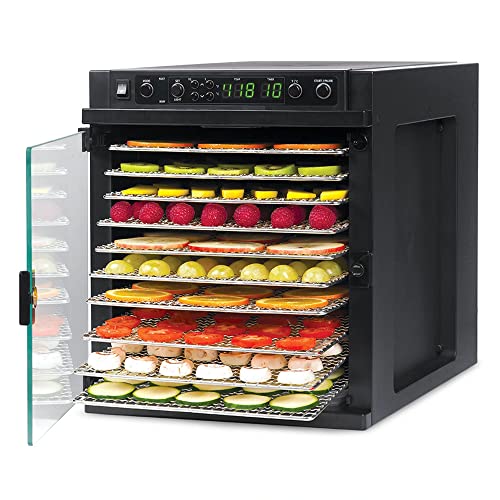
Tribest Sedona Express (Stainless Trays) SDE-S6780-B Digital Food Dehydrator
The Sedona Express in stainless: eleven SUS304 stainless trays swap in for the plastic ones behind the same glass door, with the same single rear fan and 470-watt element. Buy it for tray durability, not more capacity or speed; it is the identical machine.

Cosori Premium 6-Tray Stainless Steel Food Dehydrator
The mainstream cross-shop that costs far less. Six stainless dishwasher-safe trays, a rear fan, and simple digital controls dry jerky, fruit, and herbs evenly. It will not go nearly as low as the Sedona, so pick it when raw credentials are not the point.

Nesco Snackmaster Pro FD-75A Food Dehydrator
The cheapest honest way in. Trays that stack instead of sliding in, and a dial that reaches meat temperatures, so jerky costs you only a small outlay. You rotate trays and clean plastic instead of watching through glass, but it is a fraction of the cost.
You Might Also Need
Accessories worth grabbing alongside your purchase