Inkbird
Inkbird Curing Chamber Controller Reviews (2026)
By Theo Marchetti · Updated October 2026
Independent editorial review. We never accept payment for coverage, though we may earn a commission if you purchase through our links.

Verdict
Across r/Charcuterie, the Inkbird is the near-universal starting point for a DIY curing chamber, and most owners are happy with it: cheap, able to hold temperature and humidity independently, and steady enough once tuned that they call it the center of a working build. Accuracy and setup are the recurring frustrations. The probes read with lag, so humidity overshoots and spikes in a small chamber. Calibration is manual. A real minority find the readings float enough that they never fully trust them, or have had units quit outright. Just as many run Inkbird gear for years and would not build a chamber without one. Our sense, after weighing both sides: this is no precision instrument. It is a cheap, capable heart for a project that is still yours to run.
Read full take ↓Similar curing kits
A spare fridge will not cure meat on its own. It needs a controller, and the Inkbird ITC-608T Temperature & Humidity Controller is the one most home charcuterie makers buy first. Two switched outlets do the work: one runs cooling and heating to hold temperature, the other runs a humidifier and dehumidifier to hold humidity. Plug in a fridge, a small humidifier, a mini dehumidifier, and a fan, enter your numbers, and a beverage fridge turns into somewhere salami, coppa, or bresaola can dry slowly and safely for months.
That is why it turns up in nearly every chamber build thread. Owners like that it is cheap, that it controls both variables independently, and that it mostly just works once they have widened the differentials to suit their fridge. The catch we would flag is that it is only a controller. It does not supply the fridge, the humidifier, the dehumidifier, or the fan. It does not tune itself. And it will not keep your meat safe on its own. Below we weigh both halves, including where the probes and the reliability wobble, and who should buy something bigger instead.
The short version
The Inkbird is the cheap, capable heart of a DIY curing chamber. It also comes with a learning curve and an accuracy caveat, and a few hundred owner comments across r/Charcuterie say the same thing about both that we do.
What's good:
- Controls temperature and humidity independently from one cheap box, which is the whole reason it became the community default for curing chambers.
- Two switched outlets drive cooling/heating and a humidifier/dehumidifier, so a plain fridge plus a few parts becomes a real aging chamber.
- Averages hold well over a long cure once you set the differentials, even when the readout swings with the compressor.
- It is the gateway device for the whole hobby, which means endless build guides, settings threads, and help when you get stuck.
What's not:
- The probe reads with lag, so humidity can overshoot and spike before the controller catches up, which risks mold if you set it carelessly.
- Calibration is manual, and a real minority of owners find the readings float enough that they never fully trust them.
- It is a controller only; you still supply and tune the fridge, humidifier, dehumidifier, and fan, and you still need cure #2, the right humidity, and know-how to be safe.
- The smaller Inkbird siblings top out on amperage and have cramped outlet spacing, and a few owners have had units quit on them.
Who it's for
The Inkbird suits one kind of builder and frustrates another. Which one you are comes down to your fridge and your patience.
Buy it for:
- Building your first curing chamber from a spare fridge or wine cooler and wanting one affordable box that handles both temperature and humidity.
- Dry-cured whole muscles and salami, or aging cheese, in household batches where a fridge-sized chamber is plenty.
- Learning the hobby, where the huge community around this exact controller means every settings question has already been answered.
Skip it if:
- Your fridge draws more than the controller can switch; a heavy compressor needs a higher-amperage unit like an Auber, not the smallest Inkbird.
- You only need one variable controlled; a temp-only or humidity-only controller is cheaper and simpler for that build.
- You want lab-grade accuracy and hands-off logging; the floating readout and manual calibration will frustrate you, and a pricier controller reads truer.
The specs that matter
Three lines on the ITC-608T's spec sheet change what you can build with it. Here is what each one buys you at the fridge.
Two independent stages, one for temperature and one for humidity: the feature owners upgrade to this box for. Temperature and humidity each get their own outlet and their own set point, so your humidifier is not chained to your compressor. One owner spelled out the difference from a controller that could not separate the two.
Dual-stage outlets that switch both directions: each stage can run two devices, so the temperature outlet drives cooling and a gentle heat source, and the humidity outlet drives both a humidifier and a dehumidifier. That is what lets a fridge, which naturally dries the air as it runs, still hold the high humidity a cure needs.
A pre-wired 1800W plug box rated to 15A: you plug devices in rather than splicing mains wiring, which is the safety and simplicity win for a first build. The 15A ceiling also matters, because the smaller ITC-308 tops out at 10A and cannot switch a hungrier fridge.
How well it preserves
Holding a stable environment is the core job, and for most owners the Inkbird does it. Set a temperature band and a humidity band, wire the devices to the right outlets, and it keeps a chamber in the range dry curing needs across a months-long cure. People who have built with it describe it as the reliable center of the setup, not the weak link.
I had that one in my wine cooler, smallish, maybe 100 liters. Worked fine, i had some cheap amazon humidifier and drier controlled by inkbird. Meat was good, no problem there.
Independent dual control is what earned the community's trust. A fridge fights you by drying the air every time the compressor runs, so a humidifier has to push back while temperature holds steady, and the two systems cannot be tied together. Owners who came from a controller that could only manage one variable, or both locked to one set point, call the separation the upgrade.
Nice, would love this. I currently cure only in specific months in my cellar, I could get my fridge setup again for other times of the year. I had one going but my controller really wasn't that good and could only do both Temp and Humidity at the same time, not each individually which I think is great. My next project is a larger finocchiona, made with both fennel pollen and fennel seed. I plan to get that up by end of January.
I'm already using an ITC-608T to control a humidifier and dehumidifier in my curing cabinet. I would be able to use another unit to control cooling and heating.
Accuracy and response speed are the limits. The probe reads with lag, so in a small chamber a humidifier can overshoot the set point and spike the reading before the controller shuts it off. Left unchecked, that is how you grow mold instead of good white bloom. A wider differential fixes it more reliably than a different controller does, because what the meat experiences is the average over weeks, not the number on the display at any given second. Two experienced owners frame the swing that way.
Don’t sweat it. it swings with the compressor and the speck could care less. what counts is the average over time. don’t forget the speck is infinitely denser than the air around it so it can handle these swings.
I would say it highly depends on your actual humidifier too. For example, I set my inkbird to 85F, but my humidifier constantly “overshoots” probably because of some lag factors in measurements and I often read over 90 causing mold. I now have the controller set to 82.5 with a differential of 5 (for both humidify and de-humidify) and I’m averaging around 85 now.
Strong performance, then, with a condition attached. The dual control is what makes this the default pick. Just expect the readout to swing, expect the response to lag, and widen the differentials instead of trusting the live number cold.
Built to last
Reliability is where we would hedge. Plenty of owners run Inkbird gear for years without drama, and the brand's standing in this community rests on a lot of quietly dependable units doing exactly what they should.
I have several Inkbird products and they perform flawlessly! Would love to get my hands on this one. US, please.
The failure reports are common enough to name, though, and they cluster on two things: units that stop being reliable, and readings that drift until the owner stops trusting them. A couple of long-time curers have soured completely after cycling through gear.
I'll be honest I wish inkbirds were more reliable but about $300 later and I can't find a single one that doesnt shit the bed right as guests are on the way.
honestly I have nothing but hate for inkbird. Total trash controllers. They are extremely inaccurate, their readings float constantly, calibration is a joke unless you are doing it hourly.
There is also a hard limit on the smaller siblings that trips people up. The popular temp-only ITC-308 switches only 10A, which is not enough for some older or larger fridges, and owners hit that wall mid-build. Being rated to 15A and clearing most home fridges is a point in the ITC-608T's favor, but if you are pairing separate 308 and 200 units, check your compressor's draw first.
I have an inkbird ITC-308, which is rated for a max of 10.0A. Unfortunately, the refrigerator I plan to use for a curing chamber requires 11.6A. Has anyone else run into this? If I'm missing a simple work-around, I'd love to hear your comments!
We would still buy it. It costs little enough that a spare on the shelf is barely an expense, and most owners get years out of one. The spread is just wide. Treat the first few weeks as a shakedown, note the return deadline, and keep an independent hygrometer in the chamber so a drifting probe cannot quietly ruin a cure.
Living with it
The DIY nature of the thing shows up most in daily use, which is why the ease-of-use score sits under the performance number. As a box it is plug-and-play: two outlets, a probe each for temperature and humidity, set points you enter on the front. The chamber around it is yours to build and tune. That part is real work.
One of the things that keeps coming up when folks talk about the InkBirds is the Calibration setting. Which, is essentially manual, you need to know the temp/rH is actually off by X in order to use it properly.
Calibration is the first hurdle. The controller has no idea your probe reads a few points off, so you have to tell it, which means checking against a trusted hygrometer or a salt-test kit and entering the offset by hand. Skip it and the swings and mold problems above get worse. A fridge-sized chamber makes the tuning fiddlier still, because a short burst of the humidifier moves the air a lot and the probe reports it late.
My understanding is that since it's such a small space, short times with a humidifier or dehumidifier on will cause big swings so you kind of have to anticipate the changes they will make. The probes don't register the changes fast enough and humidity will register at 75% and will climb to 90% after the humidifier kicks on due to lag.
No controller can make your food safe, and this one does not pretend to. The Inkbird holds an environment. A safe cure still needs cure #2 in the recipe, the correct humidity so the outside does not case-harden and trap moisture inside, airflow from a fan, and enough know-how to read what the meat is doing. Buying the controller starts the learning curve rather than ending it. Accept that and it is a pleasant thing to own, and the enormous community around this exact unit means help is a search away when a setting fights you.
How it compares
Buyers weighing the Inkbird usually put it against three other controllers. Here is how each one lands against it.
Versus the SENSTREE Temperature & Humidity Controller: this is the closest like-for-like, another single box that runs temperature and humidity on separate stages and wires into the same fridge-plus-humidifier build. It is the one to price against the Inkbird when the ITC-608T is out of stock or you just want a second option, since it drops into an identical chamber with no rethinking.
Versus the Inkbird ITC-308 temperature-only controller: if your build only needs temperature control, the temp-only sibling is cheaper and simpler. It runs two-stage cooling and heating from one probe with the same plug-in wiring. Just remember its 10A ceiling and the cramped outlet spacing owners gripe about, and add a separate humidity controller if the chamber ever runs dry.
Versus stepping up to Auber Instruments: when the chamber gets big or the fridge draws hard, owners graduate to Auber controllers, which switch up to 15A per channel and read truer. You pay noticeably more, but if you are running larger loads or want fewer accuracy headaches, that is the upgrade path the community points to.
Using it well
Calibrate both probes against a trusted hygrometer or a salt-test kit before you hang any meat, and enter the offset so the controller reads true. Then set generous differentials. A narrow band only makes a laggy probe cycle your devices too hard, and you are chasing the right average over the cure, not a flat line on the display. Add a small fan for circulation. Keep a mini dehumidifier on hand for when the meat itself pushes humidity up. And watch the chamber closely for the first few days of a new cure, because that is how you learn what your particular fridge does.
Be honest about whether you need a chamber at all. If what you want is fast, safe dried meat rather than months-long dry curing, a dehydrator is the simpler tool, and our guide to the best dehydrator for jerky covers temperature, airflow, and cleanup for that job. The Inkbird is for the slower hobby: whole muscles and salami hanging for months, not a weekend batch of jerky.
Is the Inkbird worth it
We would buy the Inkbird ITC-608T, and for a first curing chamber we would not think hard about it. It is the cheap, capable controller that turns a spare fridge into a real chamber, and the independent temperature and humidity control is something lesser boxes cannot match. That is why this exact unit anchors so many first builds and so much of what the community knows.
It falls short of a rave on everything it cannot do for you. Probes lag and drift, calibration is on you, a real minority of units disappoint on reliability, and the box is one part of a chamber you still have to build, tune, and run safely. Buy it as a capable heart for a project you are responsible for, keep an independent hygrometer beside it, and it is worth every bit of its modest price. Expect it to run the hobby by itself and you will be let down.
Our Ratings
Overall score
One cheap box holds both variables a cure needs, independently, and the averages stay in range across months. That is why it became the community's default for curing chambers. Accuracy and speed are the limits. The probe reads with lag, so humidity can overshoot and spike before the controller reacts, which means widening the differentials and trusting the average rather than the live number.
Plenty of owners run Inkbird gear for years without trouble. The spread is wide, though. A real minority report readings that drift until they stop trusting them, or units that simply quit, and one long-time curer soured after cycling through several. The smaller ITC-308 sibling also tops out at 10A, not enough for some fridges. Cheap enough that a spare is no burden, but treat the first weeks as a shakedown and keep an independent hygrometer in the chamber.
As a box it is plug-and-play: two switched outlets, a probe each, set points on the front. It is only the controller, though, and the chamber around it is yours to build and tune. Calibration is manual, the small space makes humidity swings fiddly, and it will not make your food safe on its own. That still takes cure #2, the right humidity, airflow, and know-how. The huge community around this exact unit softens the learning curve without flattening it.
Inkbird Curing Chamber Controller Reviews (2026) on Amazon.
What People Are Saying
Across r/Charcuterie, the Inkbird is the near-universal starting point for a DIY curing chamber, and most owners are happy with it: cheap, able to hold temperature and humidity independently, and steady enough once tuned that they call it the center of a working build. Accuracy and setup are the recurring frustrations. The probes read with lag, so humidity overshoots and spikes in a small chamber.
Calibration is manual. A real minority find the readings float enough that they never fully trust them, or have had units quit outright. Just as many run Inkbird gear for years and would not build a chamber without one.
Our sense, after weighing both sides: this is no precision instrument. It is a cheap, capable heart for a project that is still yours to run.
We weight candid owner reports from Reddit and preservation forums above brand-influenced editorial coverage, then reach our own verdict from them. The quotes below are the evidence; the rating and the take are ours.
What Reddit Is Saying
“I had that one in my wine cooler, smallish, maybe 100 liters. Worked fine, i had some cheap amazon humidifier and drier controlled by inkbird. Meat was good, no problem there.”View thread →
“I'm already using an ITC-608T to control a humidifier and dehumidifier in my curing cabinet. I would be able to use another unit to control cooling and heating.”View thread →
“Don’t sweat it. it swings with the compressor and the speck could care less. what counts is the average over time. don’t forget the speck is infinitely denser than the air around it so it can handle these swings.”View thread →
“Winding down on my first batch, and I would love to establish a dedicated fermentation chamber. This would go a long way towards helping me get there! Currently using the dedicated temp (ITC-308) and humidity (IHC-200) controllers on one chamber used for the full process as it stands.”View thread →
“Nice, would love this. I currently cure only in specific months in my cellar, I could get my fridge setup again for other times of the year. I had one going but my controller really wasn't that good and could only do both Temp and Humidity at the same time, not each individually which I think is great. My next project is a larger finocchiona, made with both fennel pollen and fennel seed. I plan to get that up by end of January.”View thread →
“I’d use it for some whole muscle aging. The fridge temperature control is all over the place, and this would stabilize that. The humidity control would keep me from blindly guessing the conditions inside the fridge.”View thread →
“I have several Inkbird products and they perform flawlessly! Would love to get my hands on this one. US, please.”View thread →
“One of the things that keeps coming up when folks talk about the InkBirds is the Calibration setting. Which, is essentially manual, you need to know the temp/rH is actually off by X in order to use it properly.”View thread →
“I would say it highly depends on your actual humidifier too. For example, I set my inkbird to 85F, but my humidifier constantly “overshoots” probably because of some lag factors in measurements and I often read over 90 causing mold. I now have the controller set to 82.5 with a differential of 5 (for both humidify and de-humidify) and I’m averaging around 85 now.”View thread →
“My understanding is that since it's such a small space, short times with a humidifier or dehumidifier on will cause big swings so you kind of have to anticipate the changes they will make. The probes don't register the changes fast enough and humidity will register at 75% and will climb to 90% after the humidifier kicks on due to lag.”View thread →
“honestly I have nothing but hate for inkbird. Total trash controllers. They are extremely inaccurate, their readings float constantly, calibration is a joke unless you are doing it hourly.”View thread →
“I'll be honest I wish inkbirds were more reliable but about $300 later and I can't find a single one that doesnt shit the bed right as guests are on the way.”View thread →
“I have an inkbird ITC-308, which is rated for a max of 10.0A. Unfortunately, the refrigerator I plan to use for a curing chamber requires 11.6A. Has anyone else run into this? If I'm missing a simple work-around, I'd love to hear your comments!”View thread →
“For larger setups like mine I've found stepping up to more fully featured controllers makes sense. There's a whole world of controllers and automation tools, you can start finding them by looking at the home brewing scene. For my part, I use a pair of Auber controllers which are good to 15A for temp and humidity. I also had an issue with the humidity controller, where the outlets were too close together for most humidifiers I could find, due to the AC adapter on the power cords.”View thread →
Frequently asked questions
Is the Inkbird Curing Chamber Controller worth it?
As a box it is plug-and-play: two switched outlets, a probe each, set points on the front. It is only the controller, though, and the chamber around it is yours to build and tune. Calibration is manual, the small space makes humidity swings fiddly, and it will not make your food safe on its own.
How is the Inkbird Curing Chamber Controller built?
Plenty of owners run Inkbird gear for years without trouble. The spread is wide, though. A real minority report readings that drift until they stop trusting them, or units that simply quit, and one long-time curer soured after cycling through several.
What is the Inkbird Curing Chamber Controller best suited for?
One cheap box holds both variables a cure needs, independently, and the averages stay in range across months. That is why it became the community's default for curing chambers. Accuracy and speed are the limits.
What do real owners say about the Inkbird Curing Chamber Controller?
Across r/Charcuterie, the Inkbird is the near-universal starting point for a DIY curing chamber, and most owners are happy with it: cheap, able to hold temperature and humidity independently, and steady enough once tuned that they call it the center of a working build. Accuracy and setup are the recurring frustrations. The probes read with lag, so humidity overshoots and spikes in a small chamber.
Options Worth Checking Out

Inkbird ITC-308 Dual-Stage Digital Temperature Controller
If your build only needs temperature, this is the temp-only sibling: two-stage cooling and heating from one probe, same plug-in wiring, cheaper box. Pairs a fridge with a heat source for aging or fermenting. Mind its 10A ceiling on hungry fridges.

DIGITEN Humidity Controller with Dual Outlet
The cheapest way to add humidity control on its own. One controller toggles a humidifier or dehumidifier to a set point, so it bolts onto a fridge that already holds temperature, or backstops a temp-only controller when the chamber keeps running dry.
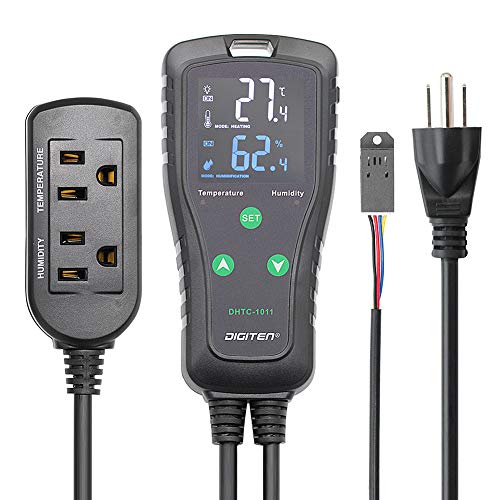
SENSTREE Temperature and Humidity Controller
The direct cross-shop when Inkbird is out of stock or you want a second option. It runs temperature and humidity on separate stages from one box, wired the same way, so it drops into the identical fridge-plus-humidifier chamber with no rethinking.
