Ball
Ball EasyCanner Electric Reviews (2026)
By Ruth Alvarez · Updated October 2026
Independent editorial review. We never accept payment for coverage, though we may earn a commission if you purchase through our links.

Verdict
Owners of the Ball EasyCanner are, on the whole, enthusiastic: no lifting a heavy pot, no riding the stove to hold a boil, a spigot that drains it without hauling, and enough hands-off convenience that several people say they simply can more now than they did before. It gets specific love from canners with a glass cooktop they don't want to risk and from people who need a lower, one-handed setup. The skeptics are a real minority clustered on two points. It is a single-purpose gadget when a tall pot you may already own does the same job, and it is an electronic device whose long-term durability is unproven next to a stovetop canner that lasts decades. Owners and moderators alike repeat one boundary, and we will repeat it too: it is a water-bath canner for high-acid foods, not a pressure canner, and it should never be used to can low-acid foods.
Read full take ↓Similar water-bath canners
The Ball EasyCanner Electric Water Bath Canner is Ball's plug-in answer to the oldest chore in home canning: a giant pot of water boiling over on your stove while you hover with a thermometer. It's a countertop electric unit that heats its own water, brings it to a boil, and holds a set temperature for a processing time you program in, with a digital screen, a preset to preheat your jars, and a spigot on the base to drain it when you're done. Load your jars, punch in the numbers, and walk away while it does the babysitting.
Owners who have one tend to rave, especially anyone canning on a glass cooktop they don't want to crack under the weight, and anyone who can't wrestle a full canning pot on and off a burner anymore. Two caveats come with that. First, this is a water-bath canner for high-acid foods like jams, pickles, salsa, and properly acidified tomatoes, and it is never a pressure canner, so it cannot safely put up low-acid foods like plain vegetables, meat, or beans. Second, it's a newer electronic appliance at a real price, and the sharpest question owners raise is whether it will last the way a plain pot does. Both the love and the doubts are below.
The short version
People love this machine, and across a few hundred owner comments they love it for the same handful of reasons. There is one scope rule you must respect and one open question about how long it will last.
What's good:
- Hands-off boiling: set a temperature and a processing time, and it holds the boil without you riding the burner.
- No heavy lifting, and a spigot on the base drains the hot water without hauling the whole pot to the sink.
- Frees the stove and can run on a counter or outside, so canning season stops heating up the whole kitchen.
- A real help for anyone with limited strength or mobility, and safe for glass cooktops that a full canning pot can crack.
What's not:
- Water-bath and atmospheric-steam only. This is not a pressure canner and must never be used for low-acid foods.
- Capacity is modest, sized more for pints and small batches than for big runs of quart jars.
- It's a single-purpose gadget at a real price when a tall pot you may already own does the same job.
- Longevity is unproven: it is a newer electronic appliance, and electronics can fail in ways a plain pot never will.
Who it's for
What you plan to put up decides this one, not your budget.
Buy it for:
- High-acid canning in household batches: jams, jellies, pickles, salsa, chutneys, and acidified tomatoes.
- Glass or induction cooktops you don't want to load, or limited arm strength that makes a full pot a non-starter.
- Keeping the stove free and the kitchen cooler, including plugging in outside or in a utility room in summer.
Skip it if:
- You need to can low-acid foods like green beans, meat, or plain vegetables; nothing electric here replaces a stovetop pressure canner.
- You put up big batches of quart jars; a roomy stovetop pot like the Granite Ware enamel canner holds far more per load.
- You want the cheapest way to boiling-water can and already own a tall stockpot; a simple rack turns it into a canner for almost nothing.
The specs that matter
Four specs decide whether this machine suits you. The last one is the one to read twice.
Around 21 quarts of water capacity: enough to cover a load of pint and half-pint jars for jams, pickles, and salsa, which is what most people reach for a water-bath canner to do. It is not built for big runs of tall quart jars, so if you can in volume, size up to a wide stovetop pot.
Digital screen, programmable timer, and a jar-preheat setting: you set the processing time and it counts down for you, and it warms the jars before you pack them. This is the piece that separates it from the older single-dial electric canners, and it is why owners describe it as set-and-forget.
Drain spigot on the base and a lift-out rack: you open the spout to empty it instead of pouring a scalding pot into the sink, and the rack lowers jars in and lifts them clear of the water. Both are small things that matter a lot if lifting is the reason you wanted an electric canner in the first place.
Water-bath and atmospheric-steam canning only, no pressure: the single most important spec. This is an open, boiling-water appliance for high-acid foods. It does not build pressure and cannot reach the temperatures that make low-acid foods safe, so meat, beans, and plain vegetables are off the table entirely.
How well it preserves
It brings the water up, holds a steady boil at the temperature you set, and runs the countdown without you standing over it, which is all a boiling-water canner has to do. People use it for exactly what a boiling-water canner is for, high-acid foods, and report clean, reliable results.
I have the Ball easy canner and I love it. I also can more now that I have it because it actually does make the process a bit easier.
Owners who came to it from a glass cooktop or a cramped kitchen describe it as the thing that finally made canning feel manageable, and they trust it enough to lean on it as their main canner rather than a novelty:
I have the Ball electric water bath canner and I loooovvveeee it! It has made canning so much easier, not having to lift heavy pots off the stove and it controls the whole process once you put the parameters in. It's also not cheap, but put it on your Amazon wish list and watch for sales.
Holding a boil is not the limit. Scope and volume are. Capacity comes first: it's sized for pints and small batches, and someone putting up a dozen quart jars at a time will find it tight. One owner recommending it in a big-batch thread names the tradeoff and a real upside in the same breath, that it heats faster than a full pot on the stove:
It wouldn’t hold as many as OP wants. But it takes way less time bc it doesn’t take so long to heat up. I can do three rounds of the time needed to seal jams in the time it takes to heat up a water bath most of the time. OP- if you read this, get the stainless steel one. It’s worth the extra bit of money.
The second limit is a safety boundary, not a knock on quality. The EasyCanner is a water-bath and atmospheric-steam canner. It is not a pressure canner, and both owners and the r/Canning moderators are emphatic that electric water-bath units are fine precisely because you can watch the water boil, while low-acid foods still require a tested pressure canner:
Water bath canners, unlike electric pressure canners, are okay. For people with disabilities or lower upper body strength, they’re a great alternative to hauling a huge pot of water. They can also be plugged in outside (if you have the right equipment) and keep from overheating your house in summer! My mom has the one made by Ball with the spout on the bottom and likes it quite a bit.
Stay inside that lane, high-acid recipes from tested sources, and the EasyCanner does the core job as reliably as a pot on the stove, with a lot less fuss. Ask it to do more than water-bath canning and you are outside what any electric canner in this class can safely deliver.
Built to last
Our lowest score of the three, and it deserves an explanation. The EasyCanner isn't racking up early-death horror stories. The concern is the opposite: it hasn't been around long enough to prove itself, and it's an electronic device where a plain canning pot is not.
The most common reservation in the community is straightforward: electronics eventually fail, and a stovetop canner has almost nothing to break. Experienced canners weighing an electric unit against a traditional one keep landing on the same bet, that the simple option outlasts the plug-in one:
I have the Victorio multipurpose canner. I think it has been rebranded to Kitchen Crop VKP Brands. It is a stove top water bath canner that can also be used as a steam canner (the lid has a temperature gauge). When I flip the rack over, the handles tuck under and I am able to fit more jars on top. If you treat it right, it should last a long time...I'd say much longer than the equivalent electric option.
That skepticism runs alongside a deeper preference some canners have for tools that do more than one thing. A water-bath canner is, by design, a unitasker, and to a certain kind of owner that alone is a mark against paying appliance money for it:
For water bath canning all you really need is a soup pot deep enough to cover your jars with a couple inches of water. It's not something I'd spend the money and kitchen storage space on a unitasker for. My soup pot is a good water bath canner, but I can also make soup, stew, broth, boil down maple syrup, heat up bath water, and anything else a big stock pot is good for.
None of that is a report of the EasyCanner breaking. It's a caution about what you're buying: convenience and controls in exchange for a circuit board that a stockpot doesn't have. On the other side of the ledger, Ball's name carries real weight in this hobby, and owners extend the brand genuine trust, enough that some are willing to pay its price and wait for stock rather than buy an unknown:
I too am comparing the Roots & Harvest electric water bath canner vs Ball. A recent canning class by a professional instructor had the Ball at the class. Unfortunately McLendon's didn't have any in stock. I didn't know of the R&H canner at the time to ask. I trust Ball and am willing to pay its price. I can't seem to find one anywhere though. If the R&H canner is non-USA made, I wouldn't buy it. BTW I too have a glass top stove, but I've successfully canned on it with both a standard washer bath canner and a pressure canner. Ya just have to stay there the entire time due to the up/down of the burner temps.
So our read is a shrug with a lean. There's no pattern of failures to point at, but there's also no long track record to lean on, and the electronics are the part most likely to date this purchase. Treat that as the risk you're accepting. Check the return window before you order, and put the machine through a full season's work while that window is open. That is why the durability number below sits well under the other two.
Living with it
You never haul a heavy pot of water on and off the burner. You never stand over a flame nudging it to hold a boil. Set the temperature and the timer and it runs itself, which takes the two worst parts of stovetop canning off the table at once.
This! My husband got it for me as a wedding gift and I love it sooooo much! Huge game changer for me. I hated having to babysit my stove.
The convenience compounds in ways owners bring up again and again. The spigot drains it without lifting, it keeps the heat of a rolling boil out of the kitchen because it can sit anywhere with an outlet, and for anyone canning on a glass cooktop it removes the worry of cracking the stovetop under a loaded pot:
Agreed. It’s a new thing for me, I’ve only used it since last Xmas, but I prefer it. I was also concerned about endangering my glass cooktop.
It also lands as a real accessibility tool, not just a luxury. Between the drain spout, the lower working height, and the fact that you never lift the full weight, it opens canning back up to people who had to give it up, and it's an easy thing to recommend as a set-up-anywhere unit:
Or they could get the Ball Electric Water Bath canner that they can set up anywhere which is exactly what they asked for.
The skeptics have a point worth stating fairly: it does exactly what a tall pot on a burner does, so the value of the buttons is real but not magical. Plenty of owners decide the hands-off experience is worth it anyway, and a few simply note they can more now than they used to because the barrier got lower:
I have the Ball one also- you will love it. It's also a cooker.
How it compares
The EasyCanner gets cross-shopped against an older Ball, a classic enamel pot, and a cheaper plug-in.
Versus the Ball freshTECH Electric Water Bath Canner: the freshTECH is the model the EasyCanner replaced, still sold and a touch larger. It swaps the EasyCanner's digital screen and programmable countdown for a single temperature dial, so you lose the automated timing and jar-preheat presets but keep the same convenient drain spout. Consider it if you want a bit more Ball capacity and prefer a simple knob to a menu.
Versus the Granite Ware Enamel Stovetop Water Bath Canner: this is the classic, and the pot that quietly undercuts the whole electric premise. A big speckled enamel pot and rack that has canned jam and pickles for generations, with no electronics to fail and a second life as a stockpot. You supply the heat and lift the full pot yourself, and if your stove can take the weight it puts up far bigger batches for a fraction of the outlay.
Versus a budget 27-quart electric water bath canner: if the plug-in format is what you want but Ball's price isn't, a plain 27-quart electric canner is the cheaper and roomier way in, swallowing bigger loads than the EasyCanner can. You give up Ball's brand track record and the more refined digital controls, but you keep the core wins: the stove stays free and it holds its own boil for high-acid batches.
Using it well
Stick strictly to tested high-acid recipes from sources like the National Center for Home Food Preservation, and acidify tomatoes with bottled lemon juice or citric acid every time. Use the jar-preheat setting so you're not lowering cold jars into hot water. Keep the rack between the jars and the base. Make sure a rolling boil is actually going before you start the processing countdown. When you're done, let it cool a little and drain through the spigot rather than lifting, which is half the reason you bought it.
If you're still deciding between an electric unit, a stovetop pot, and a steam canner, it's worth reading how the formats trade off before you commit. Our guide to water bath canning gear walks through capacity, cooktop compatibility, and cost in more depth, with the electric units in context against the classics.
The EasyCanner verdict
If you want to put up high-acid foods in household batches without heaving a heavy pot around or babysitting the stove, yes. Ease of use is what you are buying, and it's a standout for glass-cooktop owners and for anyone whose barrier to canning was lifting and standing. For that buyer the convenience is worth the money.
Two caveats keep us from recommending it to everyone. It is a water-bath canner only, so if low-acid canning is on your list you still need a pressure canner, and no amount of this appliance's polish changes that. And it's a newer electronic device without the decades-long track record a plain pot has earned, so check the return terms and lean on it hard the first season. Do that, respect the scope, and it earns its counter space for high-acid canning.
Our Ratings
Overall score
The EasyCanner does the core water-bath job well: plug it in, set a temperature and a processing time, and it brings the water up and holds a steady boil without you riding the burner. Owners use it for exactly what a boiling-water canner is for, high-acid foods like jams, pickles, salsa, and acidified tomatoes, and report clean, reliable results. Its limits are capacity and scope: it is sized more for pints than big quart batches, and it is a water-bath and atmospheric-steam canner only, never a substitute for a pressure canner on low-acid foods.
Our lowest score here, and it is about the unknown more than proven failures. The EasyCanner is a newer electronic appliance, and the community's most common reservation is that electronics eventually fail in a way a plain pot never will, with several longtime canners betting a stovetop unit outlasts it. Ball's name buys real goodwill and there is no pattern of early deaths, but there is not yet a long track record, so treat the electronics as the part most likely to date this purchase and keep the receipt somewhere you can find it.
This is what people buy it for. No hauling a heavy pot of water on and off the burner, and no babysitting a flame to hold the boil: you set the parameters and walk away. The spigot on the base drains it without lifting, it can run on a counter or outside to keep the kitchen cool, and it is a genuine help for anyone with limited strength or mobility. Owners who had given canning up describe it as the thing that got them back to it.
Ball EasyCanner Electric Reviews (2026) on Amazon.
What People Are Saying
Owners of the Ball EasyCanner are, on the whole, enthusiastic: no lifting a heavy pot, no riding the stove to hold a boil, a spigot that drains it without hauling, and enough hands-off convenience that several people say they simply can more now than they did before. It gets specific love from canners with a glass cooktop they don't want to risk and from people who need a lower, one-handed setup. The skeptics are a real minority clustered on two points.
It is a single-purpose gadget when a tall pot you may already own does the same job, and it is an electronic device whose long-term durability is unproven next to a stovetop canner that lasts decades. Owners and moderators alike repeat one boundary, and we will repeat it too: it is a water-bath canner for high-acid foods, not a pressure canner, and it should never be used to can low-acid foods.
We weight candid owner reports from Reddit and preservation forums above brand-influenced editorial coverage, then reach our own verdict from them. The quotes below are the evidence; the rating and the take are ours.
What Reddit Is Saying
“I have the Ball easy canner and I love it. I also can more now that I have it because it actually does make the process a bit easier.”View thread →
“Nice! This is what I figured. Thank you for this response! So I actually got the Easy Canner and it is wonderful. I love it!!”View thread →
“I have the Ball electric water bath canner and I loooovvveeee it! It has made canning so much easier, not having to lift heavy pots off the stove and it controls the whole process once you put the parameters in. It's also not cheap, but put it on your Amazon wish list and watch for sales.”View thread →
“This! My husband got it for me as a wedding gift and I love it sooooo much! Huge game changer for me. I hated having to babysit my stove.”View thread →
“Agreed. It’s a new thing for me, I’ve only used it since last Xmas, but I prefer it. I was also concerned about endangering my glass cooktop.”View thread →
“Or they could get the Ball Electric Water Bath canner that they can set up anywhere which is exactly what they asked for.”View thread →
“Water bath canners, unlike electric pressure canners, are okay. For people with disabilities or lower upper body strength, they’re a great alternative to hauling a huge pot of water. They can also be plugged in outside (if you have the right equipment) and keep from overheating your house in summer! My mom has the one made by Ball with the spout on the bottom and likes it quite a bit.”View thread →
“I have the Ball one also- you will love it. It's also a cooker.”View thread →
“I too am comparing the Roots & Harvest electric water bath canner vs Ball. A recent canning class by a professional instructor had the Ball at the class. Unfortunately McLendon's didn't have any in stock. I didn't know of the R&H canner at the time to ask. I trust Ball and am willing to pay its price. I can't seem to find one anywhere though. If the R&H canner is non-USA made, I wouldn't buy it. BTW I too have a glass top stove, but I've successfully canned on it with both a standard washer bath canner and a pressure canner. Ya just have to stay there the entire time due to the up/down of the burner temps.”View thread →
“It wouldn’t hold as many as OP wants. But it takes way less time bc it doesn’t take so long to heat up. I can do three rounds of the time needed to seal jams in the time it takes to heat up a water bath most of the time. OP- if you read this, get the stainless steel one. It’s worth the extra bit of money.”View thread →
“water bath ones are fine. it's about the same as having a pot of water on a electric single burner. personally not a fan because I'm not a fan of unitasker tools but if it works for other people I'm glad they have the option. the only things you really need for water bath canning are a pot that's tall enough to cover your jars by an inch of water while it's boiling, and something to put in the bottom of the pot to keep the jars from resting directly on it so they don't get too much heat on the bottom”View thread →
“For water bath canning all you really need is a soup pot deep enough to cover your jars with a couple inches of water. It's not something I'd spend the money and kitchen storage space on a unitasker for. My soup pot is a good water bath canner, but I can also make soup, stew, broth, boil down maple syrup, heat up bath water, and anything else a big stock pot is good for.”View thread →
“I have the Victorio multipurpose canner. I think it has been rebranded to Kitchen Crop VKP Brands. It is a stove top water bath canner that can also be used as a steam canner (the lid has a temperature gauge). When I flip the rack over, the handles tuck under and I am able to fit more jars on top. If you treat it right, it should last a long time...I'd say much longer than the equivalent electric option.”View thread →
Frequently asked questions
Is the Ball EasyCanner Electric worth it?
This is what people buy it for. No hauling a heavy pot of water on and off the burner, and no babysitting a flame to hold the boil: you set the parameters and walk away. The spigot on the base drains it without lifting, it can run on a counter or outside to keep the kitchen cool, and it is a genuine help for anyone with limited strength or mobility.
How is the Ball EasyCanner Electric built?
Our lowest score here, and it is about the unknown more than proven failures. The EasyCanner is a newer electronic appliance, and the community's most common reservation is that electronics eventually fail in a way a plain pot never will, with several longtime canners betting a stovetop unit outlasts it. Ball's name buys real goodwill and there is no pattern of early deaths, but there is not yet a long track record, so treat the electronics as the part most likely to date this purchase and keep the receipt somewhere you can find it.
What is the Ball EasyCanner Electric best suited for?
The EasyCanner does the core water-bath job well: plug it in, set a temperature and a processing time, and it brings the water up and holds a steady boil without you riding the burner. Owners use it for exactly what a boiling-water canner is for, high-acid foods like jams, pickles, salsa, and acidified tomatoes, and report clean, reliable results. Its limits are capacity and scope: it is sized more for pints than big quart batches, and it is a water-bath and atmospheric-steam canner only, never a substitute for a pressure canner on low-acid foods.
What do real owners say about the Ball EasyCanner Electric?
Owners of the Ball EasyCanner are, on the whole, enthusiastic: no lifting a heavy pot, no riding the stove to hold a boil, a spigot that drains it without hauling, and enough hands-off convenience that several people say they simply can more now than they did before. It gets specific love from canners with a glass cooktop they don't want to risk and from people who need a lower, one-handed setup. The skeptics are a real minority clustered on two points.
Options Worth Checking Out

Ball freshTECH Electric Water Bath Canner
The model the EasyCanner replaced, still sold and a bit larger. You trade the digital screen and programmable countdown for a single temperature dial, but keep the steady boil and handy drain spout. Pick it for more Ball capacity and a simple knob.
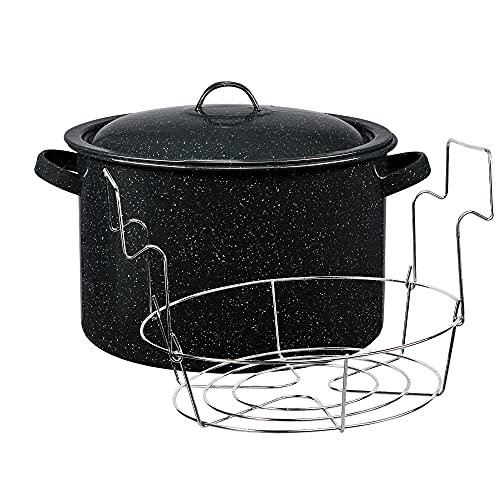
Granite Ware Enamel Stovetop Water Bath Canner with Rack
The classic stovetop answer: a speckled enamel pot and jar rack that has put up jam and pickles for generations. Nothing electronic to fail and it doubles as a stockpot, but you supply the heat and the lifting. It holds far bigger batches per load.

Electric Water Bath Canner, 27-Quart
The cheaper, roomier way into electric canning, with 27 quarts to hold loads the EasyCanner can't. You give up Ball's track record and refined digital controls for a plainer unit, but it still frees the stove and holds a boil for high-acid batches.
You Might Also Need
Accessories worth grabbing alongside your purchase

